Commemorative Coins
Constantine and his sons issued a few
different types of commemoratives from 330-346. These were
issued to mark the foundation of Constantinople and to also
re-affirm Rome as the traditional center of the Empire.
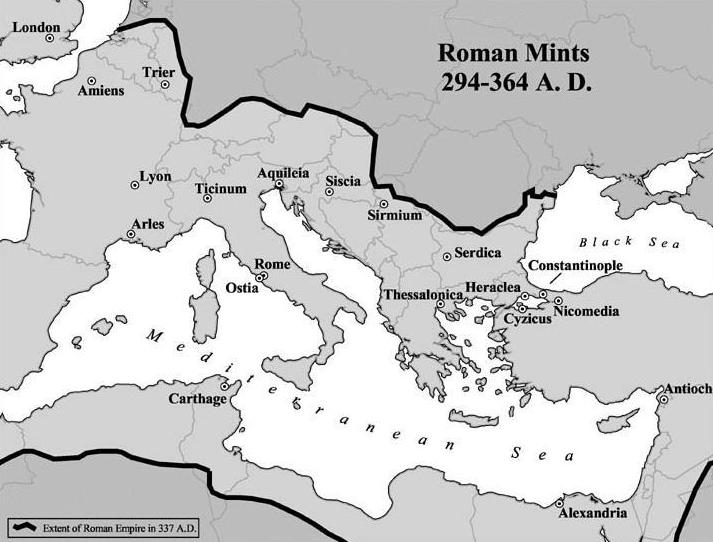
Thirteen mints produced these types: Trier, Lugdunum (Lyons),
Arelate (Arles), Aquileia, Rome, Siscia, Thessalonica,
Heraclea, Constantinople, Nicomedia, Cyzicus, Antioch and
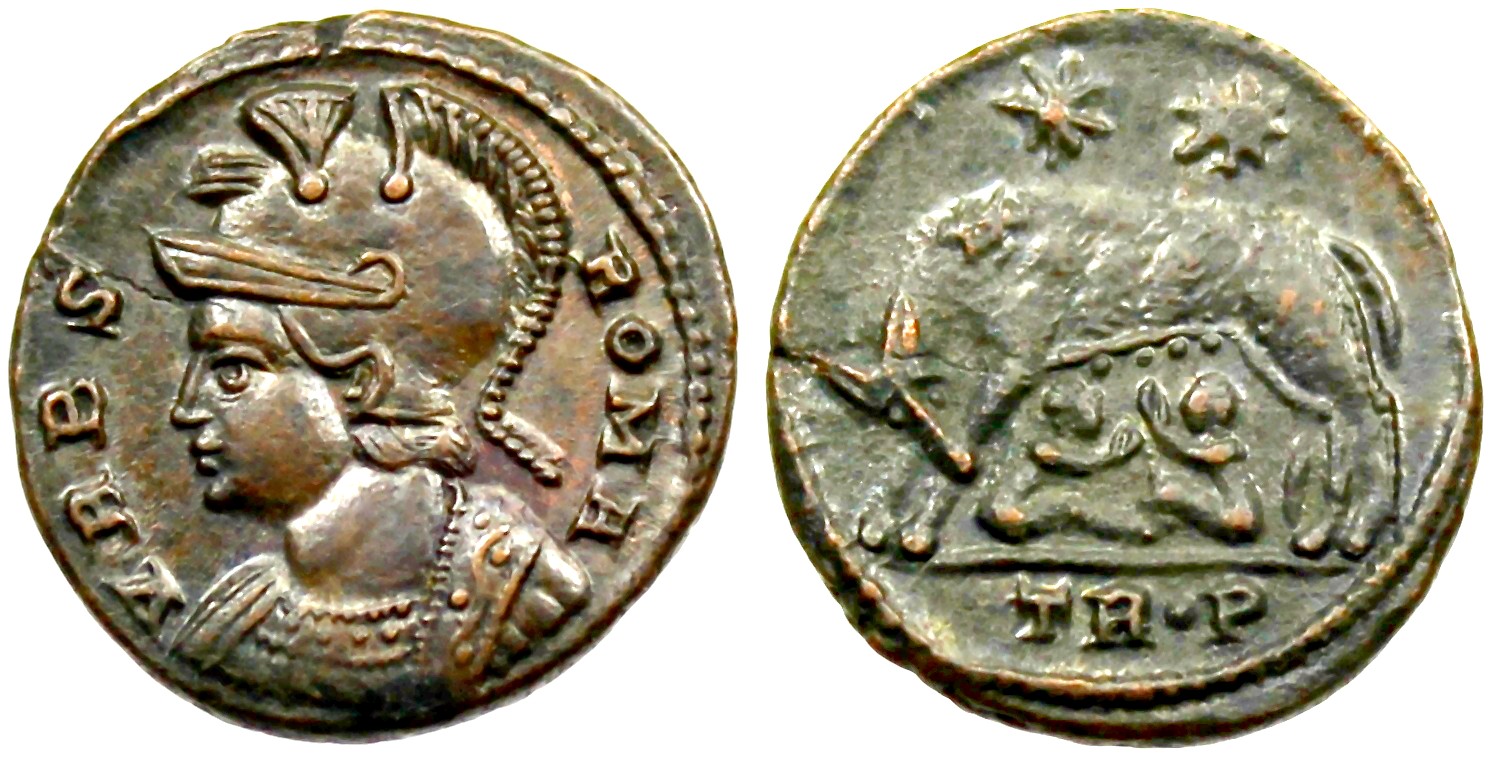
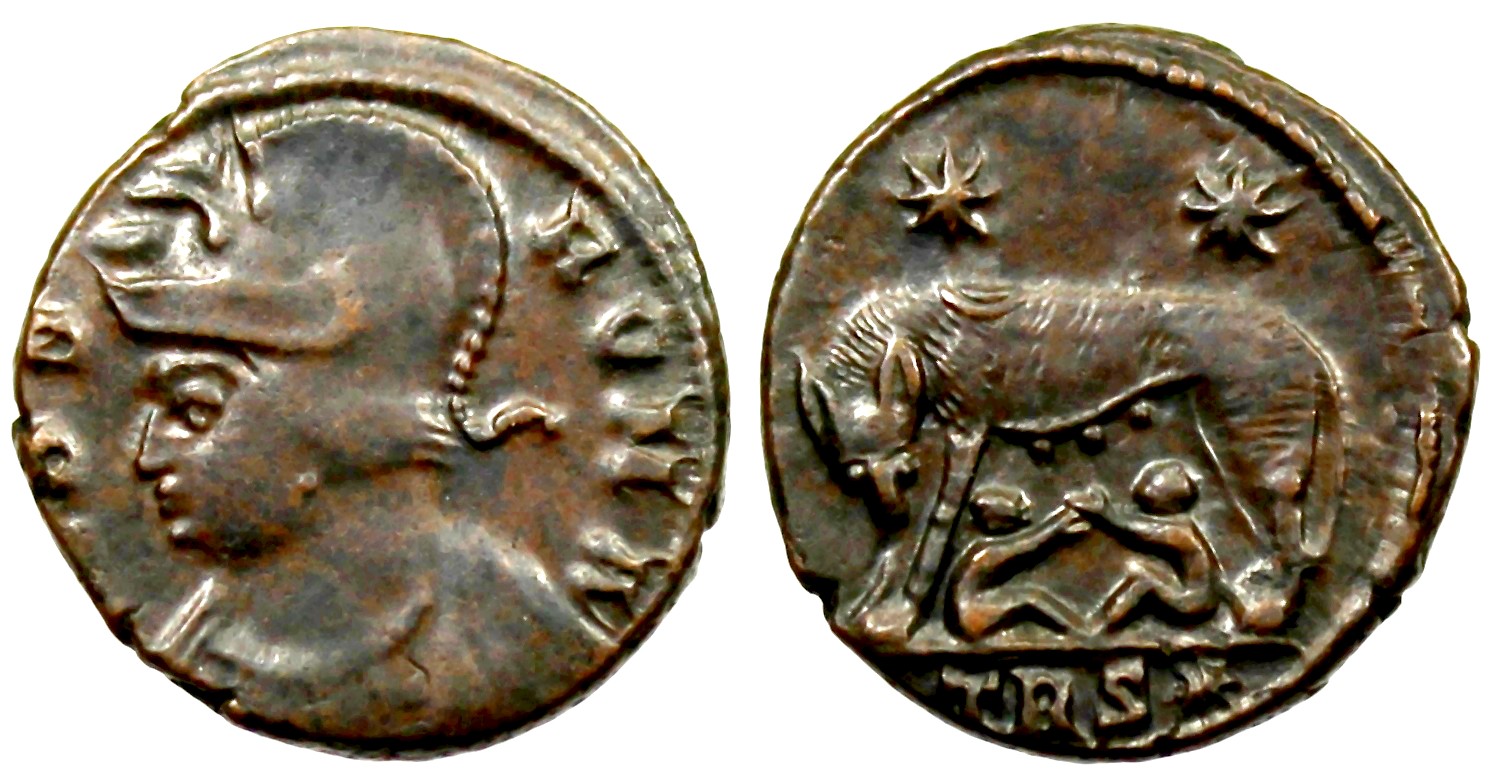
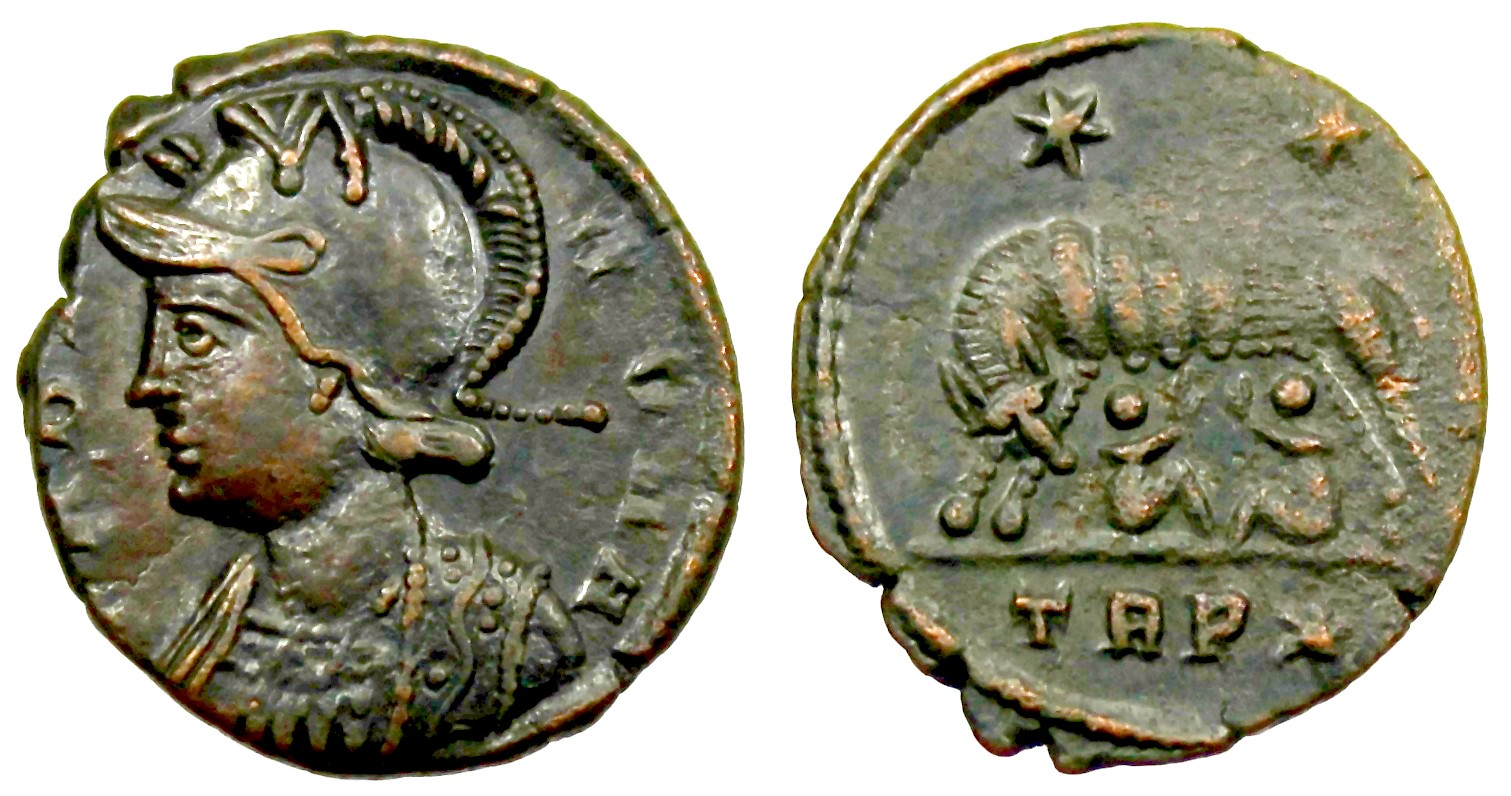
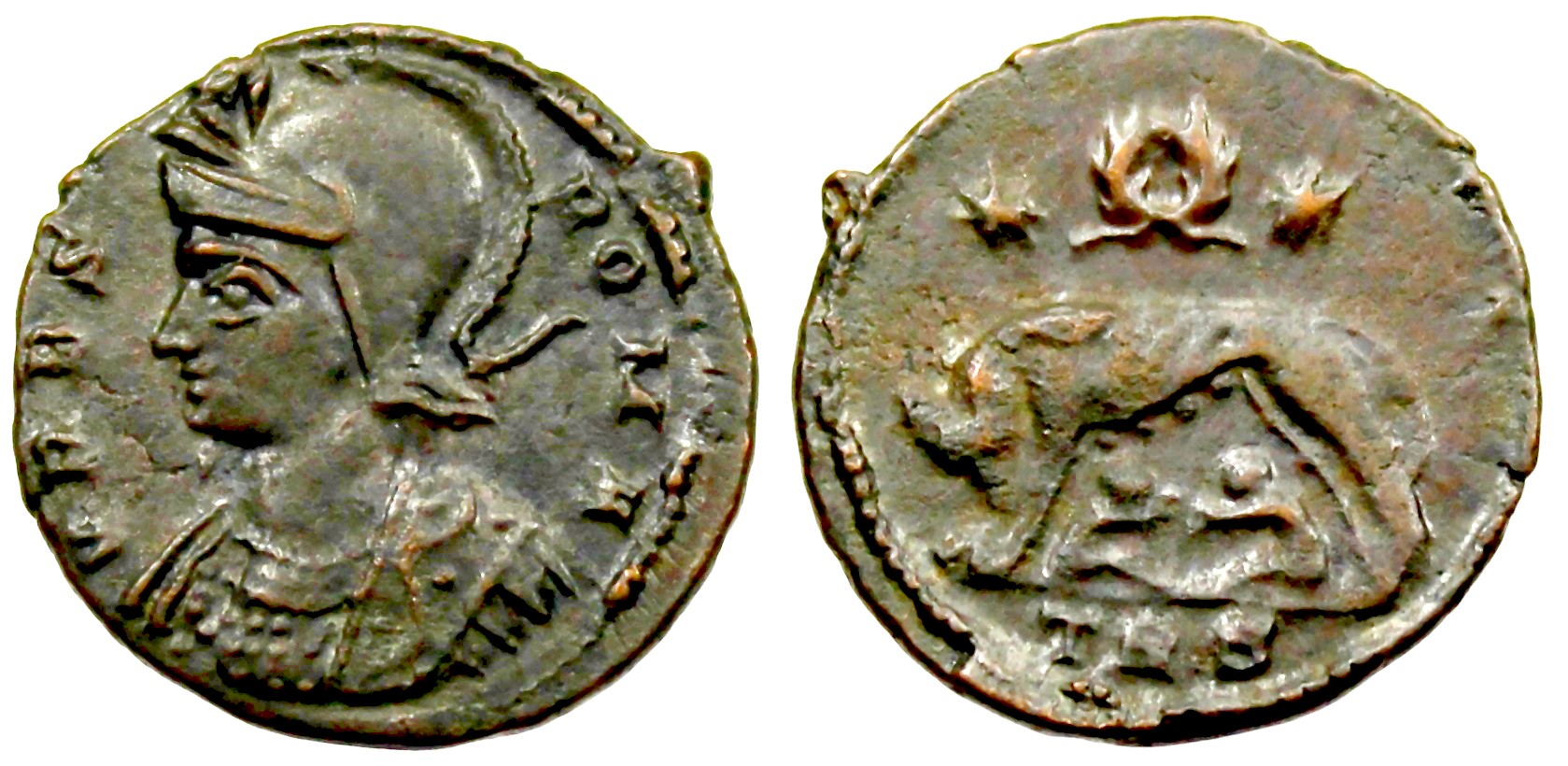
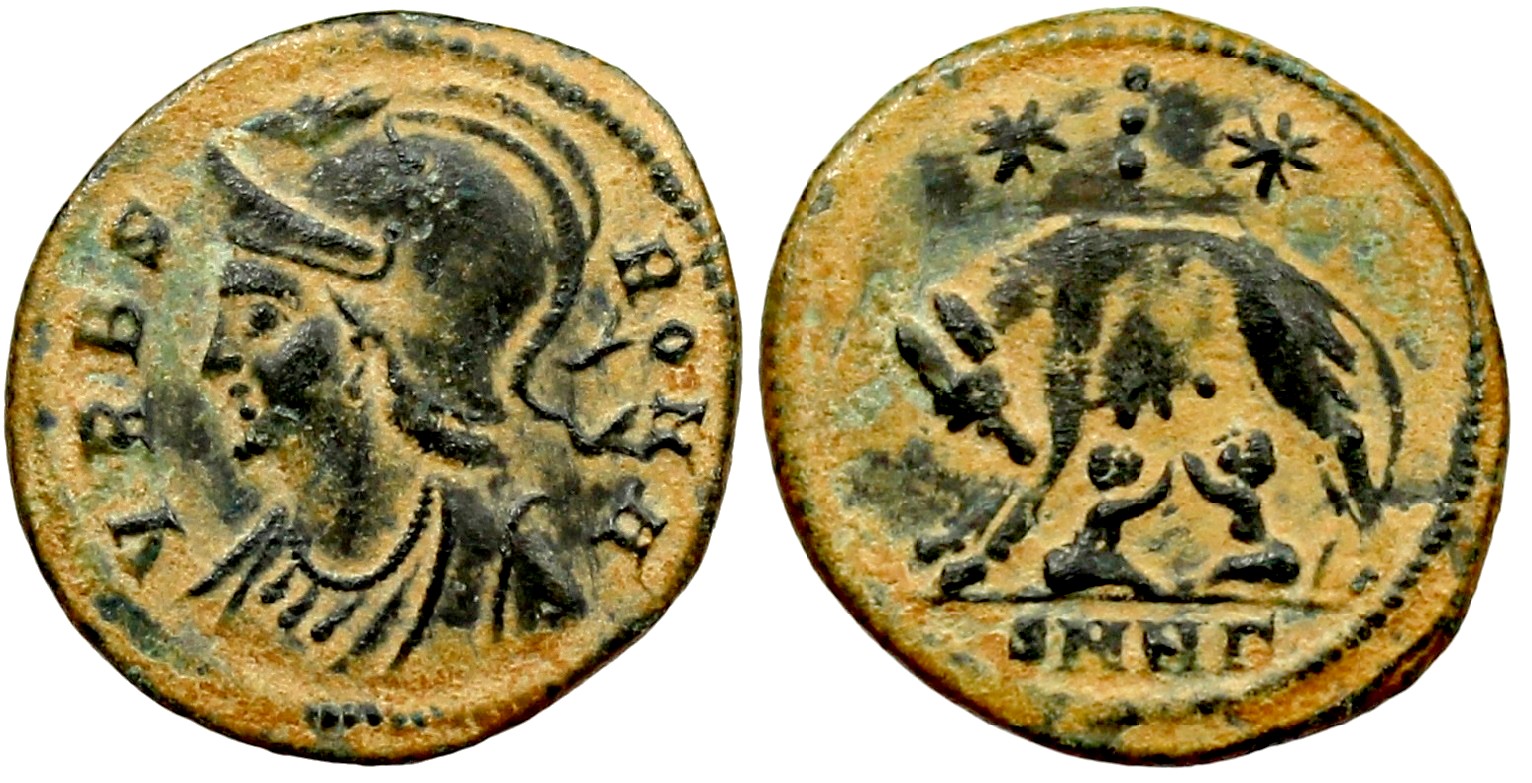
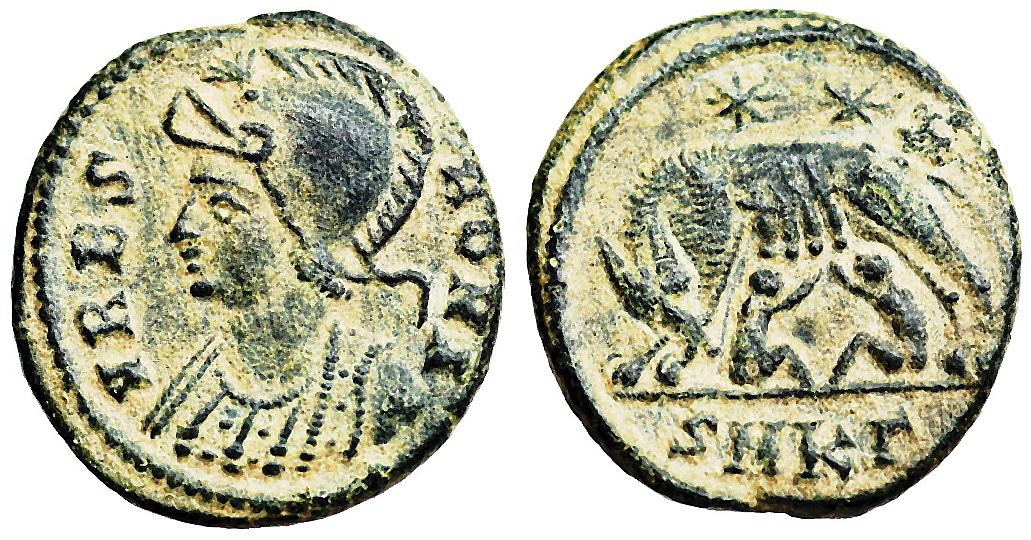
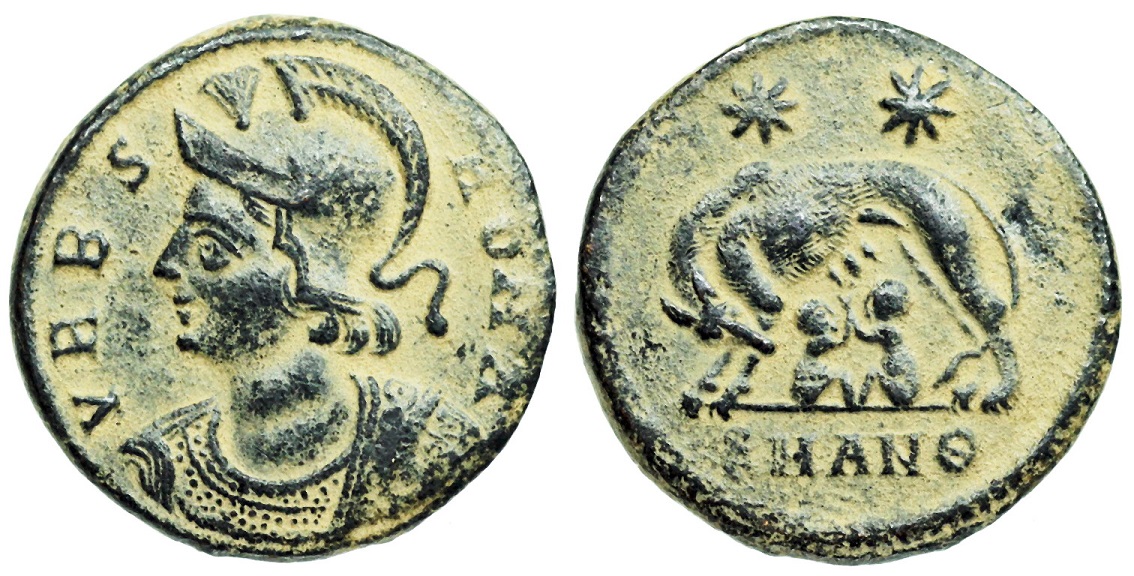
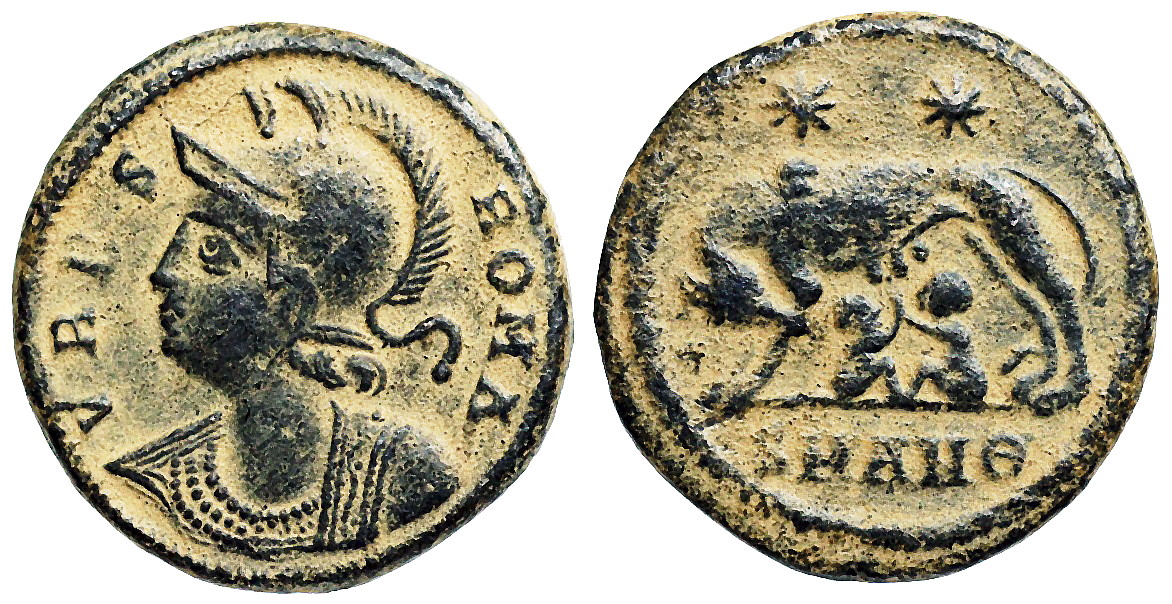
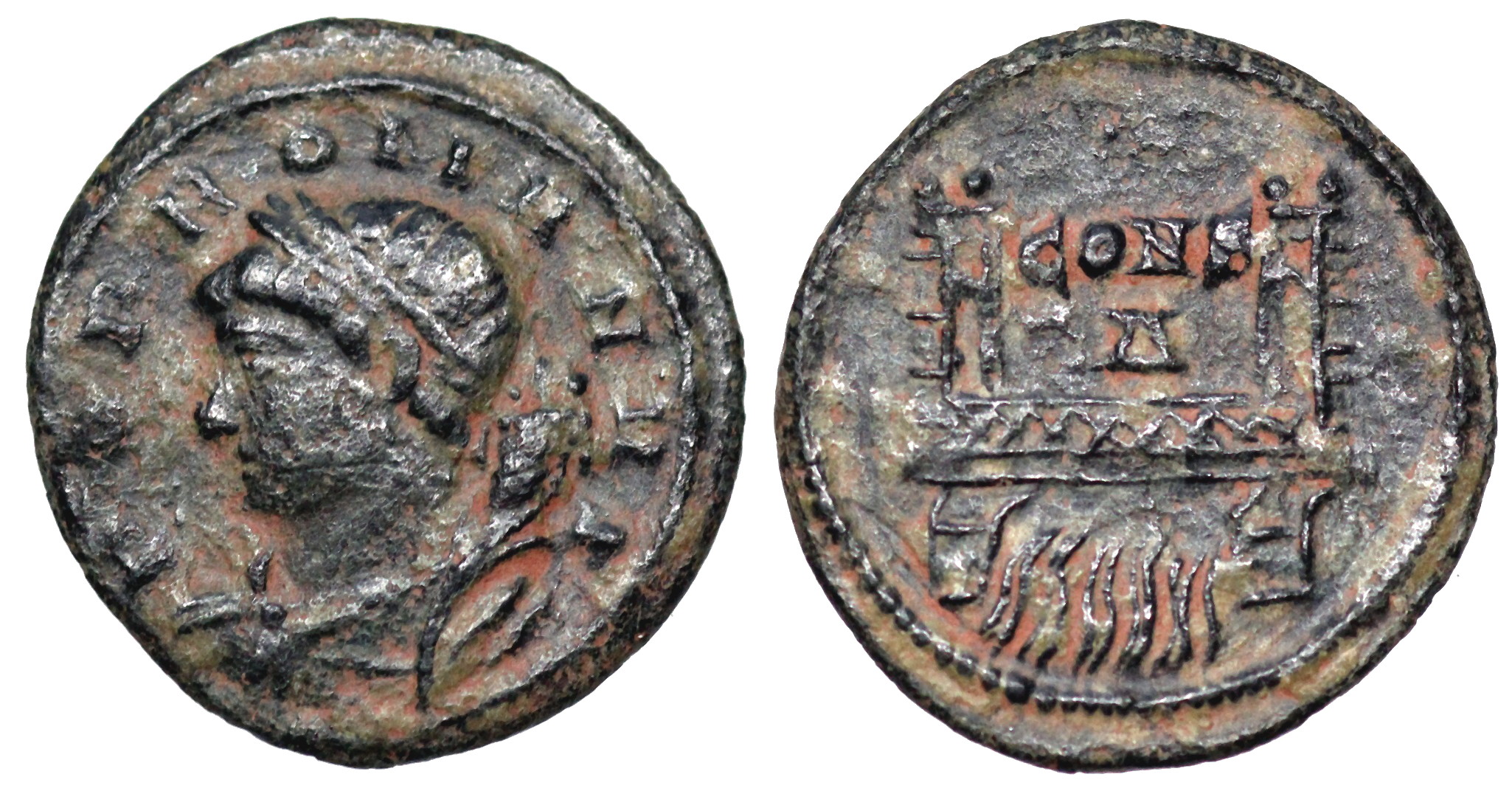
Alexandria. The two most common are the CONSTANTINOPOLIS
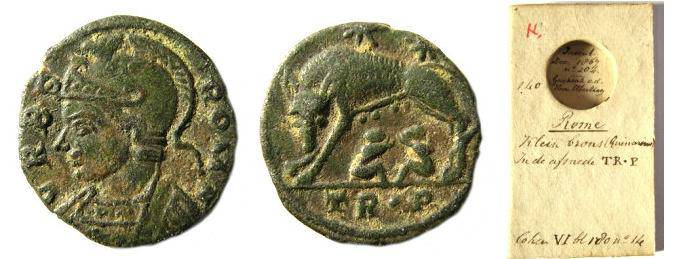
(Victory on a prow) and VRBS ROMA (wolf and twins) types. The
female figure on the obverse is the personification of
Constantinople or Rome. The wolf and twins type depict Romulus
and Remus (the founders of Rome) being suckled by the
she-wolf. The two stars on the reverse represent the dioscuri
( the twins Castor and Pollux).
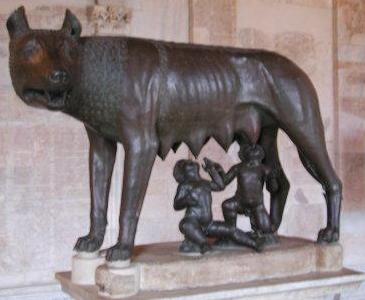
The famous Wolf (Lupa Capitolina).
The statue was made circa 500 B.C. and it used to stand on
the Capitoline Hill.
Romulus and Remus were added during the Renaissance.
The victory on a prow type alludes to the naval victory of Crispus and his subsequent capture of Byzantium (soon to be re-named Constantinople). Zosimus said that Constantine's fleet had 200 ships and Licinius had 350 ships. Zosimus might have exaggerated, but all sources agreed that Constantine's fleet was greatly outnumbered. What accounted for the surprise victory of Constantine's forces? Could it have been that Constantine had better trained sailors...maybe divine providence? A papyrus letter from circa A.D. 323, gives an answer. The letter is from a procurator who said that the government of Egypt had an urgent requirement of box and acanthus wood for repair of the men-at-war vessels in the arsenals of Memphis and Babylon. Egypt sent a total of 130 ships to serve in the navy of Licinius, but it seems that they were all old tubs!1
The description in
RIC describes Constantinopolis as holding reversed spear .
This object might actually be a scepter, rather than a
reversed spear. Compare the object with the scepter that the
victory on the reverse is holding. The ends are alike--they
both end in small globes. On some coins, Constantinopolis
is holding what might be considered a cross- scepter with a
globe (often topped with a smaller globe). This may or may not
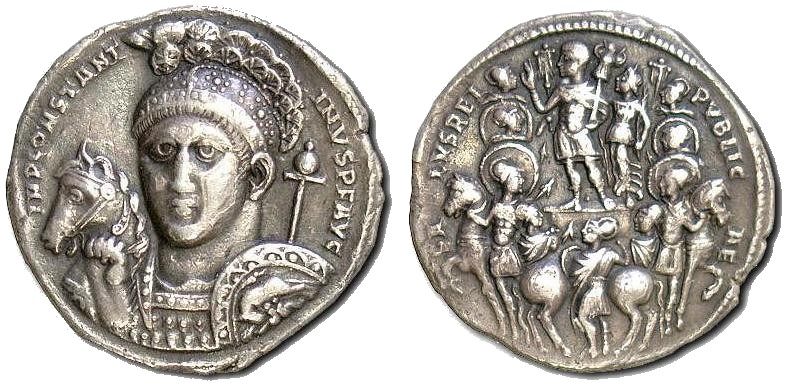
have had Christian significance, but Constantine first used
this symbolism in A.D. 315 on a silver
medallion, which also has a chi-rho on the crest, issued
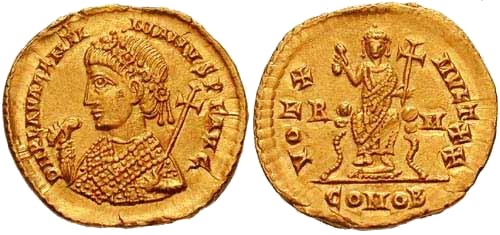
in Ticinum. The cross-scepter imagery was later an imperial
attribute and sign of power on some gold coins of Valentinian III. This symbolism, and
other imagery, may not have been understood by many people at
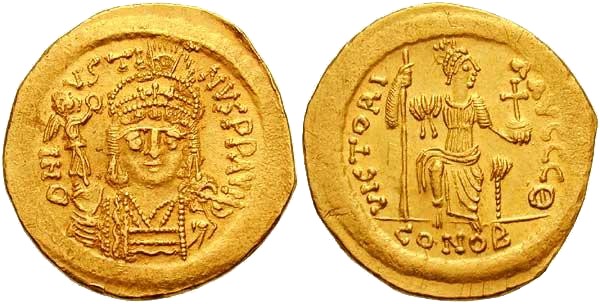
the time, though. In the sixth century, John of Ephesus wrote
that the general public believed that the figure of
Constantinopolis on gold coins of Justin
II was actually Venus.2
It seems that a lot of the message of ancient coins was lost
on the audience!
Palladas, a fourth-century pagan poet, wrote mockingly about
the city of Constantinople and coins with Victories on the
prow --
The mints of Heraclea,
Constantinople, Nicomedia and Cyzicus which surrounded the Propontis
(the Sea of Marmara) dropped the S from the obverse
legend. This is a regional variation and "reflects the fall of
the terminal -s in the spoken language."3The obverse legend break for all the mints is
always CONSTAN-TINOPOLIS except for coins from Rome and one
issue from Aquileia (RIC137), which used the legend
break CONSTANTI-NOPOLIS . Sometimes the engravers at
Rome misunderstood what the reverse was supposed to depict,
and engraved the prow
moving towards Victory, instead of Victory standing on the
prow. The tendency in the western mints was to render the prow
of the ship in a very simple fashion, but some of the eastern
mints occasionally engraved the prow with more style, and
sometimes you can even see the oars
of the galley.
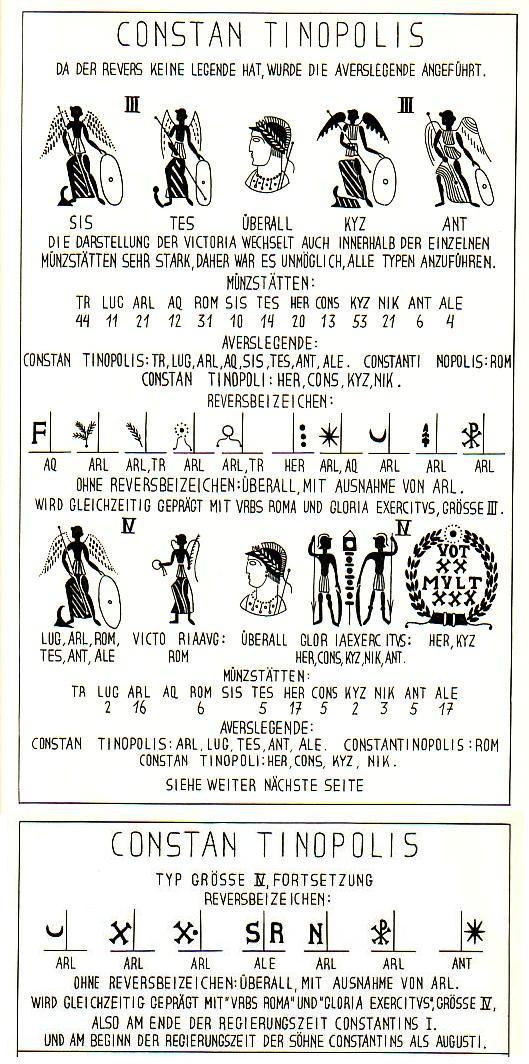
Here is a page of line drawings of Constantinopolis Commemoratives and various field marks from the Vienna collection in the book by Guido Bruck, Die Spätrömische Kupferprägung - Ein Bestimmungsbuch Für Schlecht Erhaltene Münzen.
Constantinopolis
Commemorative
The
Constantinopolis coins are arranged geographically (the
same as RIC), from west to east.
Lyons
|
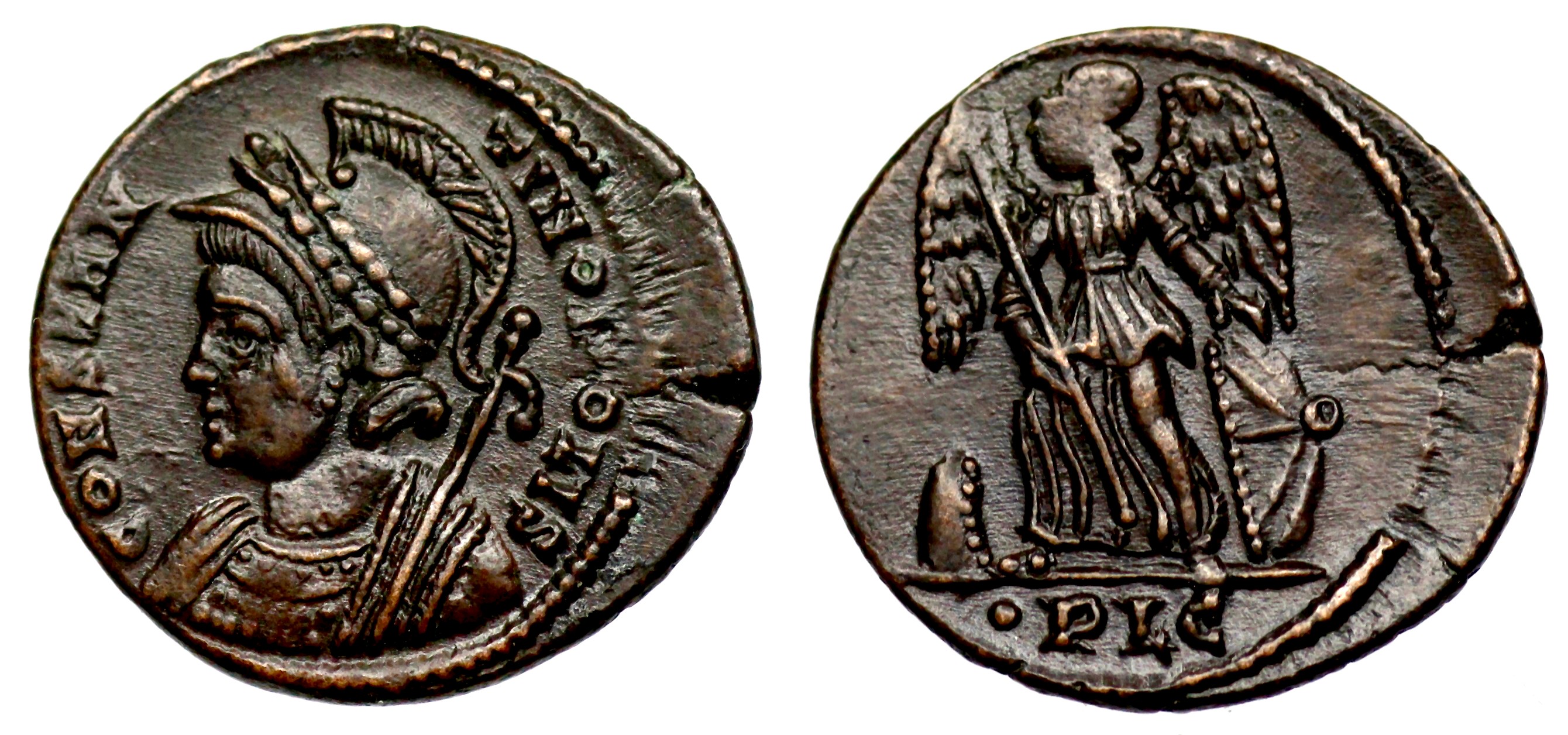
A.D. 330-331 16x17mm 1.9g Obv. CONSTAN-TINOPOLIS laureate,
helmeted, wearing imperial mantle, holding scepter. Rev. Victory stg. on prow,
holding long scepter in r. hand, and resting l. hand
on shield, seen from side. In ex.•PLG RIC VII Lyons 246 |
 |
|
|
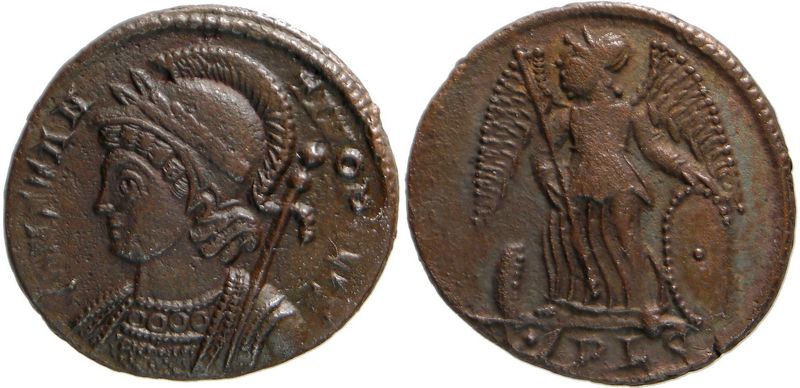
17x16mm 2.4 g Obv. CONSTAN-TINOPOLIS laureate, helmeted, wearing imperial mantle, holding scepter. Rev. Victory stg. on prow, holding long scepter in r. hand, and resting l. hand on shield. in ex. • in crescent PLG RIC VII Lugdunum 256 |
 |
|
|
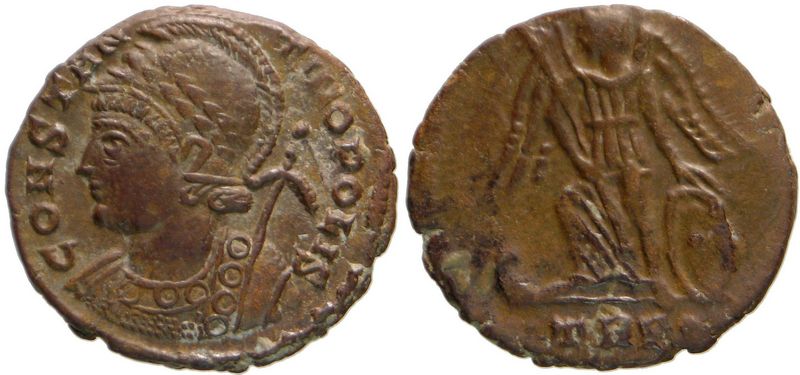
17x16mm 2.1gm Obv. CONSTAN-TINOPOLIS laureate, helmeted, wearing imperial mantle, holding scepter. Rev. Victory stg. on prow, holding long scepter in r. hand, and resting l. hand on shield. in ex. TRP• RIC VII Trier 530 |
 |
|
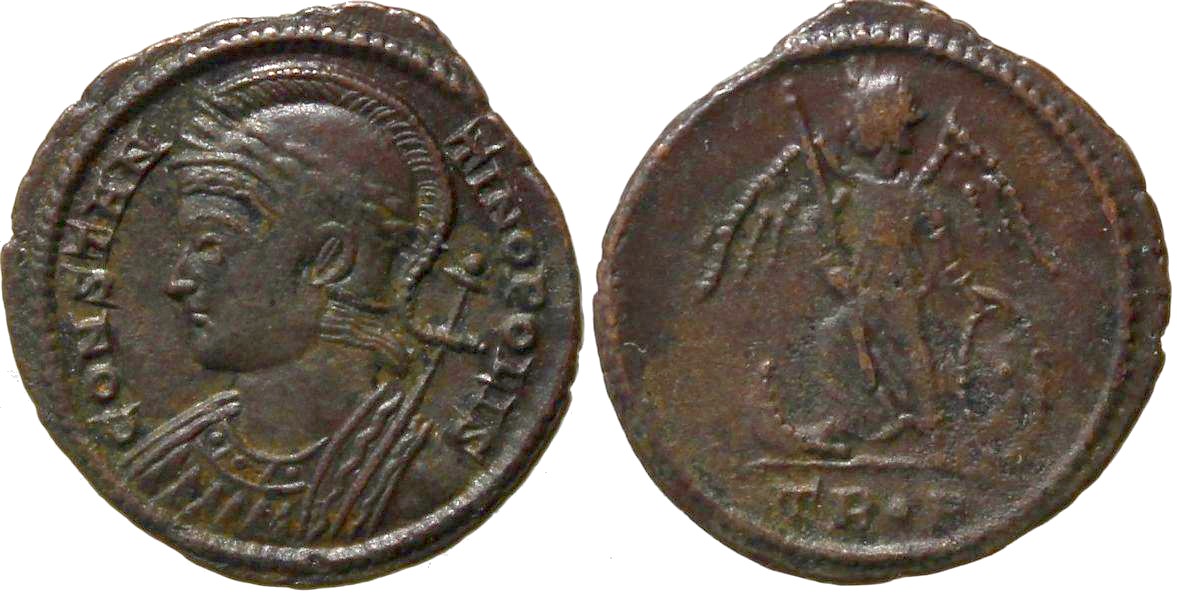
18mm 2.2gm Obv. CONSTAN-TINOPOLIS laureate, helmeted, wearing imperial mantle, holding scepter. Rev. Victory stg. on prow, holding long scepter in r. hand, and resting l. hand on shield. in ex. TR • P RIC VII Trier 543 |
 |
|
|
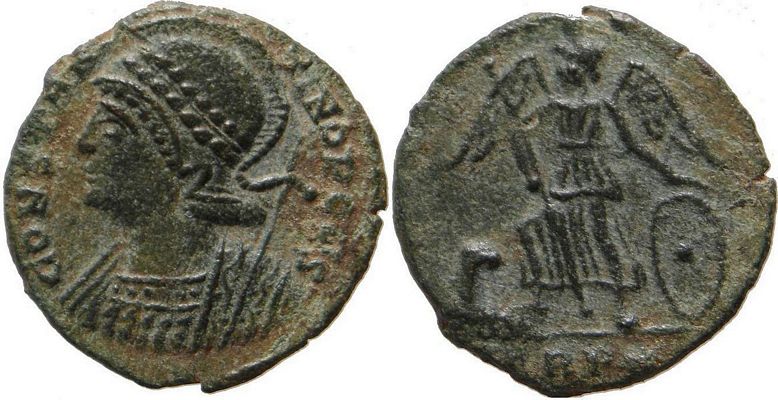
to the heavens bust |
A.D. 332-3 18mm
2.1gm Obv. CONSTAN-TINOPOLIS
laureate, helmeted, wearing imperial mantle, holding
scepter. Rev. Victory stg. on prow,
holding long scepter in r. hand, and resting l. hand
on shield. in ex. TRP✶ RIC VII Trier 548 |
 |
|
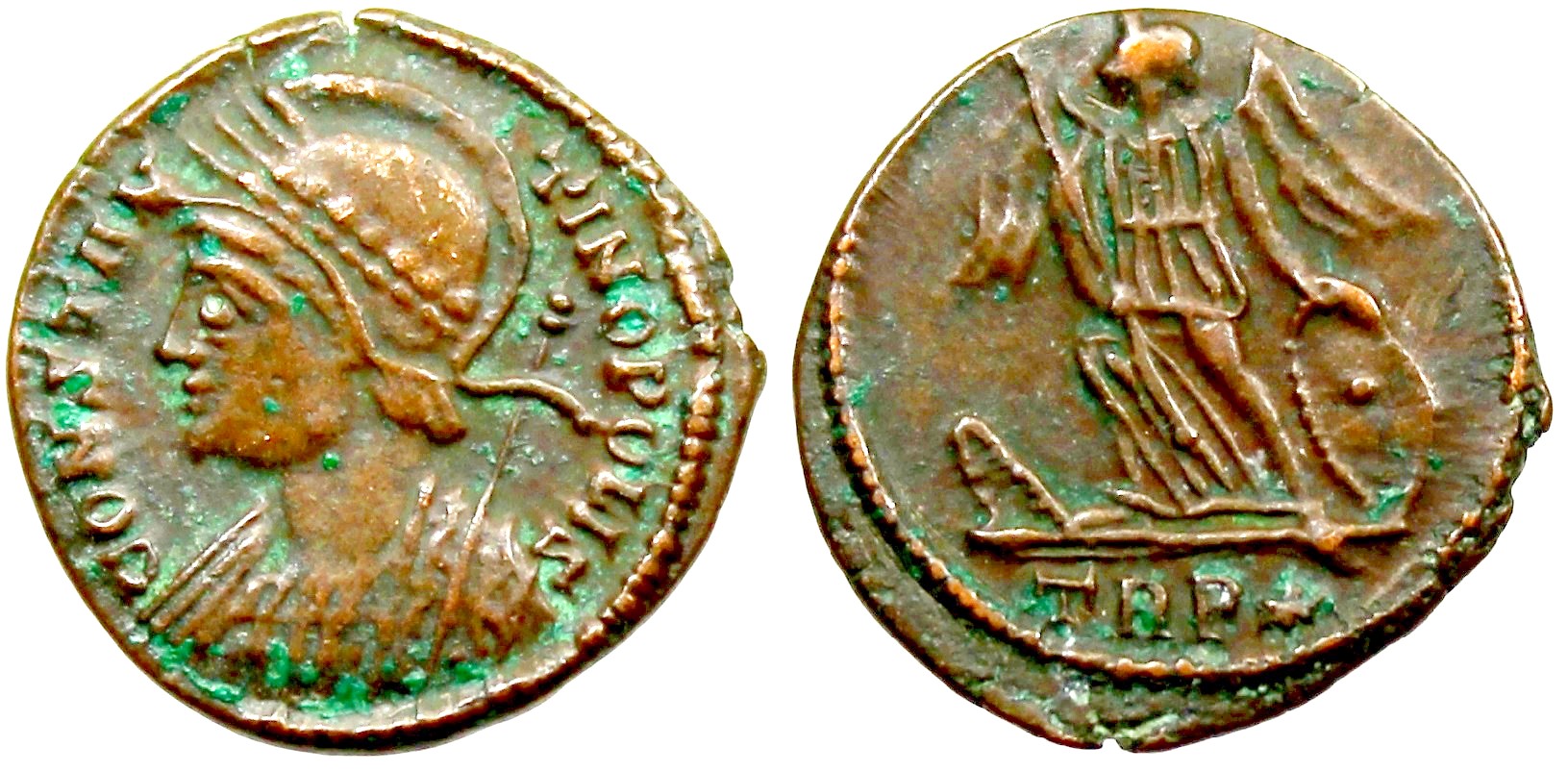
A.D. 332-3 17mm
2.4gm CONSTAN-TINOPOLIS;
laureate, helmeted, wearing imperial mantle, holding
scepter. Rev. Victory
stg. on prow, holding long scepter in r. hand, and
resting l. hand on shield. in ex. TRP✶ RIC VII Trier
548 |
 |
|
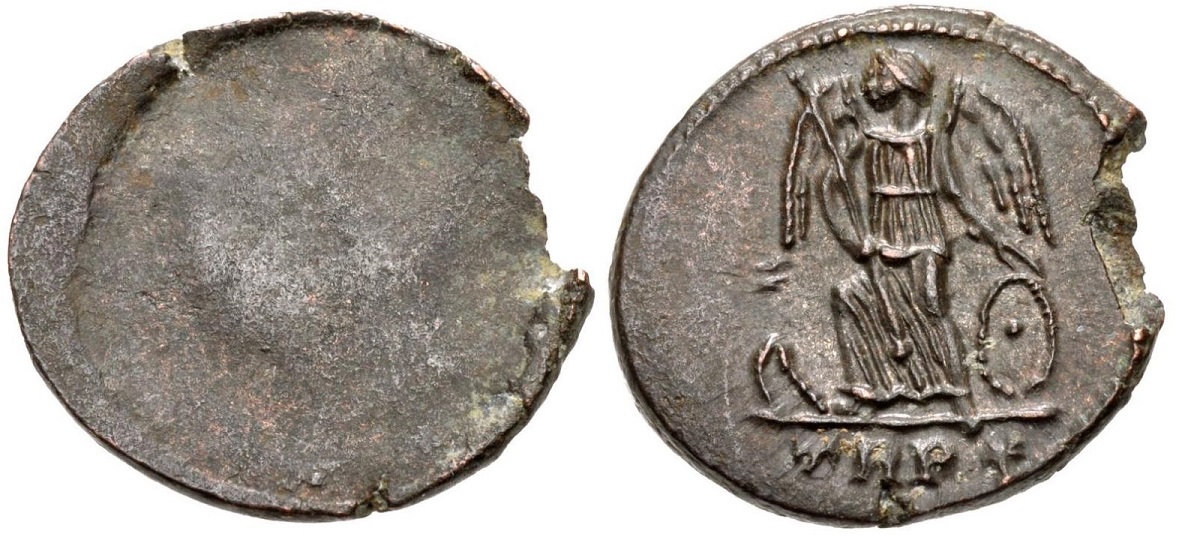
| A.D. 332- 333 18mm 2.5gm Obv: uniface—striking error Rev. Victory stg. on prow, holding long scepter in r. hand, and resting l. hand on shield. in ex. TRP✶ RIC VII Trier 548 Ex 1989 Nether Compton (Dorset) Hoard. |
 |
|
|
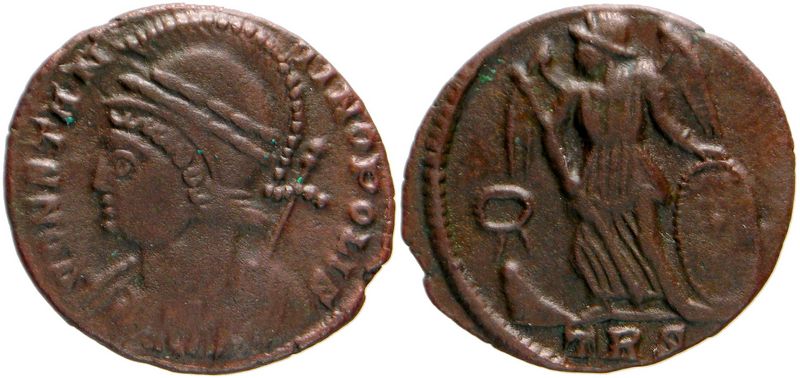
18x17mm 1.9gm Obv. CONSTAN-TINOPOLIS laureate, helmeted, wearing imperial mantle, holding scepter. Rev. Victory stg. on prow, holding long scepter in r. hand, and resting l. hand on shield. In left field wreath;in ex. TRS RIC VII Trier 554 This coin is from the 'monneron' hoard |
 |
|
|
A.D.
333- 334 18x19mm
2.6gm CONSTAN-TINOPOLIS;
laureate, helmeted, wearing imperial mantle,
holding scepter. Rev.
Victory stg. on prow, holding long scepter in r.
hand, and resting l. hand on shield; palm branch
in left. in
ex. TRS RIC VII Trier 563 |
 |
|
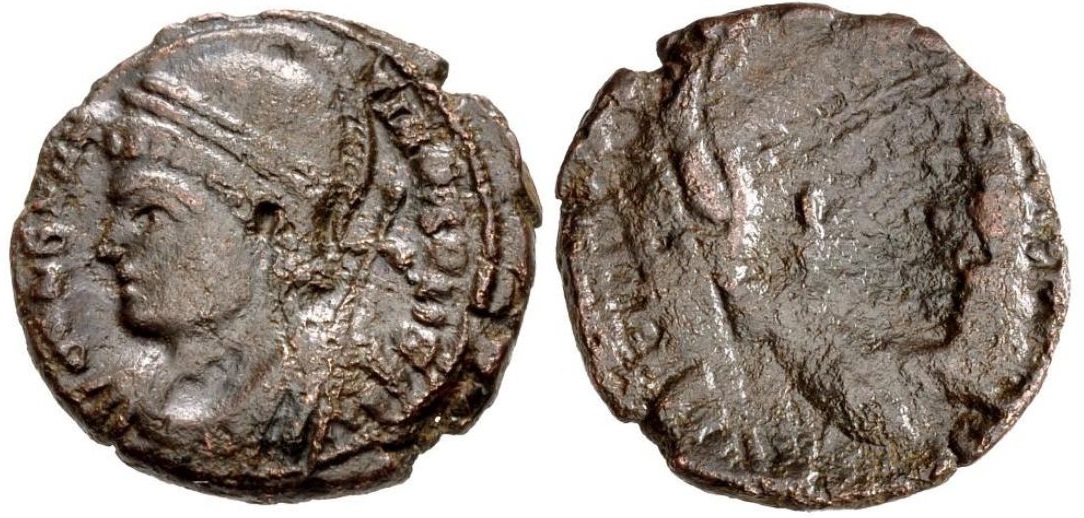
Brockage from Trier
15mm 1.8g Ex 1989 Nether Compton (Dorset) Hoard |
 |
|
|
|
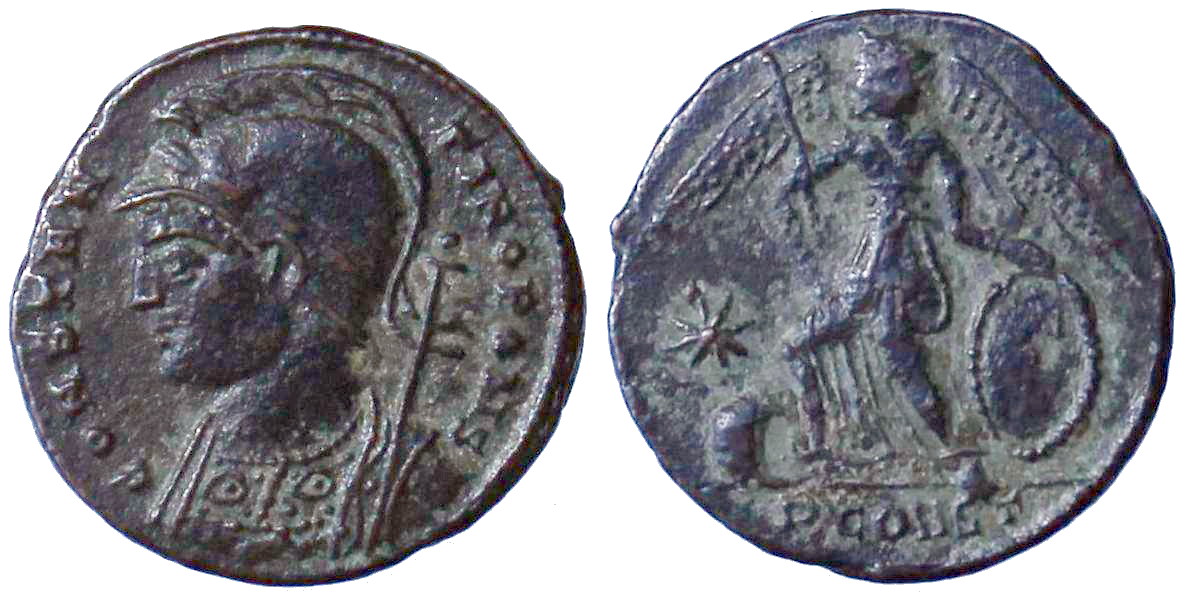
18mm 2.6 gm Obv. CONSTAN-TINOPOLIS laureate, helmeted, wearing imperial mantle, holding scepter. REV- Victory stg. on prow, holding long scepter in r. hand, and resting l. hand on shield; ✶in left field. in ex. PCONST RIC VII Arles 352 |
 |
|
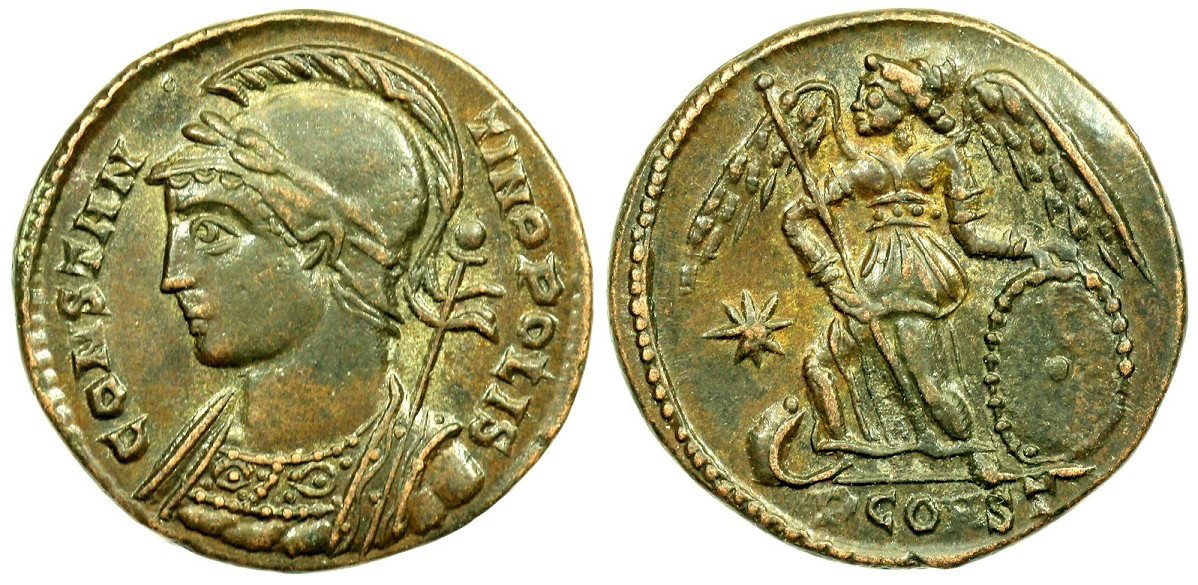
A.D. 330- 331 17mm 2.8gm CONSTAN-TINOPOLIS laureate, helmeted, wearing imperial mantle, holding scepter. REV- Victory stg. on prow, holding long scepter in r. hand, and resting l. hand on shield; ✶in left field. in ex. PCONST RIC VII Arles 352 |
 |
|
|
A.D. 330- 331 16mm 2.2 gm CONSTAN-TINOPOLIS laureate, helmeted, wearing imperial mantle, holding scepter. REV- Victory stg. on prow, holding long scepter in r. hand, and resting l. hand on shield; ✶in left field. in ex. PCONST RIC VII Arles 352 |
 |
|
|
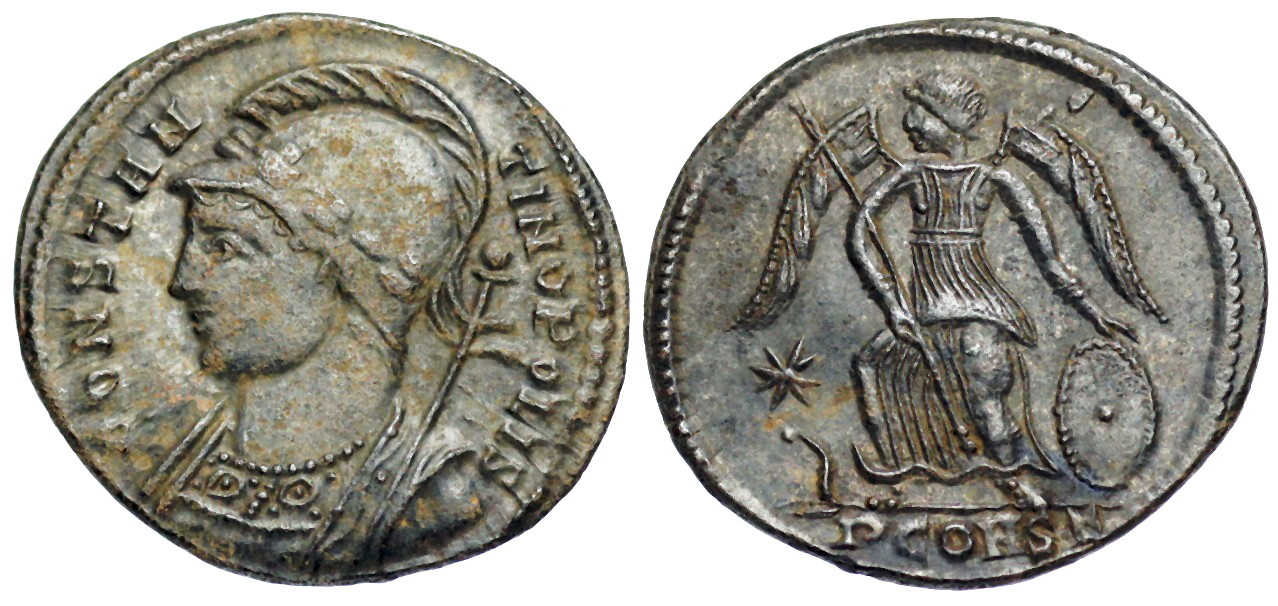
A.D.
330- 331 18x19mm 2.3gm CONSTAN-TINOPOLIS
laureate, helmeted, wearing imperial mantle, holding
scepter. Rev.
Victory stg. on prow, holding long scepter in r.
hand, and resting l. hand on shield, star in left
field. in ex.
PCONST RIC
VII Arles 352 |
 |
|
|
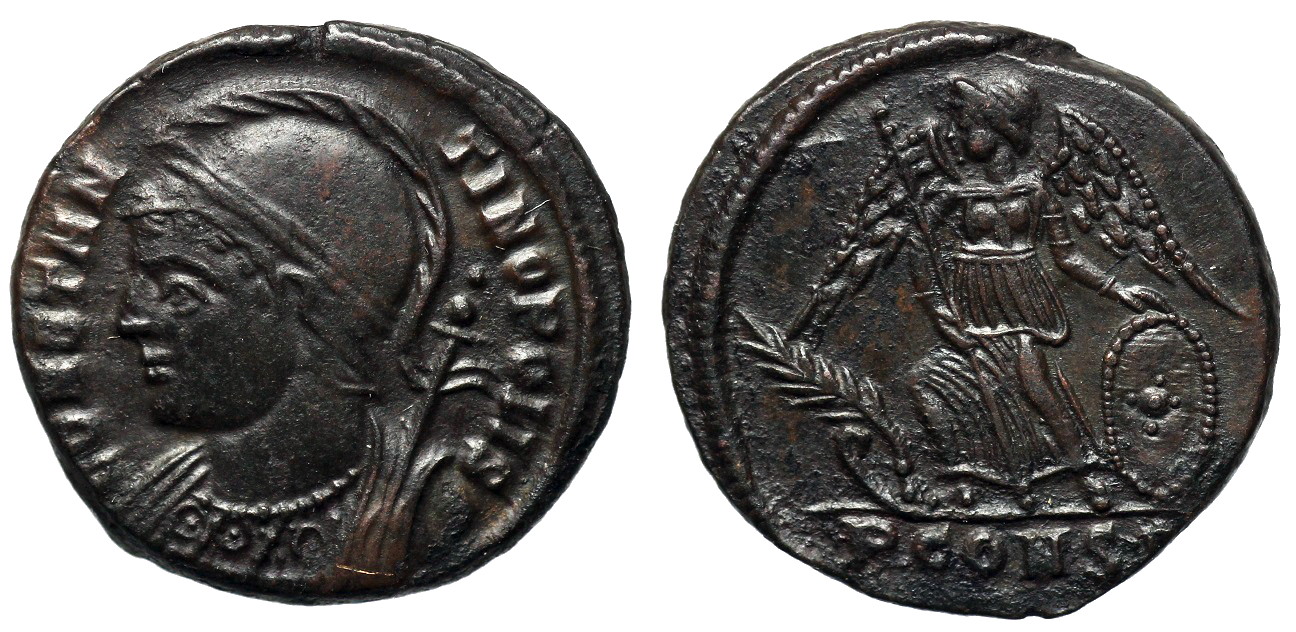
A.D.
332 17x18mm 3.1gm
CONSTAN-TINOPOLIS
laureate, helmeted, wearing imperial mantle,
holding scepter. Rev.
Victory stg. on prow, holding long scepter in r.
hand, and resting l. hand on shield; palm branch
in left field. in
ex. PCONST RIC VII Arles 363 |
 |
|
|
17x18mm 2.6g CONSTAN-TINOPOLIS laureate, helmeted, wearing imperial mantle, holding scepter. REV: Victory stg. on prow, holding long scepter in r. hand, and resting l. hand on shield; triple palm branch in left field. in ex. PCONST RIC VII Arles 369 |
 |
|
|
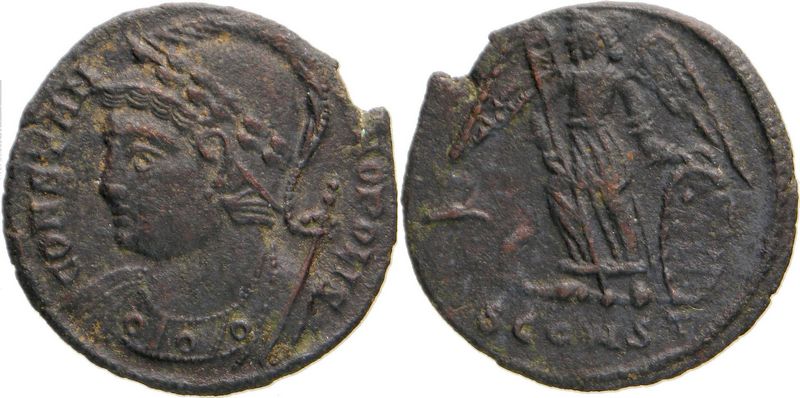
18mm 2.1 gm Obv. CONSTAN-TINOPOLIS laureate, helmeted, wearing imperial mantle, holding scepter. Rev. Victory stg. on prow, holding long scepter in r. hand, and resting l. hand on shield. wreath in left field, in ex. SCONST RIC VII Arles 374 |
 |
|
|
A.D.
333- 334 18mm 2.8gm CONSTAN-TINOPOLIS
laureate, helmeted, wearing imperial mantle, holding
scepter. Rev.
Victory stg. on prow, holding long scepter in r.
hand, and resting l. hand on shield; • in wreath in
left field. in ex.
PCONST RIC
VII Arles 380 |
 |
|
|
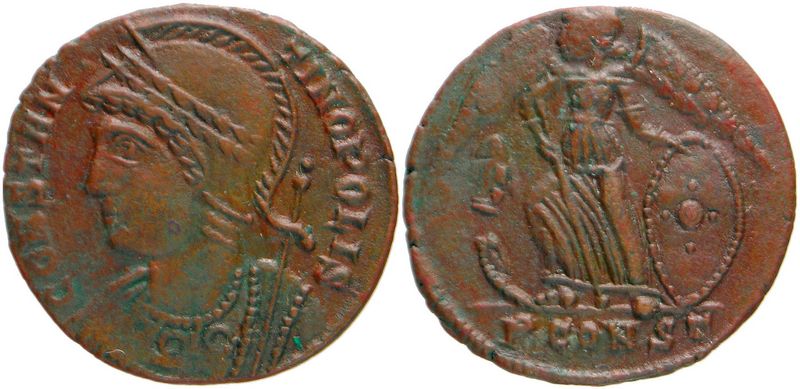
A.D. 335 18x17mm 1.9gm Obv.
CONSTAN-TINOPOLIS laureate, helmeted, wearing imperial
mantle, holding scepter. Rev. Victory
stg. on prow, holding long scepter in r. hand, and
resting l. hand on shield; Pine tree in left field. in ex. PCONST RIC VII Arles
393 |
 |
|
|
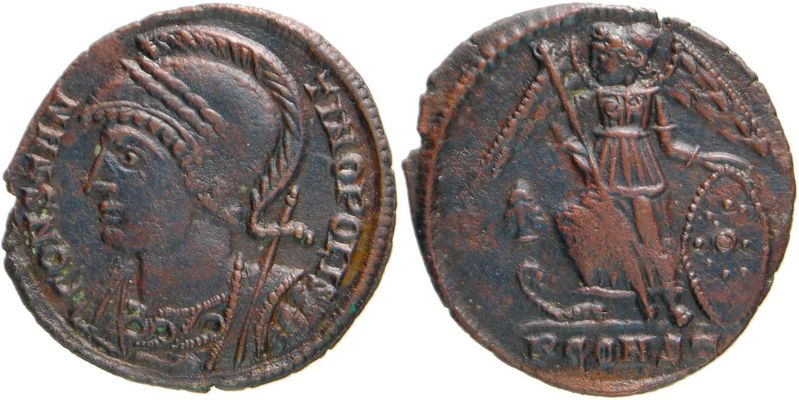
A.D. 335 19mm 2.1
gms Obv. CONSTAN-TINOPOLIS
laureate, helmeted, wearing imperial mantle, holding
scepter. Rev. Victory stg. on prow,
holding long scepter in r. hand, and resting l. hand
on shield; Pine tree in left field. in ex. PCONST RIC VII Arles 393 |
 |
|
|
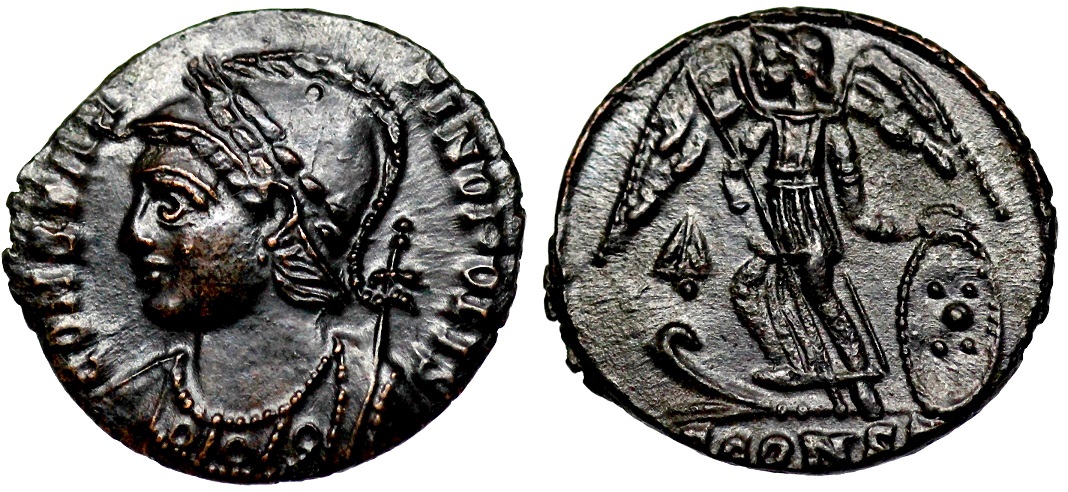
A.D. 335 17x19mm 2.2gm CONSTAN-TINOPOLIS laureate, helmeted, wearing imperial mantle, holding scepter. REV: Victory stg. on prow, holding long scepter in r. hand, and resting l. hand on shield; Pine tree in left field. in ex. SCONST RIC VII Arles 393 |
 |
|
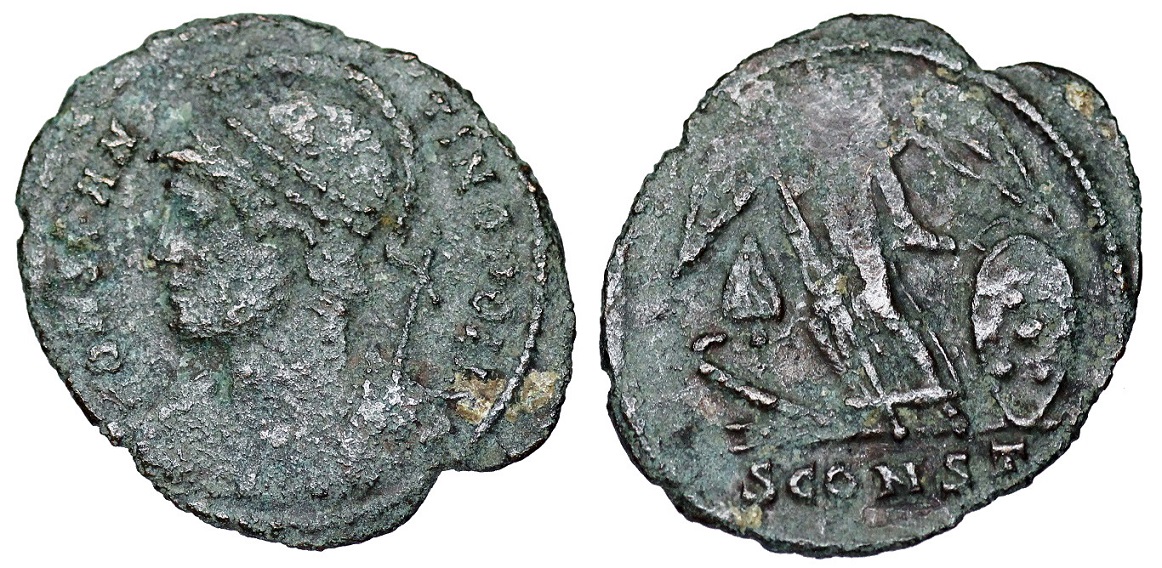
| A.D. 335 17x20mm 1.8gm CONSTAN-TINOPOLIS laureate, helmeted, wearing imperial mantle, holding scepter. REV: Victory stg. on prow, holding long scepter in r. hand, and resting l. hand on shield; Pine tree in left field. in ex. SCONST RIC VII Arles 393 The shield has six circular devices surrounding the central boss |
 |
|
|
|
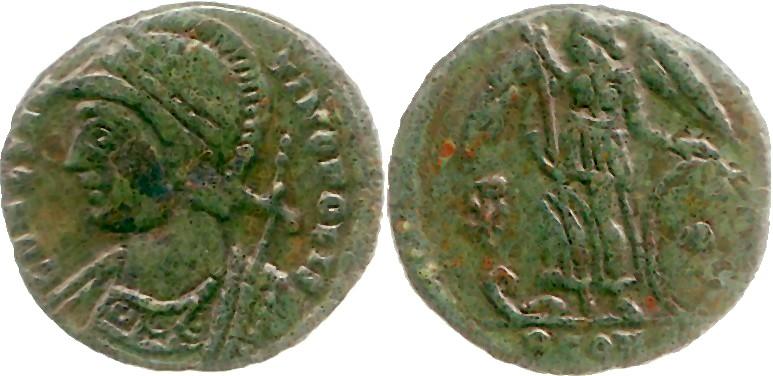
17mm 1.8gm Obv. CONSTAN-TINOPOLIS laureate, helmeted, wearing imperial mantle, holding scepter. Rev. Victory stg. on prow, holding long scepter in r. hand, and resting l. hand on shield; in left field CHi-Rho. in ex. PCONST RIC VII Arles 401 |
 |
|
|
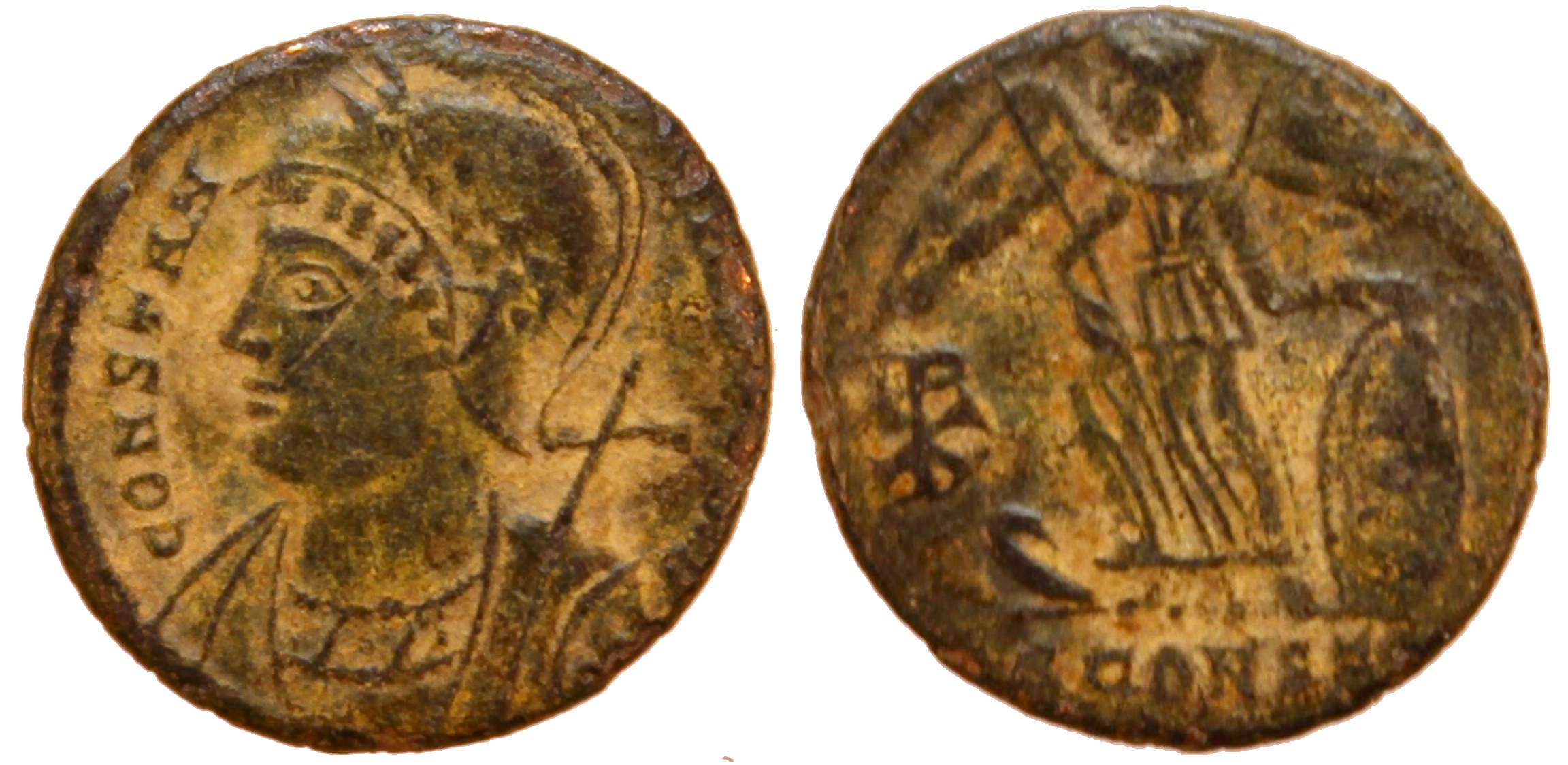
16mm 2.3gm Obv. CONSTAN-TINOPOLIS laureate, helmeted, wearing imperial mantle, holding scepter. Rev. Victory stg. on prow, holding long scepter in r. hand, and resting l. hand on shield; in left field CHi-Rho. in ex. SCONST RIC VII Arles 401 |
 |
|
|
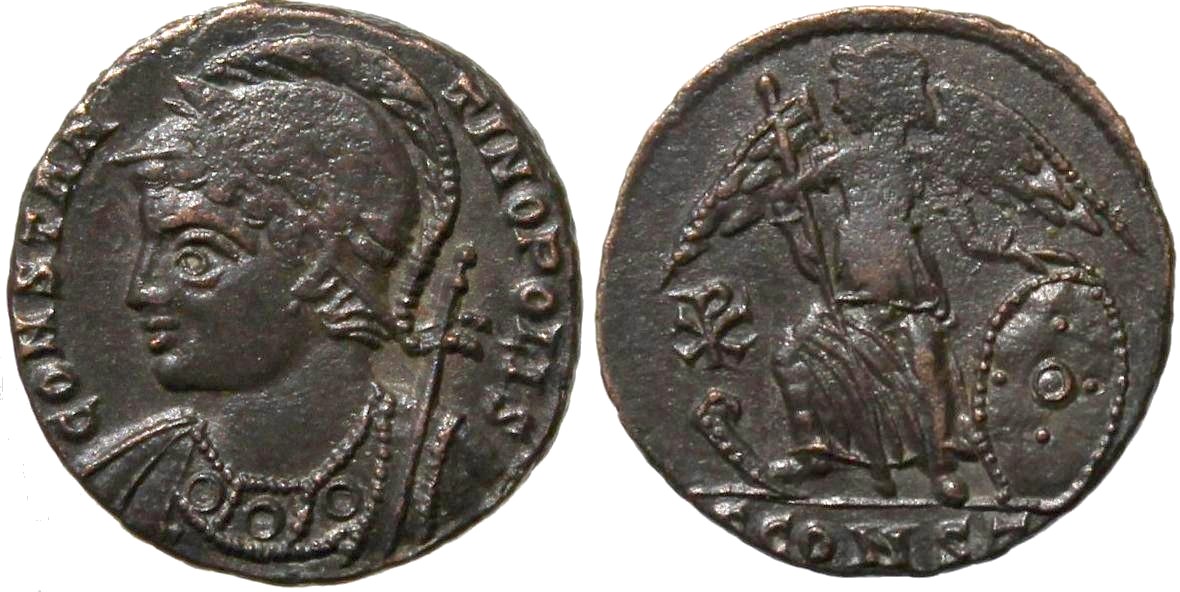
16mm 2.3gm Obv. CONSTAN-TINOPOLIS laureate, helmeted, wearing imperial mantle, holding scepter. Rev. Victory stg. on prow, holding long scepter in r. hand, and resting l. hand on shield. Chi-Rho in left field, in ex. SCONST RIC VII Arles 401 |
 |
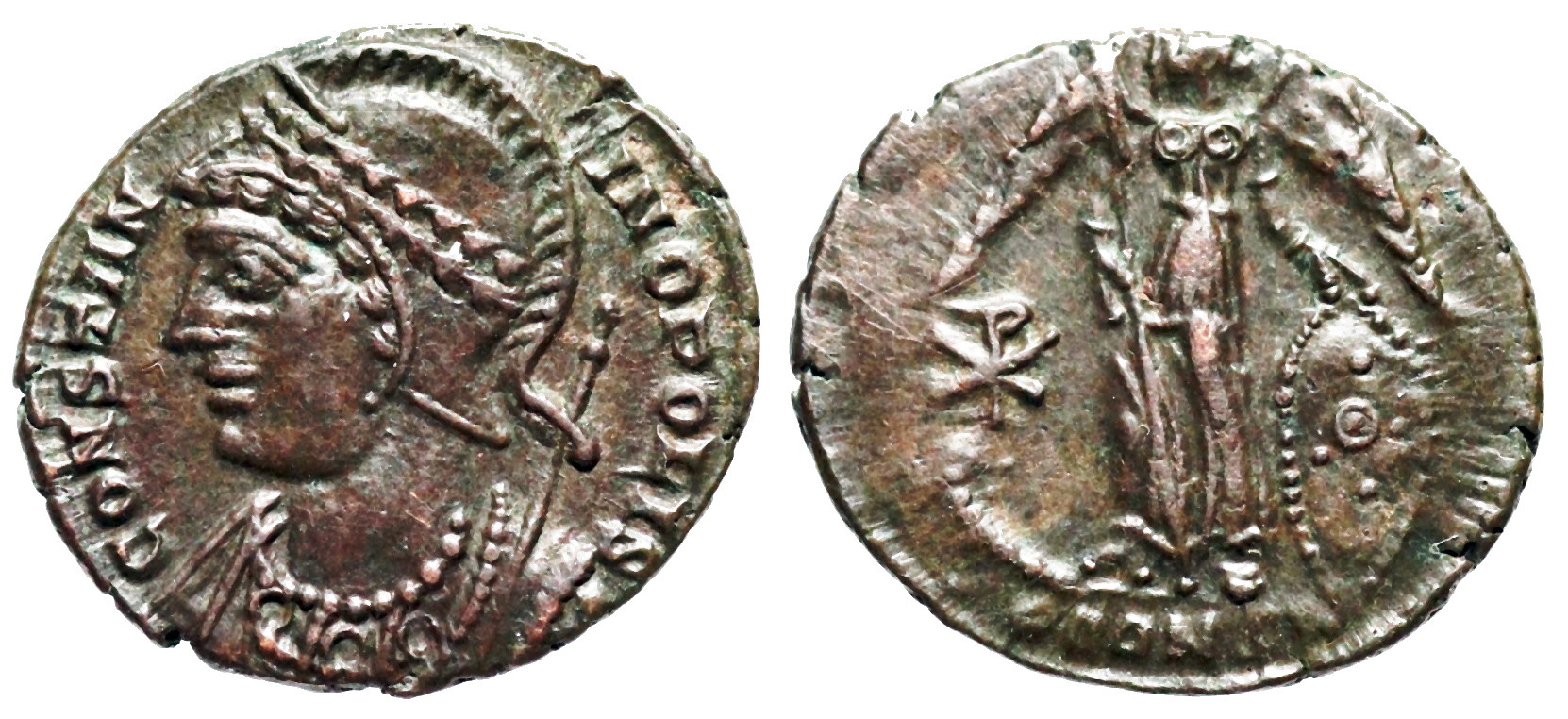
Chi-rho
|
A.D. 336 14x16mm 1.6gm Obv.
CONSTAN-TINOPOLIS laureate, helmeted, wearing imperial
mantle, holding scepter. Rev. Victory
stg. on prow, holding long scepter in r. hand, and
resting l. hand on shield. Chi-Rho in
left field. in ex. PCONST RIC VII Arles
401 Victory's
chest seems over-emphasized |
 |
|
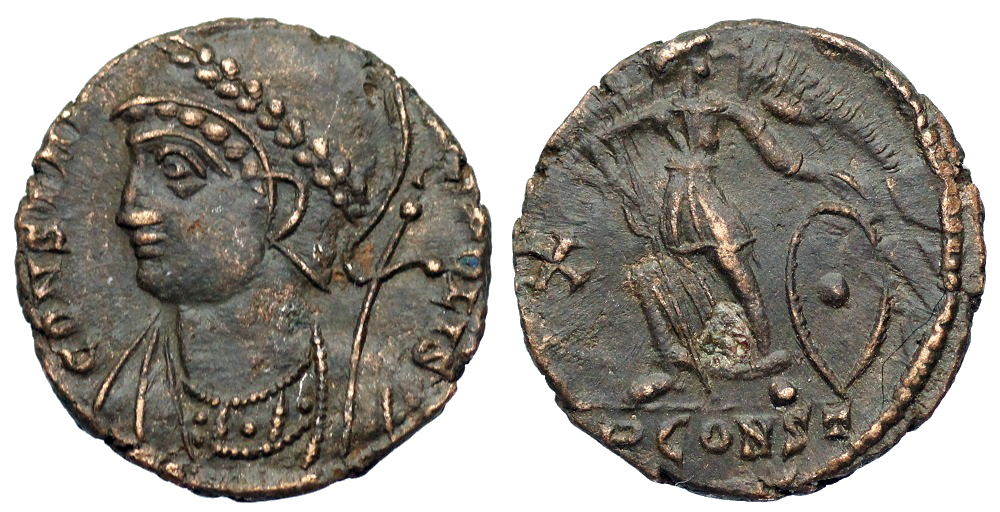
A.D.
337- 340 14x15mm 1.5gm Obv.
CONSTAN-TINOPOLIS; laureate and crested helmet,
necklace and ornamental mantle over left shoulder,
holding sceptre Rev.
Victory stg. on prow, holding long scepter in r. hand,
and resting l. hand on shield; in left field X in
ex. PCONST
RIC
VIII Arles 26 |
 |
|
|
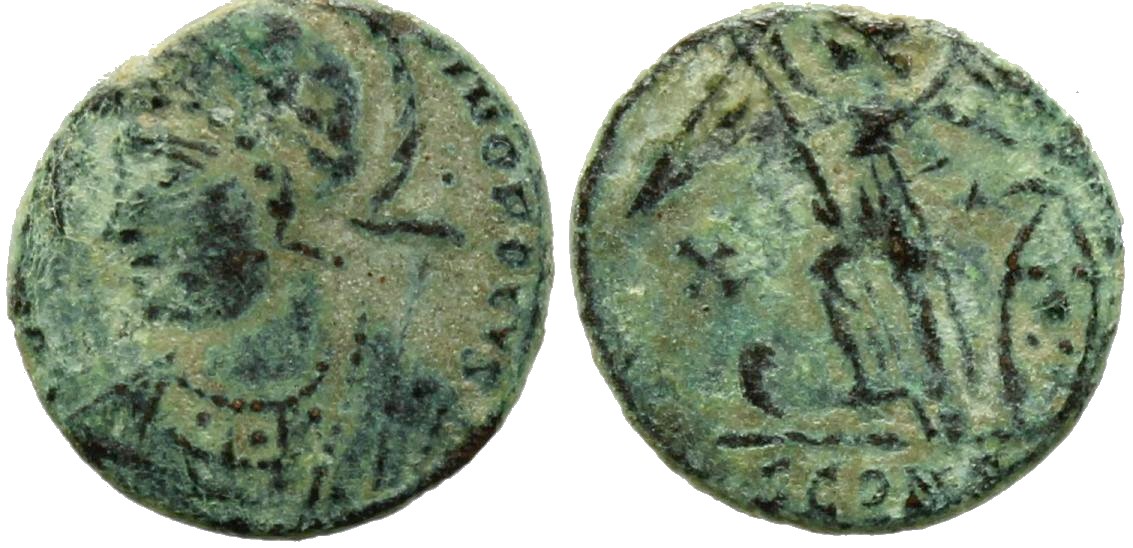
14mm 1.5gm Obv. CONSTAN-TINOPOLIS, laureate and crested helmet, necklace and ornamental mantle over left shoulder, holding sceptre Rev. Victory stg. on prow, holding long scepter in r. hand, and resting l. hand on shield; in left field X in ex. SCONST RIC VIII Arles 26 |
 |
|
|
|
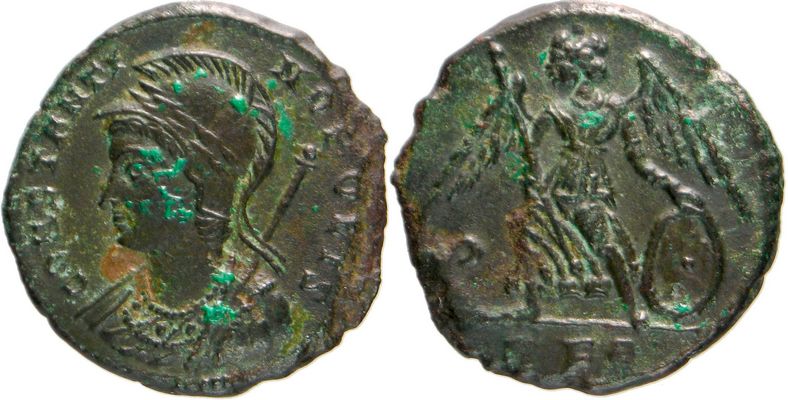
19mm 2.3g Obv. CONSTANTI-NOPOLIS laureate, helmeted, wearing imperial mantle, holding cross- scepter with a globe. Rev. Victory stg. on prow, holding long scepter in r. hand, and resting l. hand on shield. in exergue R F E RIC VII Rome 332 RF in the exergue likely stands for Roma Felix (Happy Rome) |
 |
|
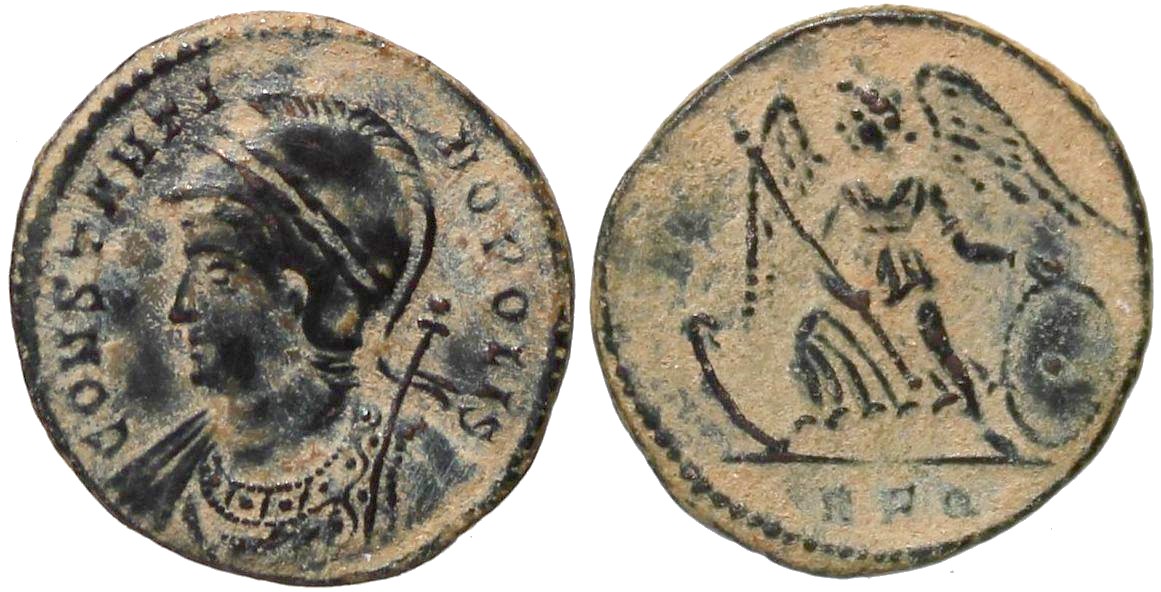
A.D. 330 18mm 2.3g Obv. CONSTANTI-NOPOLIS laureate, helmeted, wearing imperial mantle, holding cross- scepter with a globe. Rev. Victory stg. on prow, holding long scepter in r. hand, and resting l. hand on shield. in exergue RFQ RIC VII Rome 332unlisted officina |
 |
|
|
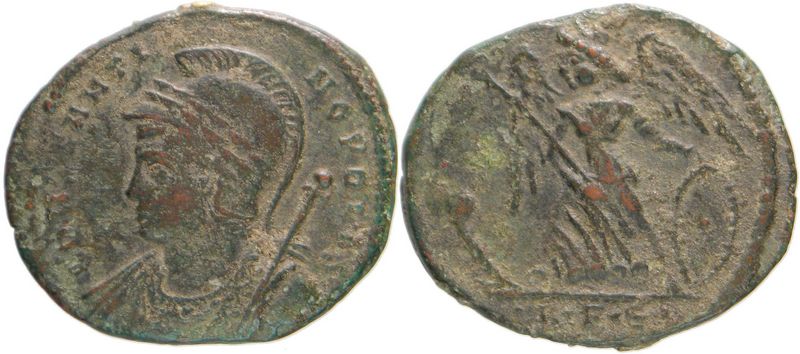
20x18mm 2.4g Obv. CONSTANTI-NOPOLIS laureate, helmeted, wearing imperial mantle, holding cross- scepter with a globe. Rev. Victory stg. on prow, holding long scepter in r. hand, and resting l. hand on shield. in exergue dot R dot F dot epsilon dot RIC VII Rome 334 r4 RF in the exergue likely stands for Roma Felix (Happy Rome) |
 |
|
|
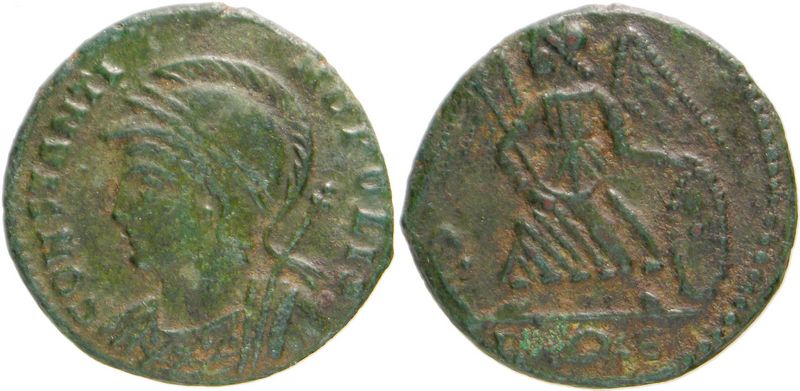
18mm 2.5g Obv. CONSTANTI-NOPOLIS laureate, helmeted, wearing imperial mantle, holding cross- scepter with a globe. Rev. Victory stg. on prow, holding long scepter in r. hand, and resting l. hand on shield. in exergue R wreath E RIC VII Rome 355 |
 |
|
|
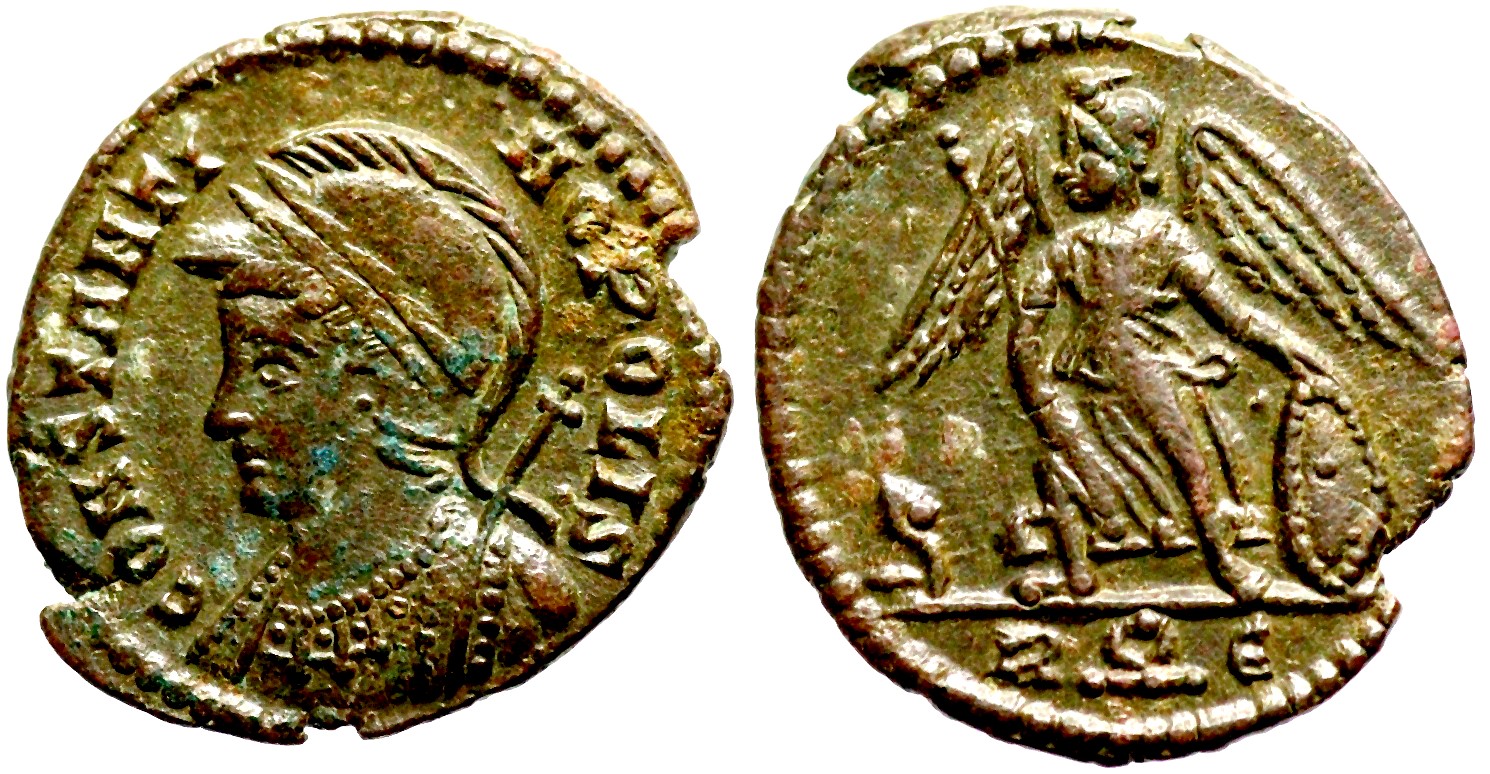
A.D. 330 18mm 2.0g Obv. CONSTANTI-NOPOLIS laureate, helmeted, wearing imperial mantle, holding cross- scepter with a globe. Rev. Victory stg. on prow, holding long scepter in r. hand, and resting l. hand on shield. in exergue R wreath E RIC VII Rome 355 |
 |
|
|
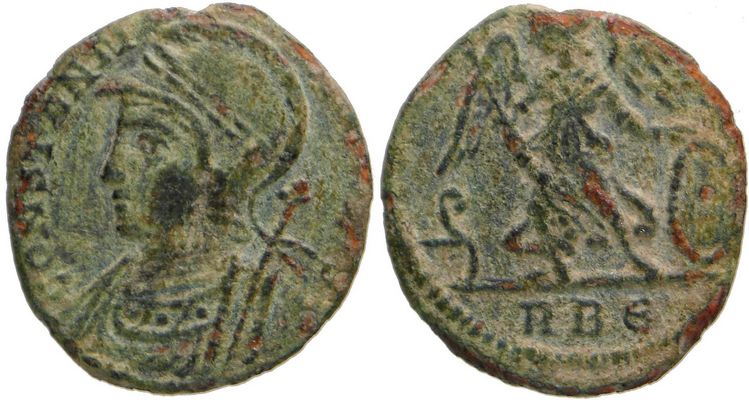
17x16mm 2gm Obv. CONSTANTI-NOPOLIS laureate, helmeted, wearing imperial mantle, holding cross- scepter with a globe. Rev. Victory stg. on prow, holding long scepter in r. hand, and resting l. hand on shield. in exergue R B E RIC VII Rome 339 RB in the exergue likely stands for Roma Beata (Blessed Rome) Note that Victory is not on the prow, but the prow is coming towards her. The engraver misunderstood his instructions! |
 |
|
|
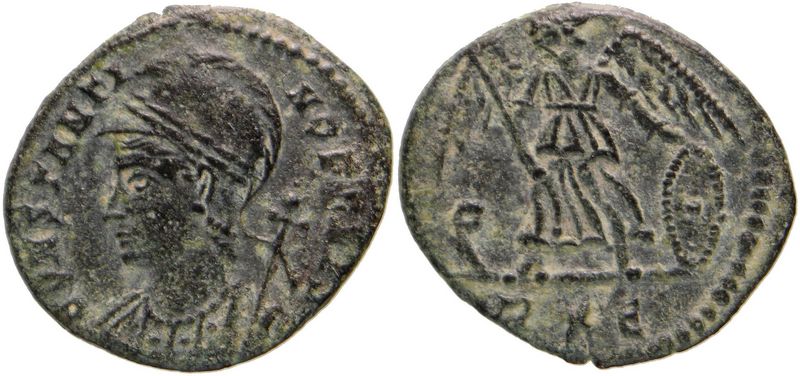
19x18mm 2.2g Obv. CONSTANTI-NOPOLIS laureate, helmeted, wearing imperial mantle, holding cross- scepter with a globe. Rev. Victory stg. on prow, holding long scepter in r. hand, and resting l. hand on shield. in exergue R ✶ E RIC VII Rome 371 Note that Victory is not on the prow, but the prow is coming towards her. The engraver misunderstood his instructions! |
 |
|
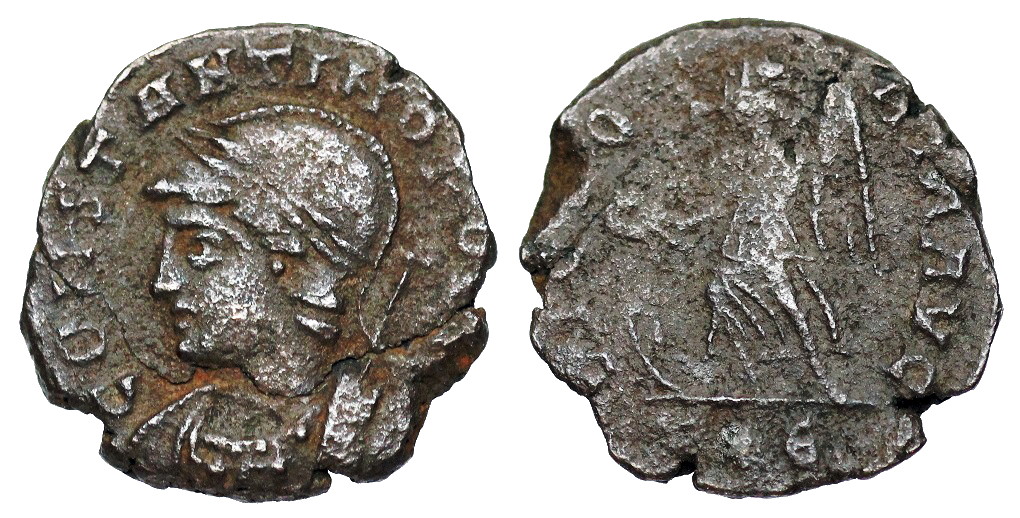
| A.D. 337- 340 15mm 1.6gm CONSTANTINOPOLIS; laureate, helmeted, wearing imperial mantle, holding scepter. VICTORIA AVG; Victory stg. on prow, holding wreath and palm. in exergue R ✶ E RIC VIII Rome 31 rare type with reverse legend |
 |
|
|
|
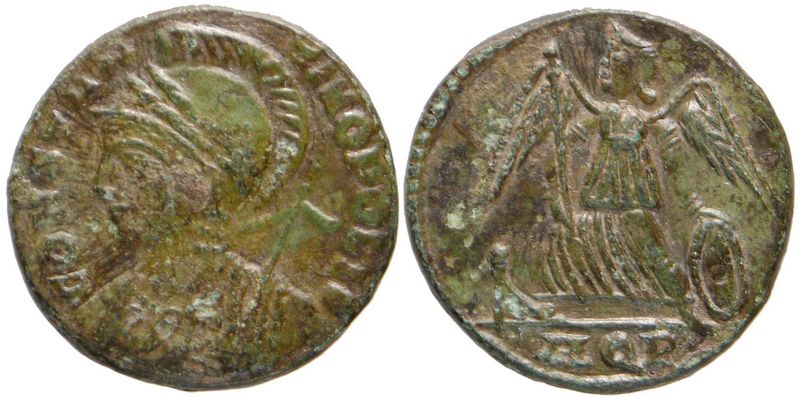
18mm 2.5gm Obv. CONSTAN-TINOPOLIS laureate, helmeted, wearing imperial mantle, holding scepter. Rev. Victory stg. on prow, holding long scepter in r. hand, and resting l. hand on shield. in ex. AQP RIC VII Aquileia 123 |
 |
|
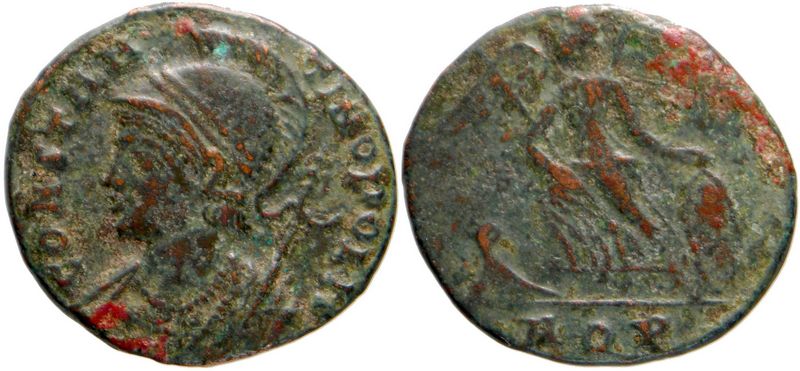
19x18mm 2.1gm Obv. CONSTAN-TINOPOLIS laureate, helmeted, wearing imperial mantle, holding scepter. Rev. Victory stg. on prow, holding long scepter in r. hand, and resting l. hand on shield. in ex. AQP RIC VII Aquileia 123 |
 |
|
|
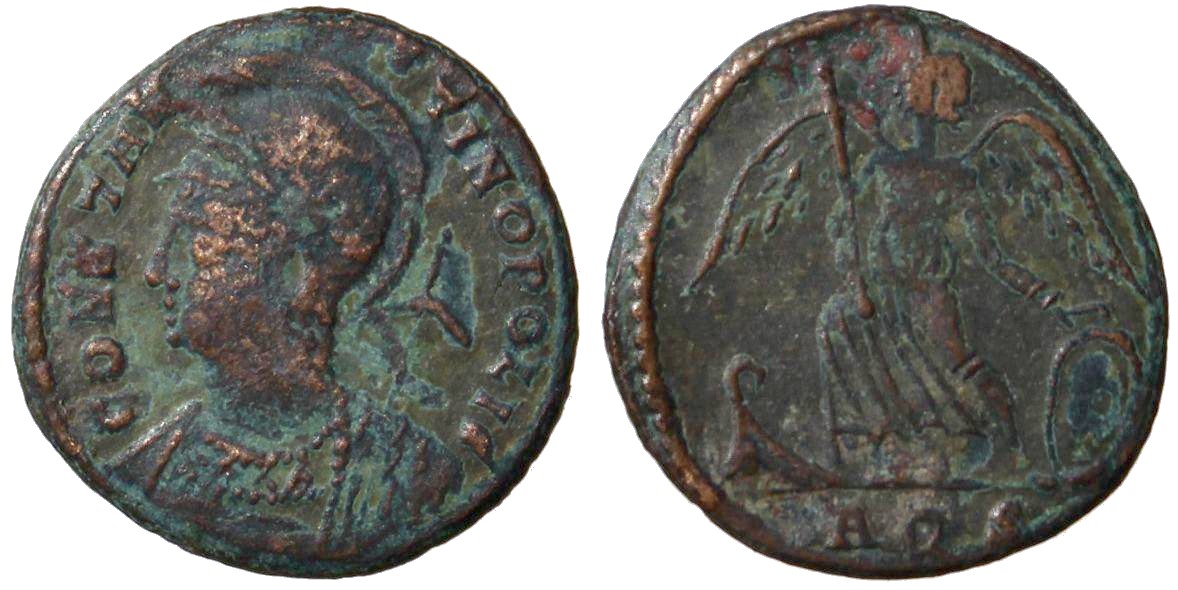
18x17mm 2.5 gm Obv. CONSTAN-TINOPOLIS laureate, helmeted, wearing imperial mantle, holding scepter. Rev. Victory stg. on prow, holding long scepter in r. hand, and resting l. hand on shield. in ex. AQS RIC VII Aquileia 123 |
 |
|
|
A.D. 334- 335 17x18mm 2.3gm CONSTAN-TINOPOLIS; laureate, helmeted, wearing imperial mantle, holding scepter. REV.- Victory stg. on prow, holding long scepter in r. hand, and resting l. hand on shield. in ex. AQP RIC VII Aquileia 123 |
 |
|
|
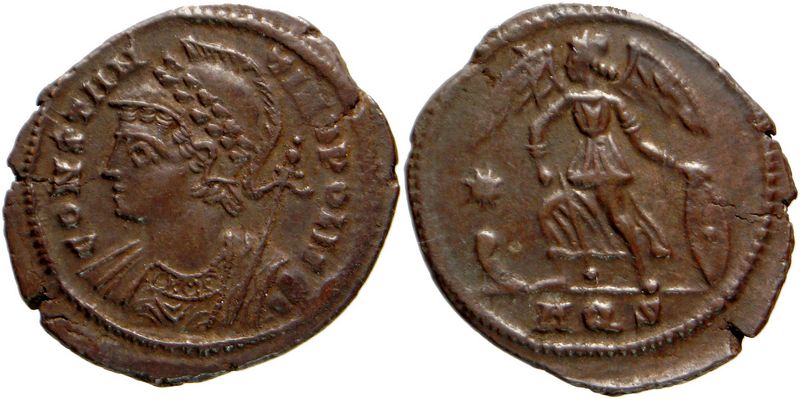
20x18mm 2.3 gm Obv. CONSTAN-TINOPOLIS laureate, helmeted, wearing imperial mantle, holding cross- scepter with a globe. Rev. Victory stg. on prow, holding long scepter in r. hand, and resting l. hand on shield. * left field, in ex. AQS RIC VII Aquileia 129 |
 |
|
|
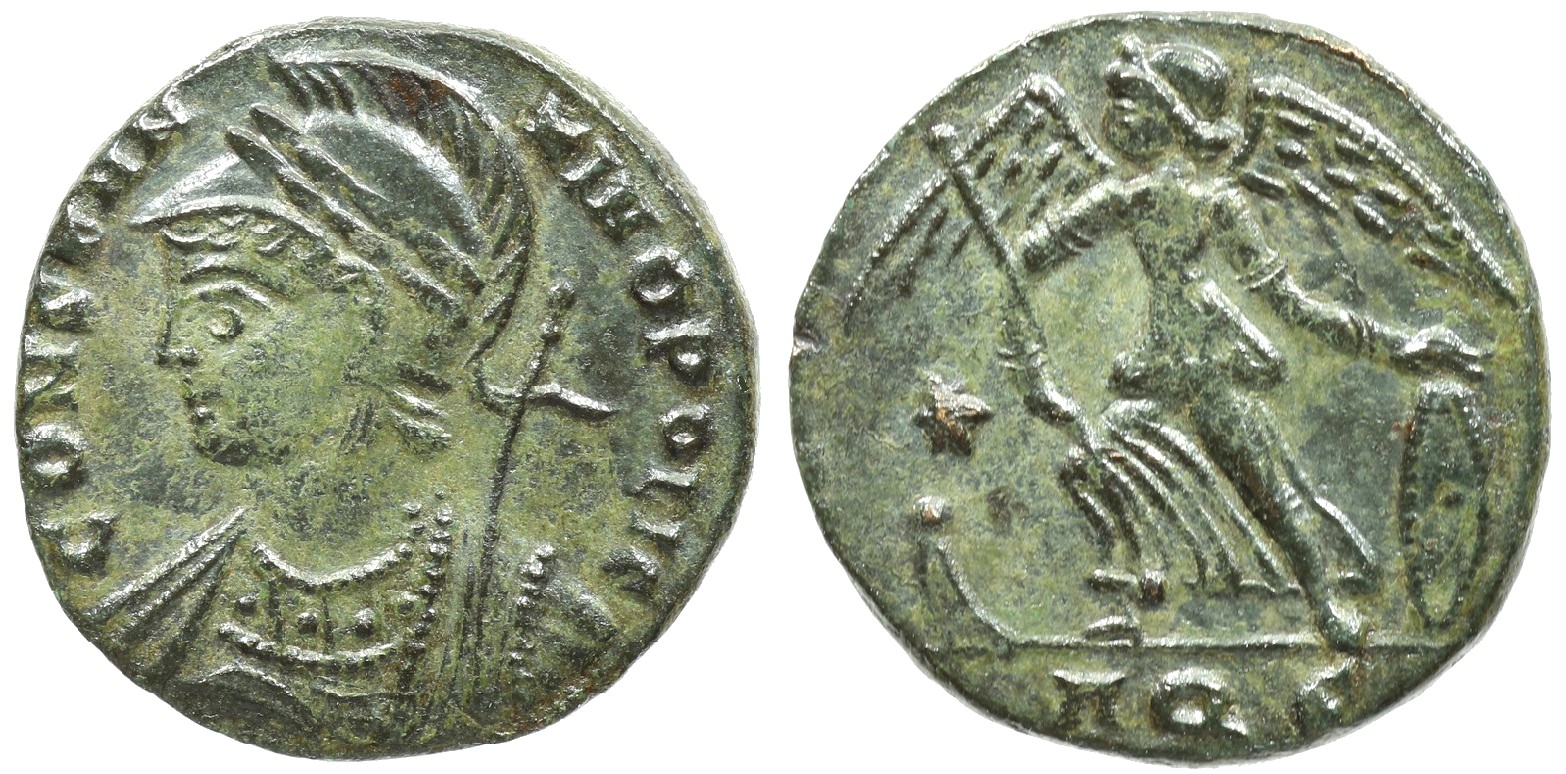
A.D. 334- Sept. 335 17mm 2.4 gm CONSTAN-TINOPOLIS, laureate helmet, wearing imperial mantle, holding scepter. Reverse- Victory stg. on prow, holding long scepter in r. hand, and resting l. hand on shield; * left field in ex. AQS RIC VII Aquileia 129 |
 |
|
|
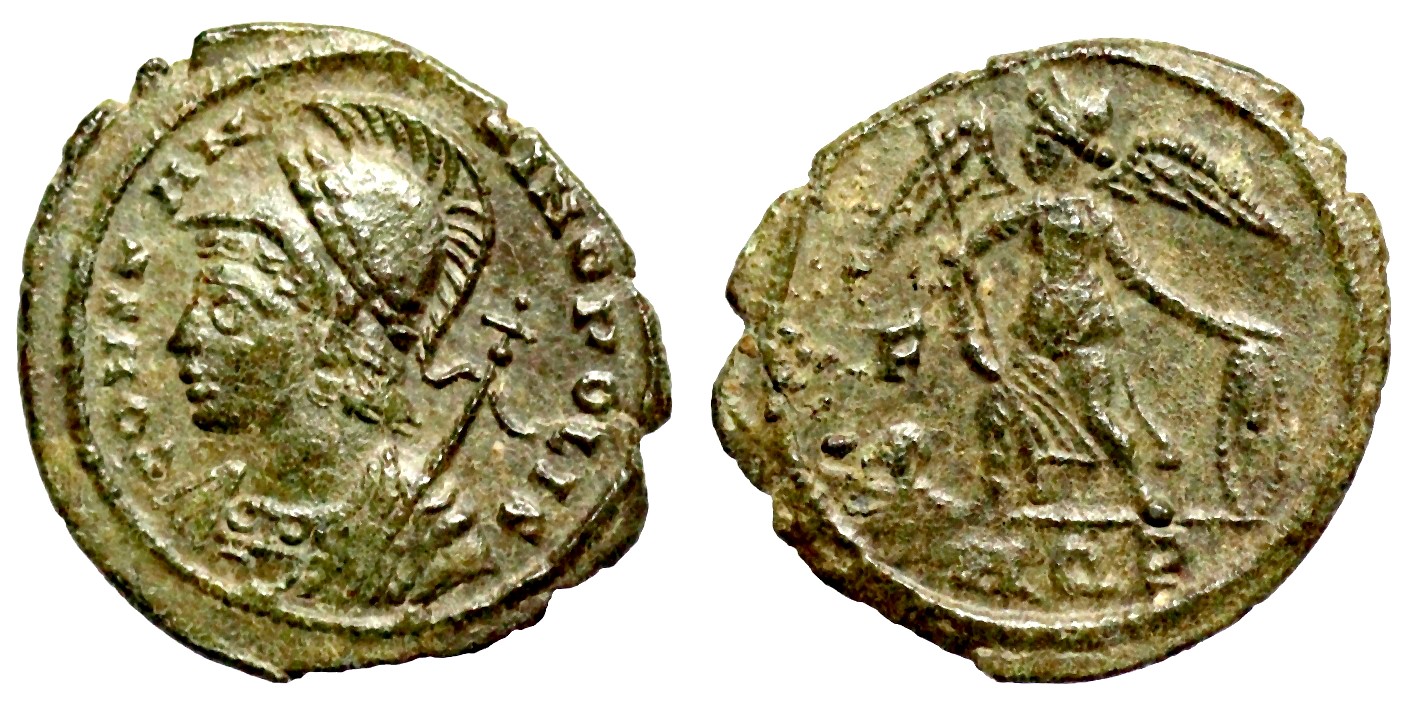
A.D. 335-336 17x18mm 1.8 gm Obv. CONSTAN-TINOPOLIS laureate, helmeted, wearing imperial mantle, holding scepter. Rev. Victory stg. on prow, holding long scepter in r. hand, and resting l. hand on shield, F left field. in ex. AQP RIC VII Aquileia 137 |
 |
|
|
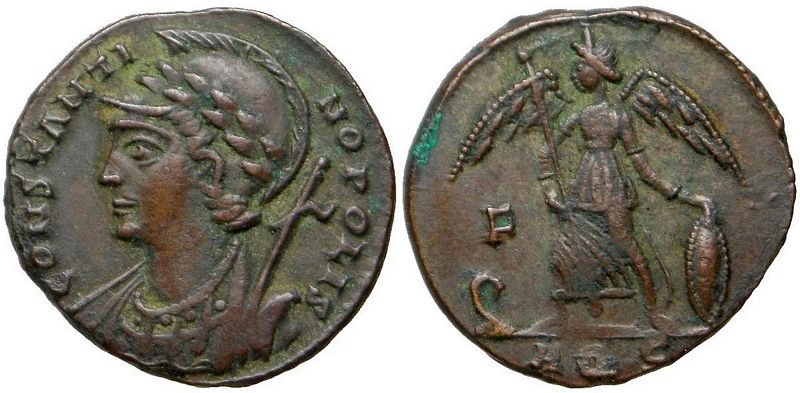
18mm 2.7 gm Obv. CONSTANTI-NOPOLIS laureate, helmeted, wearing imperial mantle, holding scepter. Rev. Victory stg. on prow, holding long scepter in r. hand, and resting l. hand on shield. F left field, in ex. AQS RIC VII Aquileia 137 r4 |
 |
|
|
|
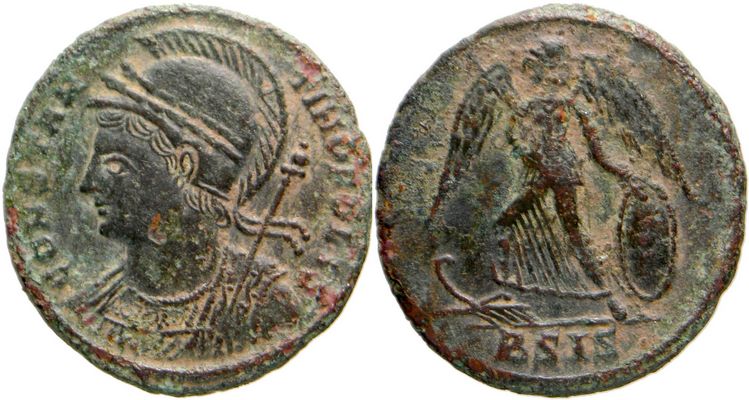
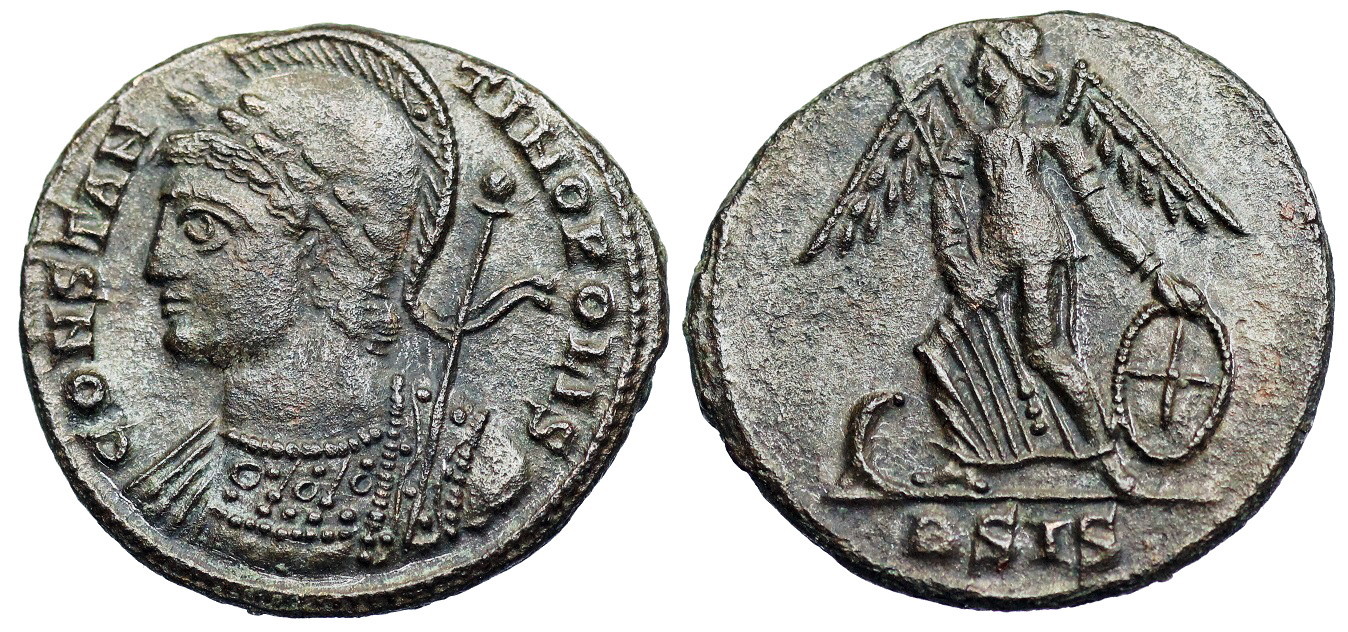
19mm 2.3gm Obv. CONSTAN-TINOPOLIS laureate, helmeted, wearing imperial mantle, holding cross- scepter with a globe. Rev. Victory stg. on prow, holding long scepter in r. hand, and resting l. hand on shield. in ex. BSIS RIC VII Siscia 224 |
 |
|
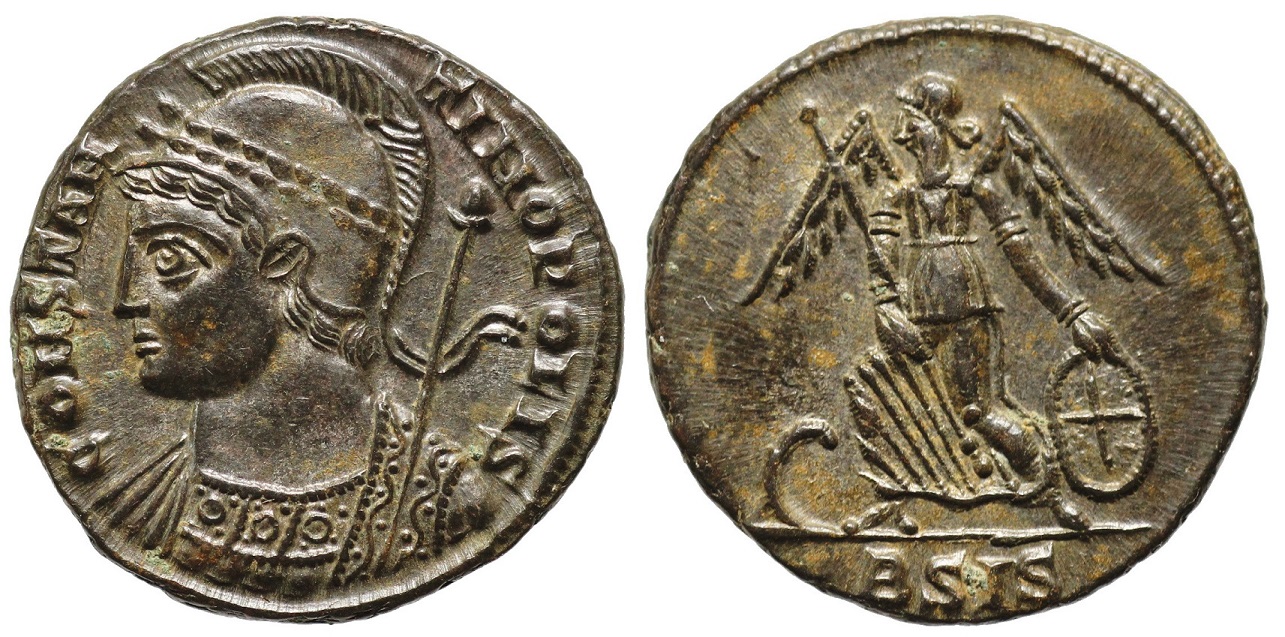
A.D. 330-3 18mm 2.4gm
Obv.
CONSTAN-TINOPOLIS laureate, helmeted, wearing imperial
mantle, holding reversed spear/scepter. Rev. Victory
stg. on prow, holding long scepter in r. hand, and
resting l. hand on shield engraved with equilateral
cross. in ex. BSIS RIC VII Siscia
224
The shield is
engraved with a quadripartite design |
 |
|
|
A.D. 330-3
17x19mm 2.5gm Obv. CONSTAN-TINOPOLIS laureate, helmeted, wearing imperial mantle, holding reversed spear/scepter. Rev. Victory stg. on prow, holding long scepter in r. hand, and resting l. hand on shield engraved with equilateral cross. in ex. BSIS RIC VII Siscia 224 The shield is engraved with a quadripartite design |
 |
|
|
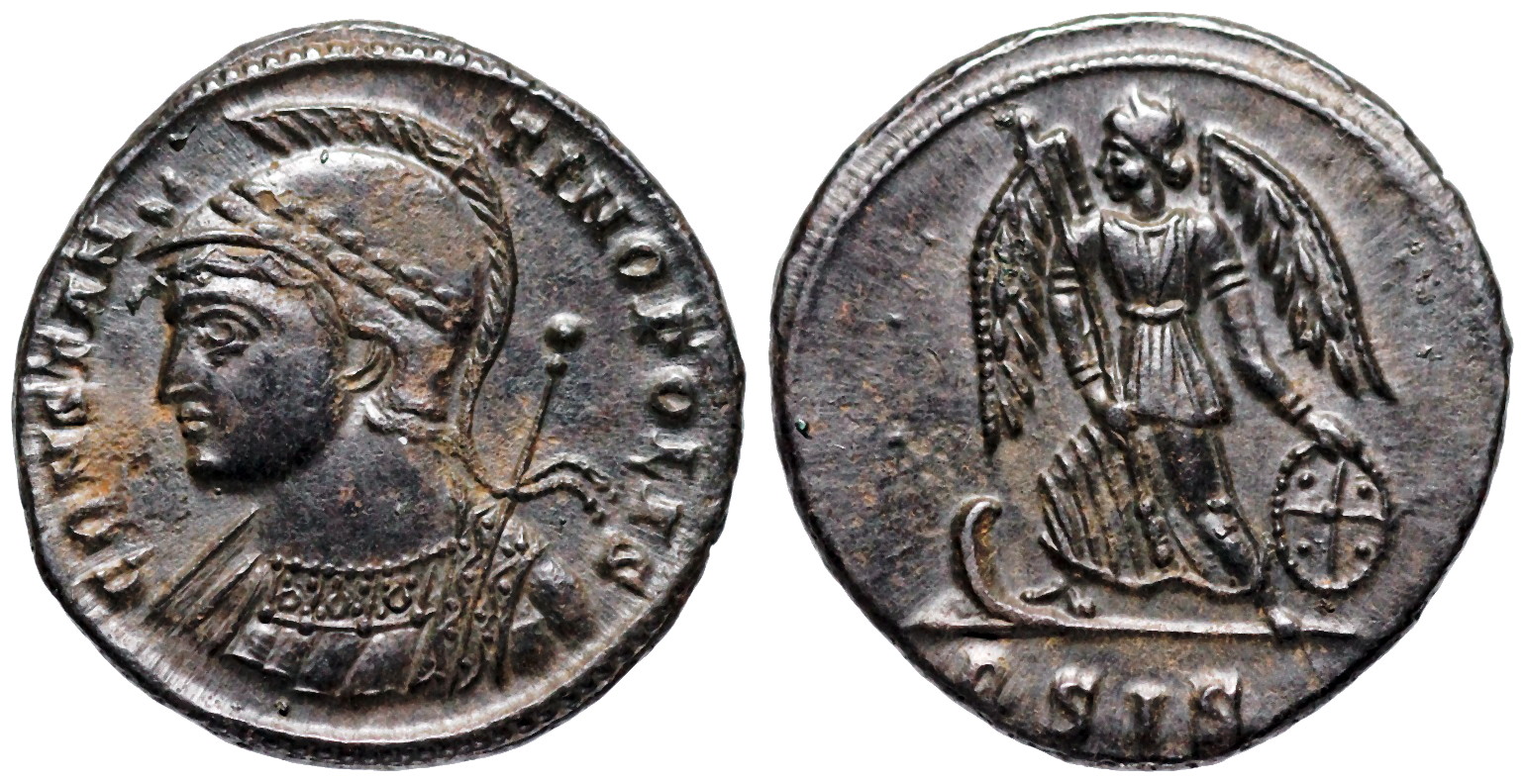
A.D. 330-3 18mm 2.4gm Obv.
CONSTAN-TINOPOLIS laureate, helmeted, wearing imperial
mantle, holding reversed spear/scepter. Rev. Victory
stg. on prow, holding long scepter in r. hand, and
resting l. hand on engraved shield. in ex. BSIS RIC VII Siscia
224 The shield is
engraved with a quadripartite design, with a dot in
each section |
 |
|
|
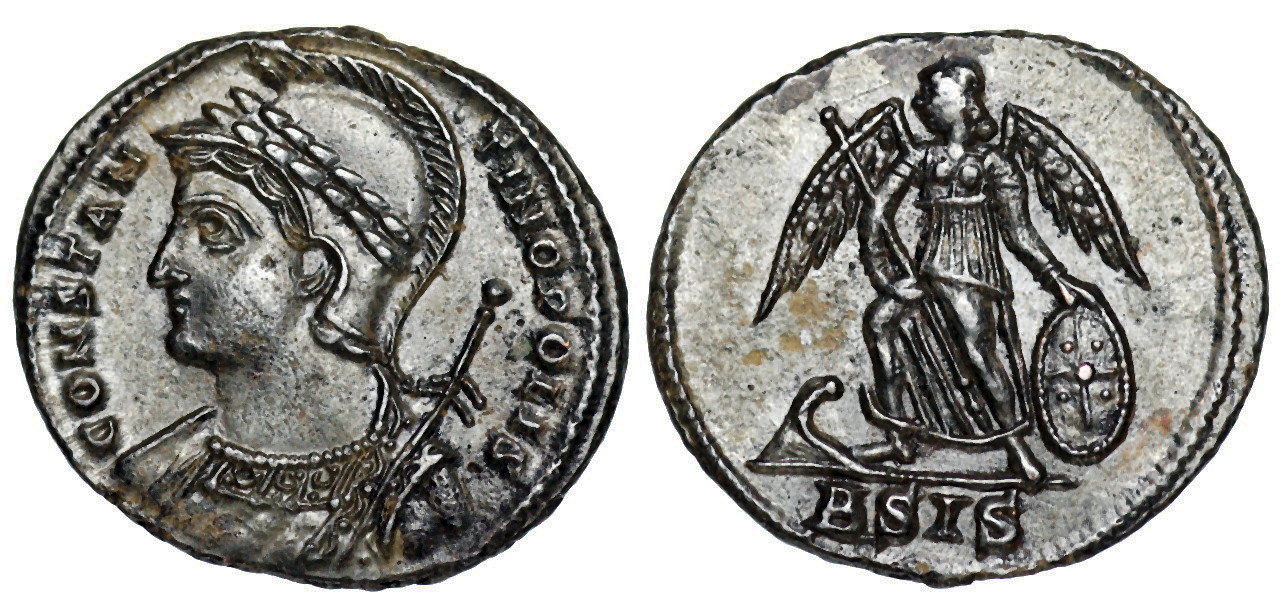
A.D. 330-3 17x19mm 2.4gm
Obv.
CONSTAN-TINOPOLIS laureate, helmeted, wearing imperial
mantle, holding reversed spear/scepter. Rev. Victory
stg. on prow, holding long scepter in r. hand, and
resting l. hand on engraved shield. in ex. BSIS RIC VII Siscia
224 The shield is
engraved with a quadripartite design, with a dot in
each section |
 |
|
|
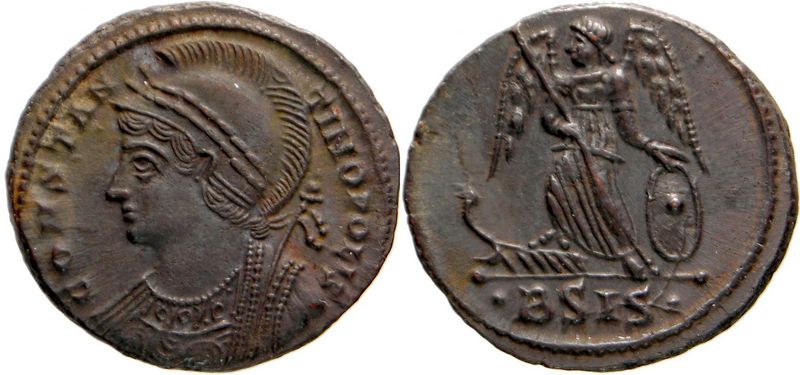
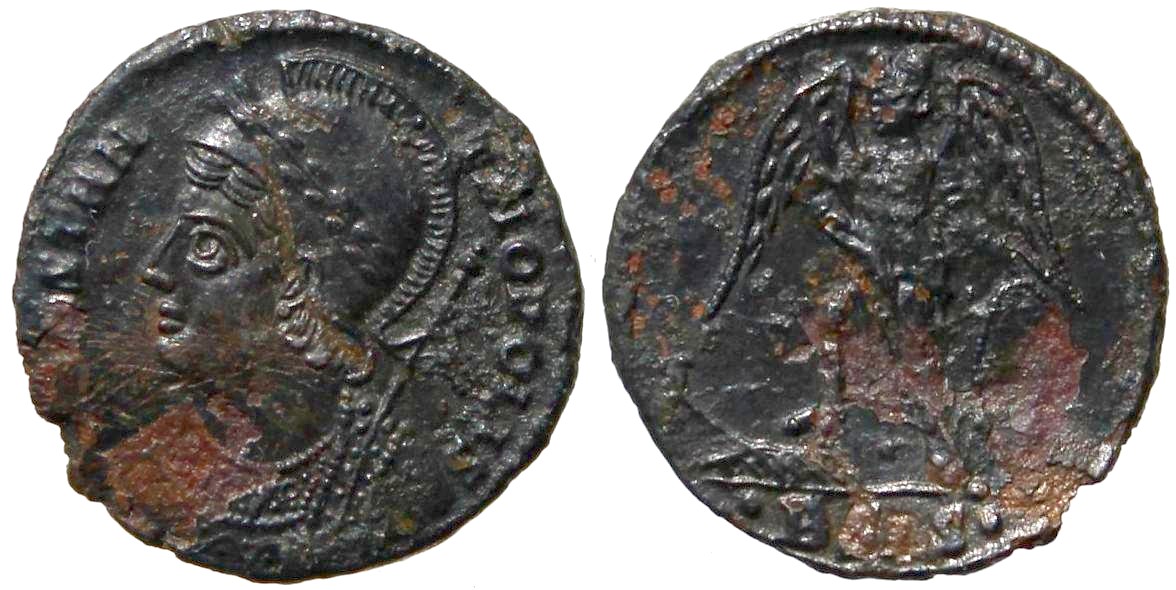
19x18mm 2.9gm Obv. CONSTAN-TINOPOLIS laureate, helmeted, wearing imperial mantle, holding cross- scepter with a globe. Rev. Victory stg. on prow, holding long scepter in r. hand, and resting l. hand on shield. in ex. • BSIS • RIC VII Siscia 241 |
 |
|
|
to the heavens bust |
17mm 2.0gm Obv. CONSTAN-TINOPOLIS laureate, helmeted bust looking up to Heaven, wearing imperial mantle, holding scepter. Rev. Victory stg. on prow, holding long scepter in r. hand, and resting l. hand on shield. in ex. dot BSIS dot RIC VII Siscia 241 Unlisted for “eyes to heavens” bust |
 |
|
|
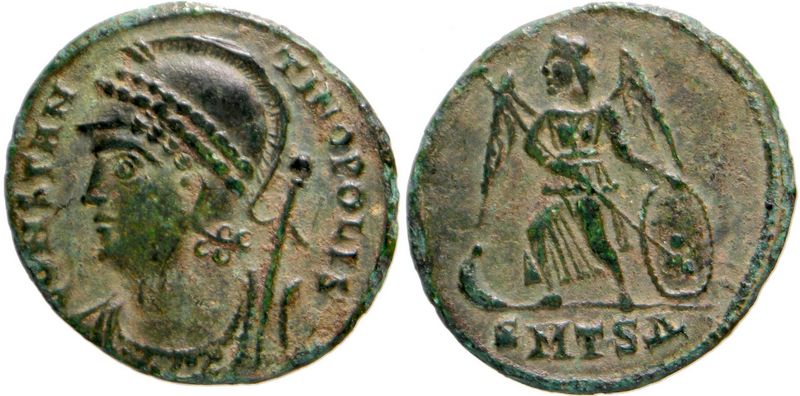
19x18mm 2.3 gm Obv. CONSTAN-TINOPOLIS laureate, helmeted, wearing imperial mantle, holding scepter. Rev. Victory stg. on prow, holding long scepter in r. hand, and resting l. hand on shield. in ex. SMTS delta RIC VII Thessalonica 188 Check out those curls in the hair! |
 |
|
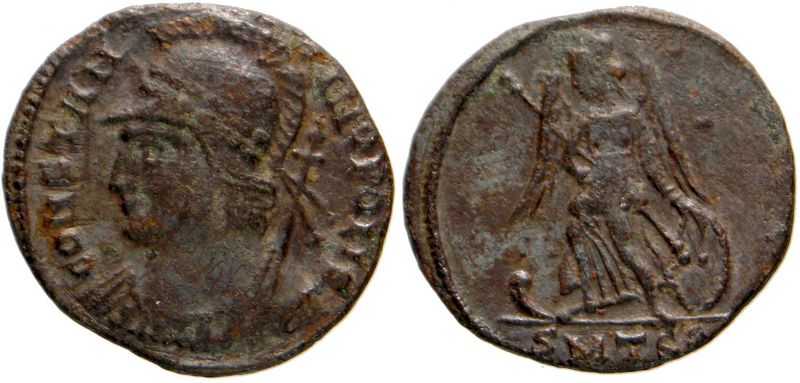
16x16mm 2.0gm Obv. CONSTAN-TINOPOLIS laureate, helmeted, wearing imperial mantle, holding cross- scepter with a globe. Rev. Victory stg. on prow, holding long scepter in r. hand, and resting l. hand on shield. in ex. SMTSE RIC VII Thessalonica 188 |
 |
|
| Heraclea |
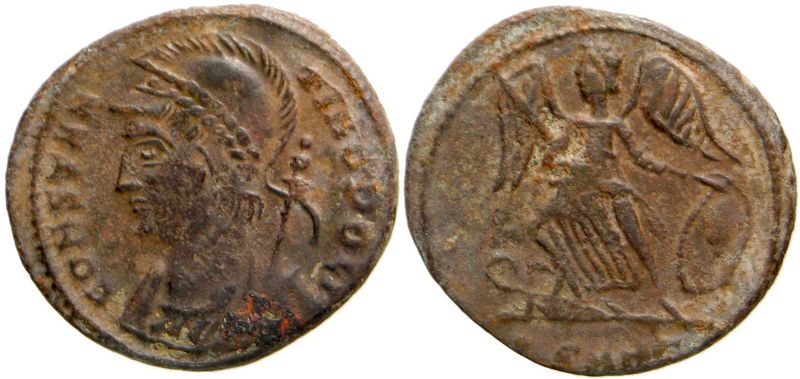
19x18 mm 2.7gm Obv. CONSTAN-TINOPOLI laureate, helmeted, wearing imperial mantle, holding scepter. Rev. Victory stg. l., on prow with spear, shield. in ex. •SMHΓ RIC VII Heraclea 120 |
 |
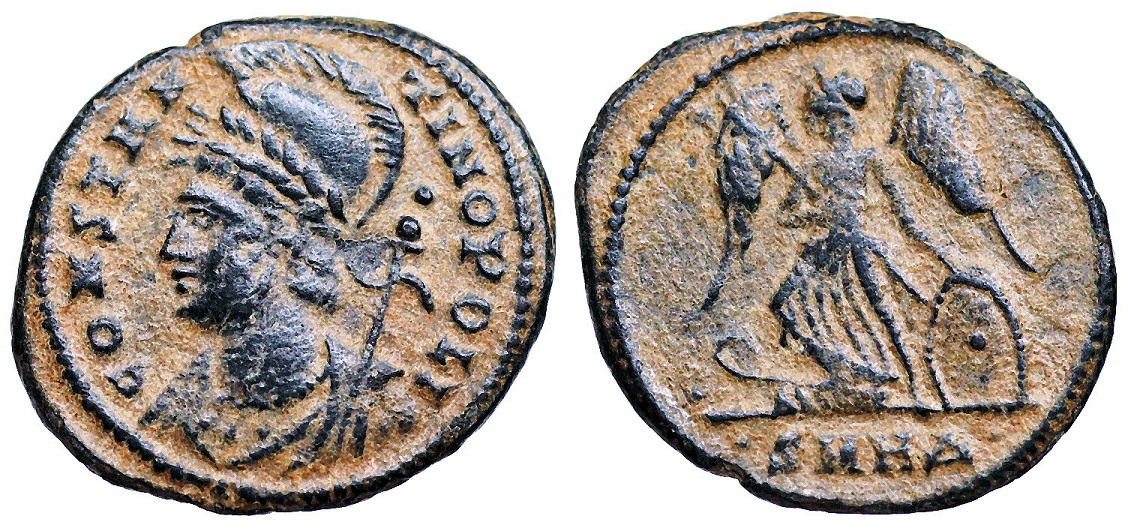
| A.D. 330-3 17x19mm 2.4gm Obv. CONSTAN-TINOPOLI laureate, helmeted, wearing imperial mantle, holding scepter. Rev. Victory stg. l., on prow with spear, shield. In ex. •SMHΔ• RIC VII Heraclea 125 |
 |
|
|
|
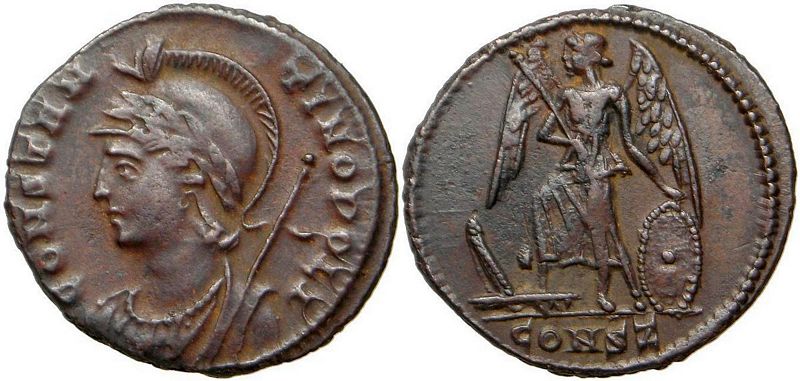
19x18 mm 2.5g Obv. CONSTAN-TINOPOLI laureate, helmeted, wearing imperial mantle, holding scepter. Rev. Victory stg. on prow, holding long scepter in r. hand, and resting l. hand on shield. CONSZ in exergue RIC VII Constantinople 63 |
 |
|
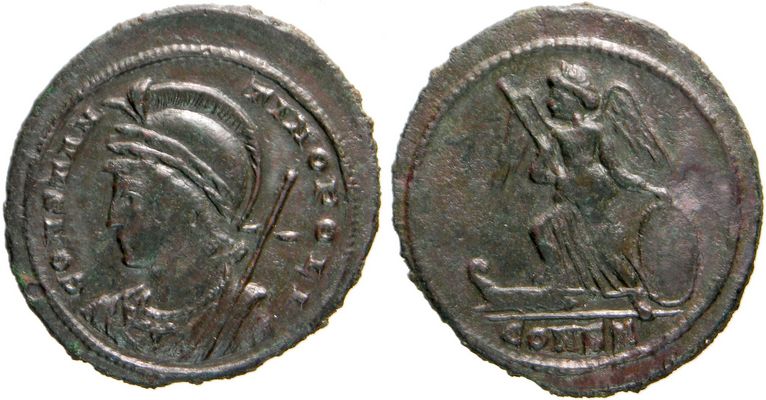
20 mm 2.6g Obv. CONSTAN-TINOPOLI laureate, helmeted, wearing imperial mantle, holding scepter. Rev. Victory stg. on prow, holding long scepter in r. hand, and resting l. hand on shield. CONSZ in exergue RIC VII Constantinople 63 |
 |
|
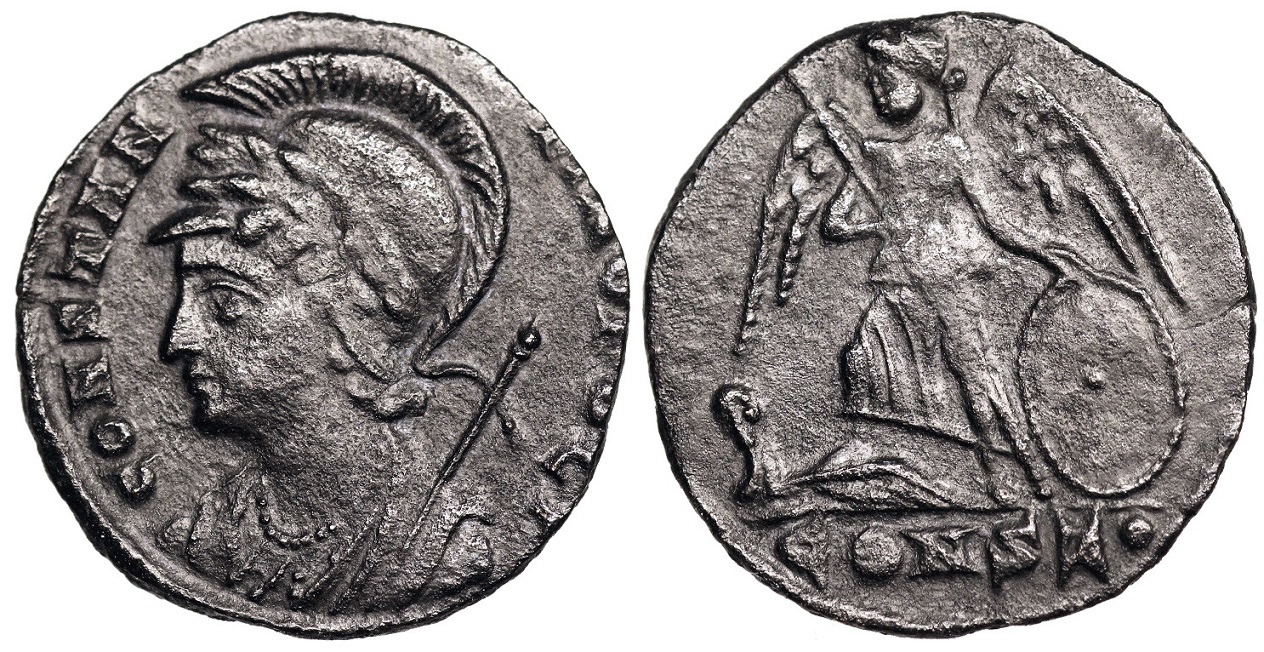
| A.D. 333-335 17mm 1.6g Obv. CONSTAN-TINOPOLI; laureate, helmeted bust of Constantinopolis, wearing imperial mantle, holding scepter. Rev. Victory stg. on prow, holding long scepter in r. hand, and resting l. hand on shield. in ex. CONSZ • RIC VII Constantinople 79 |
 |
|
Nicomedia
|
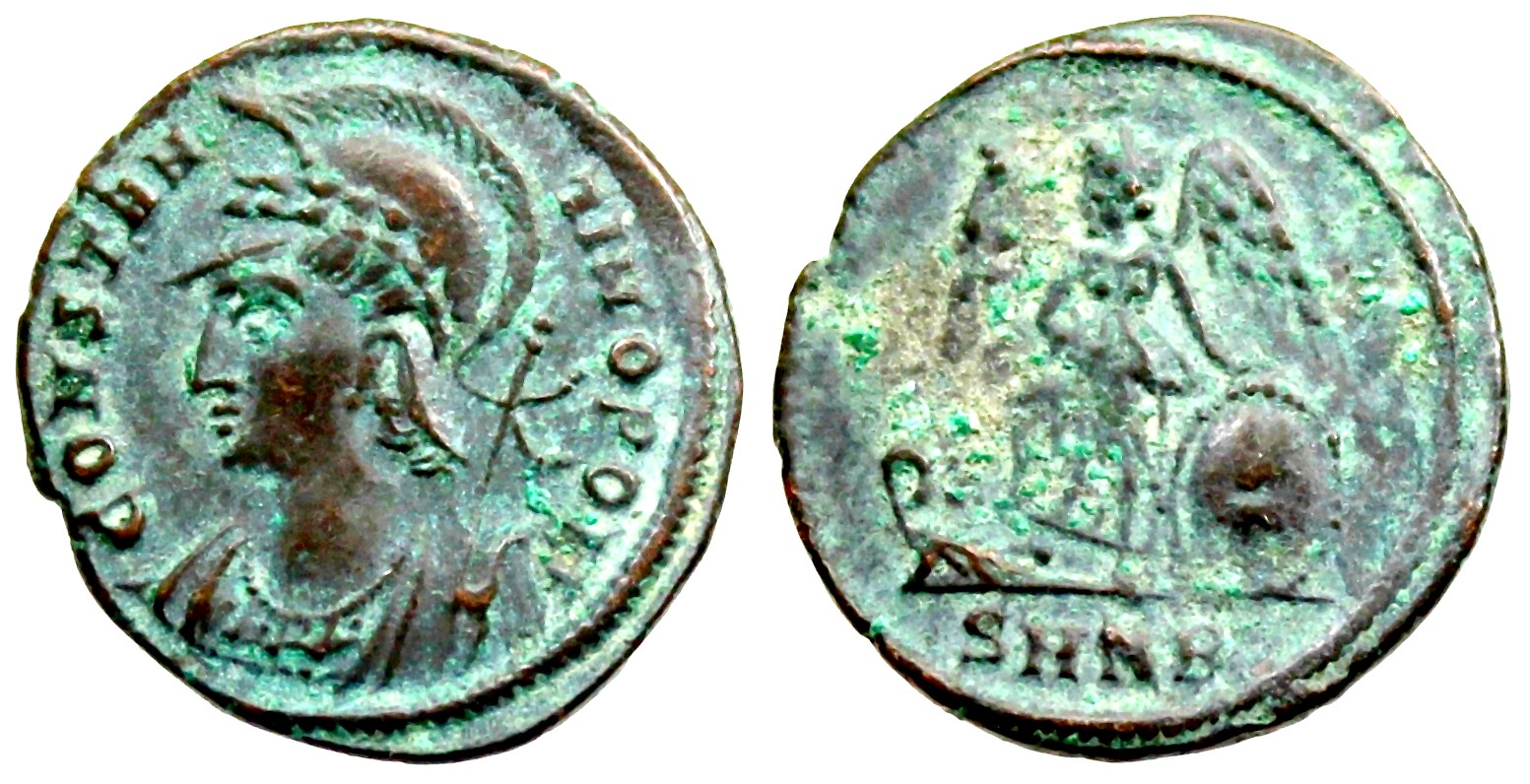
A.D. 330- 335 18mm
2.0gm CONSTAN-TINOPOLI; laureate, helmeted,
wearing imperial mantle, holding scepter. Rev. Victory stg. on prow, holding long
scepter in r. hand, and resting l. hand on shield. in ex. SMNB RIC VII Nicomedia 196 |
 |
|
|
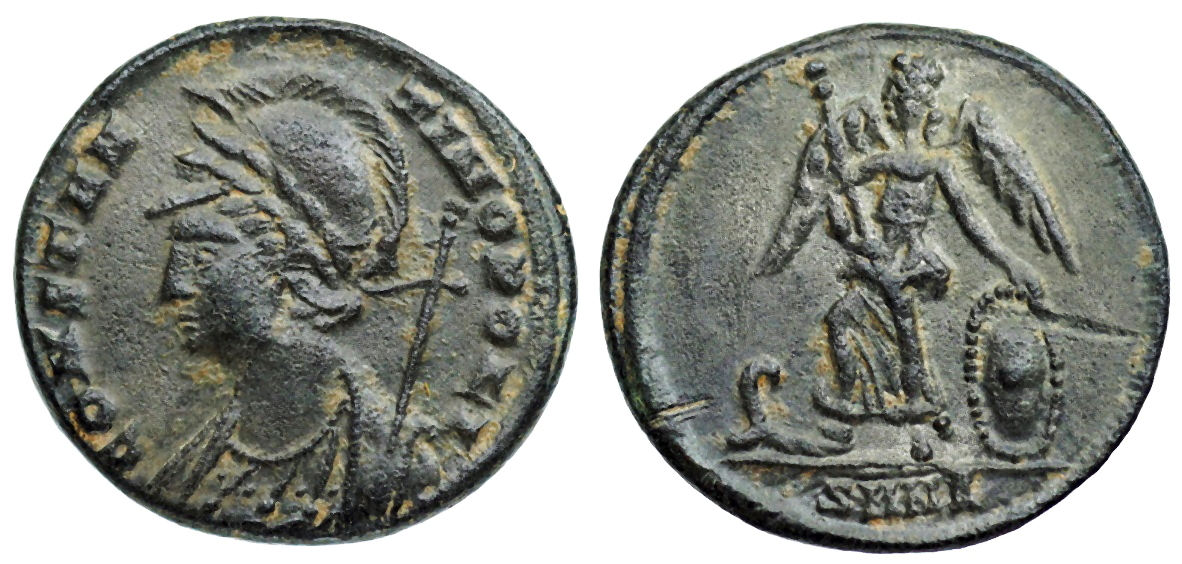
20x19mm 2.6gm Obv. CONSTAN-TINOPOLI laureate, helmeted, wearing imperial mantle, holding cross- scepter with a globe. Rev. Victory stg. l., on prow with spear, shield. SMNdelta RIC VII Nicomedia 196 r1 |
 |
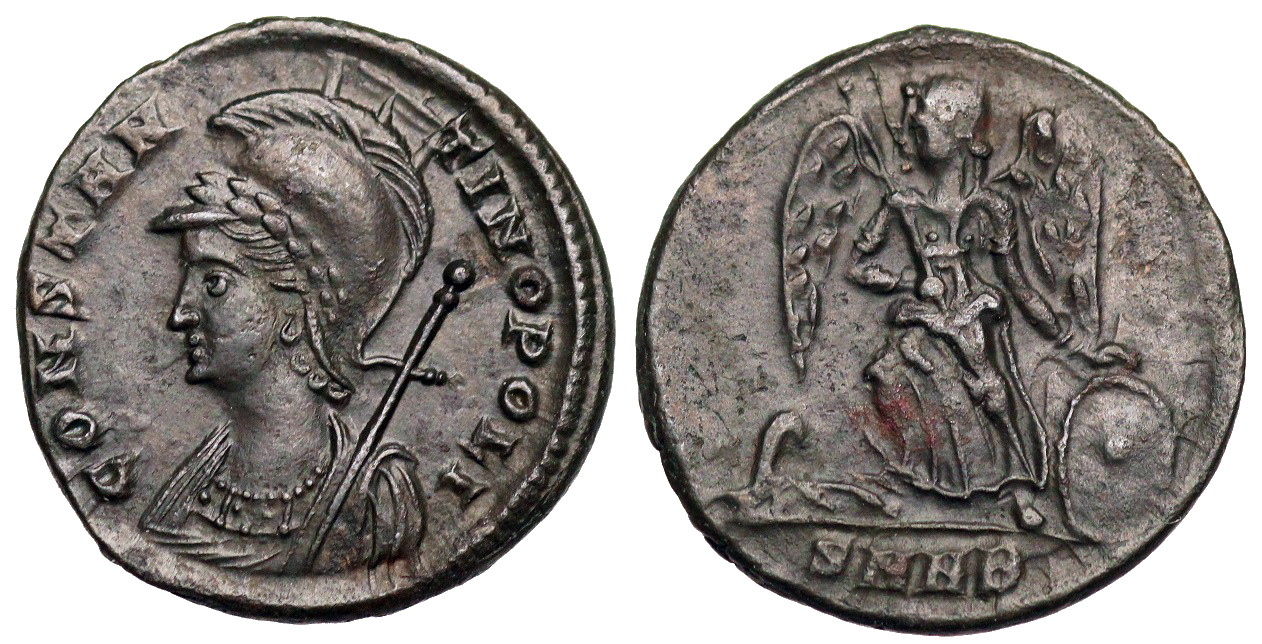
| A.D. 330- 335 18mm 2.6g CONSTAN-TINOPOLI; laureate, helmeted, wearing imperial mantle, holding scepter. Rev. Victory stg. on prow, holding long scepter in r. hand, and resting l. hand on shield. in ex. SMNB RIC VII Nicomedia 196 unusual double-striking |
 |
|
Cyzicus
|
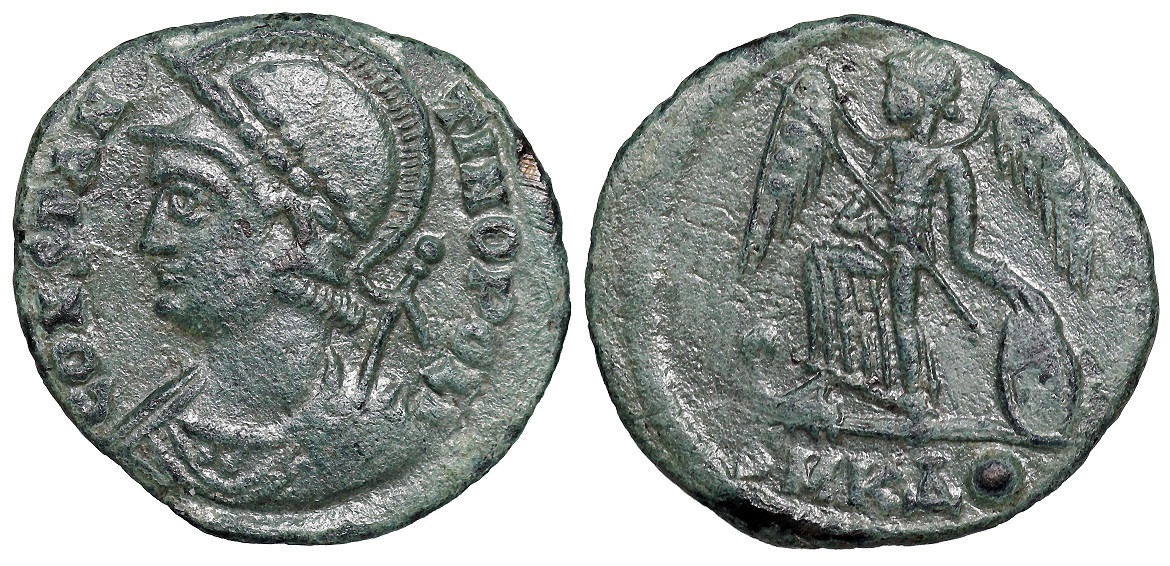
A.D. 330/
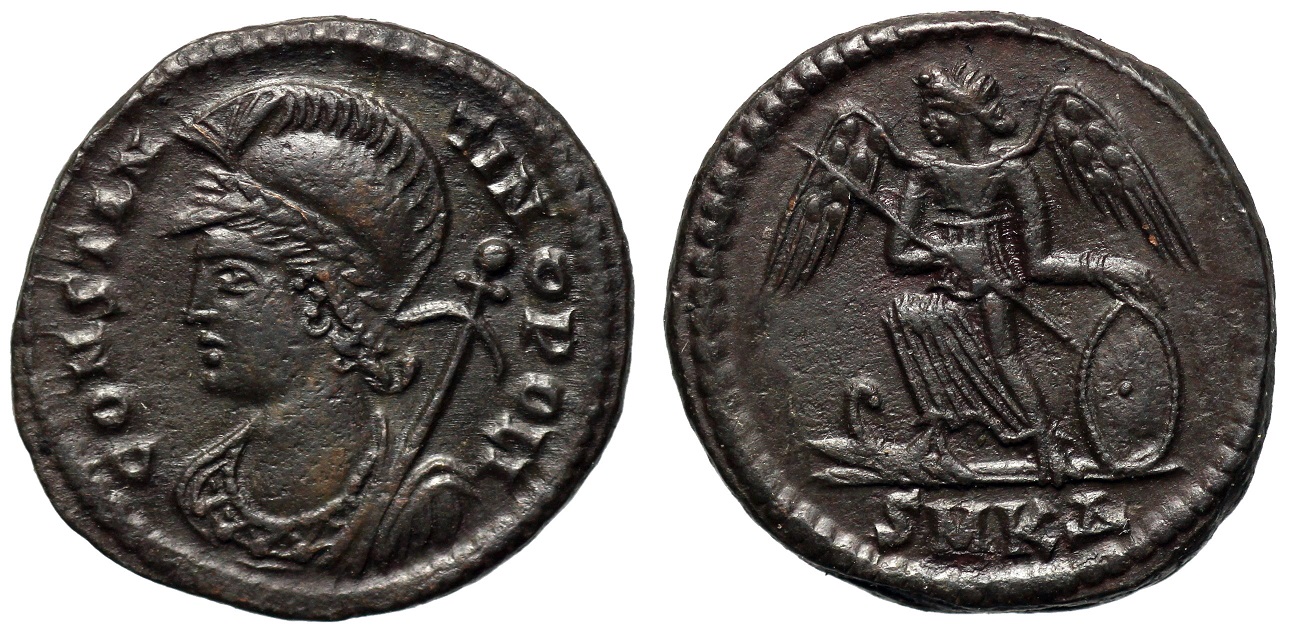
334 17x18mm 1.7gm Obv. CONSTAN-TINOPOLI laureate, helmeted, wearing imperial mantle, holding scepter. Rev. Victory stg. l., on prow with spear, shield. In ex. SMKΔ• (note the unusual shape of the dot) RIC VII Cyzicus 73 |
 |
|
A.D.
330-3 17x18mm 2.5gm Obv.
CONSTAN-TINOPOLI laureate, helmeted, wearing
imperial mantle, holding scepter. Rev.
Victory stg. l., on prow with spear, shield. In
ex. SMKΔ RIC VII Cyzicus 92 |
 |
|
|
A.D.
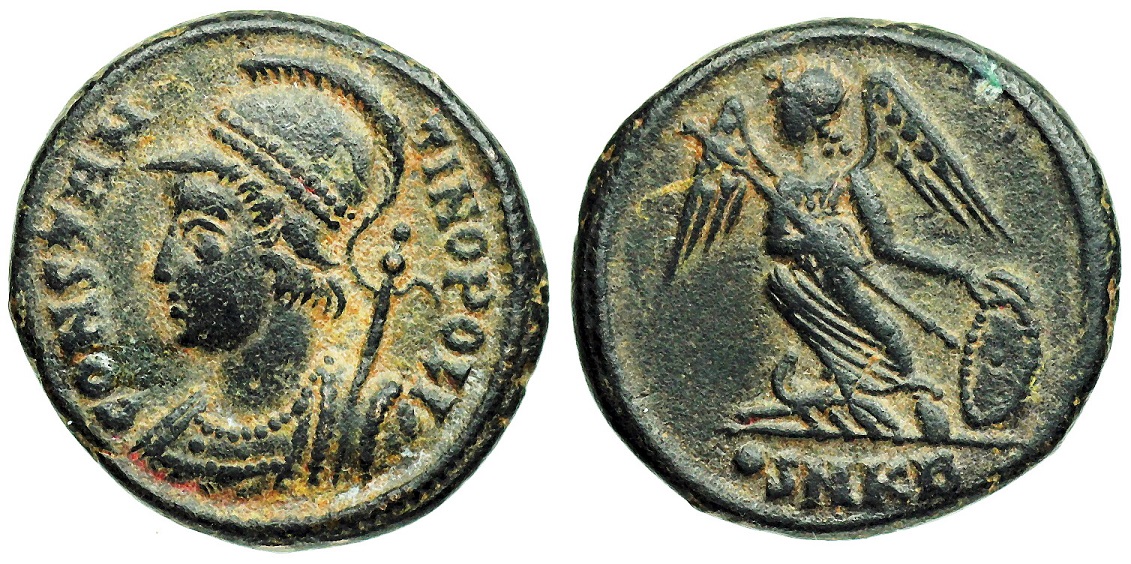
332- 333 17x18mm 3.0gm Obv.
CONSTAN-TINOPOLI; laureate (resembles pearls),
helmeted, wearing imperial mantle, holding scepter. Rev.
Victory stg. l., on prow with spear, shield. In
ex. •SMKB RIC
VII Cyzicus 108 |
 |
|
Antioch
|
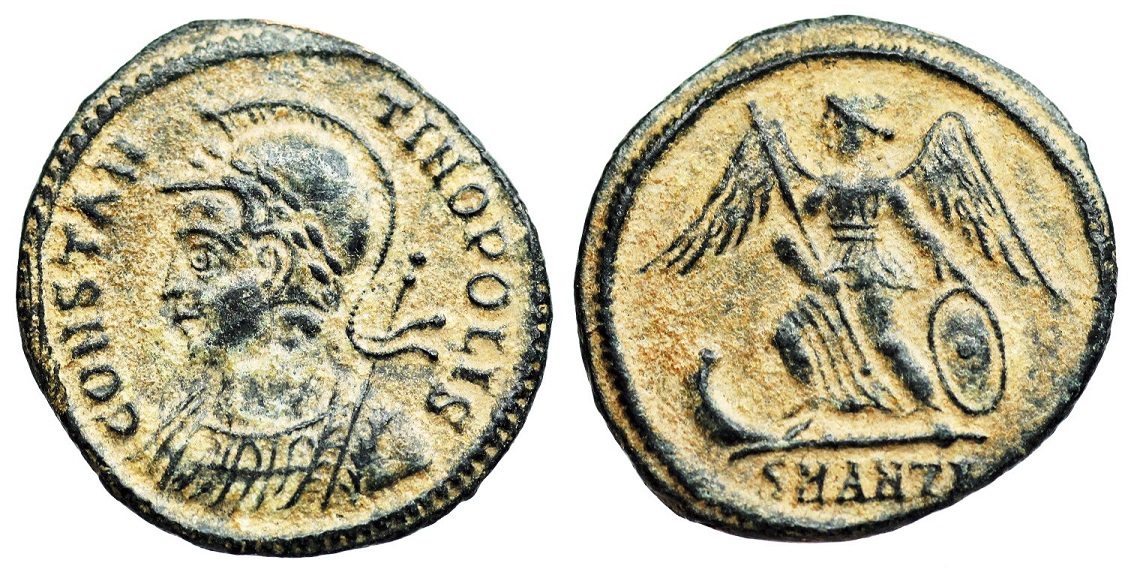
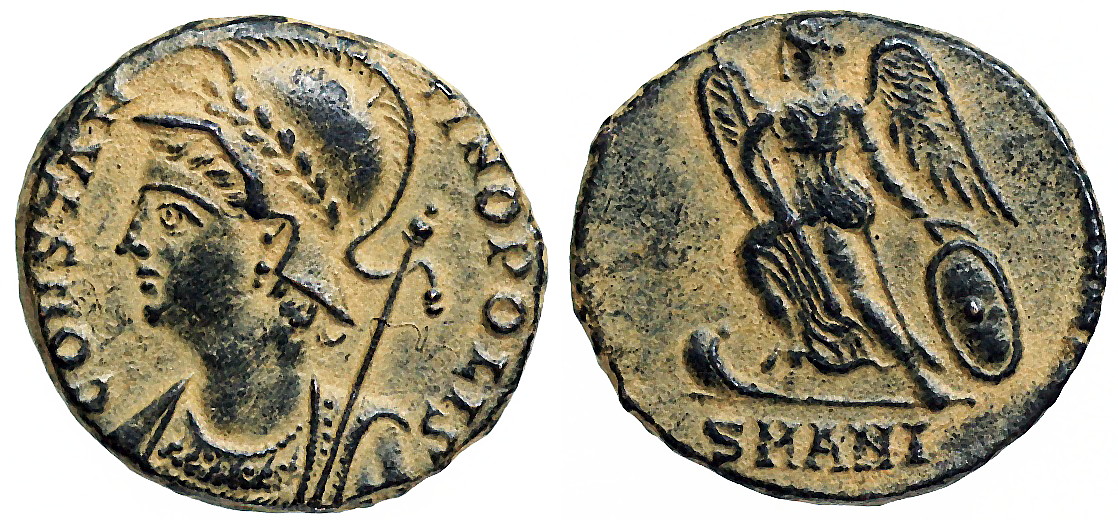
A.D. 335 18x19mm 2.4gm Obv. CONSTAN-TINOPOLIS laureate, helmeted, wearing imperial mantle, holding scepter. Rev. Victory stg. l., on prow with spear, shield. in ex. SMANTI RIC VII Antioch – RIC only lists the mintmark SMANI for the Constantinopolis issue, but does have SMANTA for a Constantine I GLORIA EXERCITVS issue (RIC 85) and this coin should come after it. |
 |
|
|
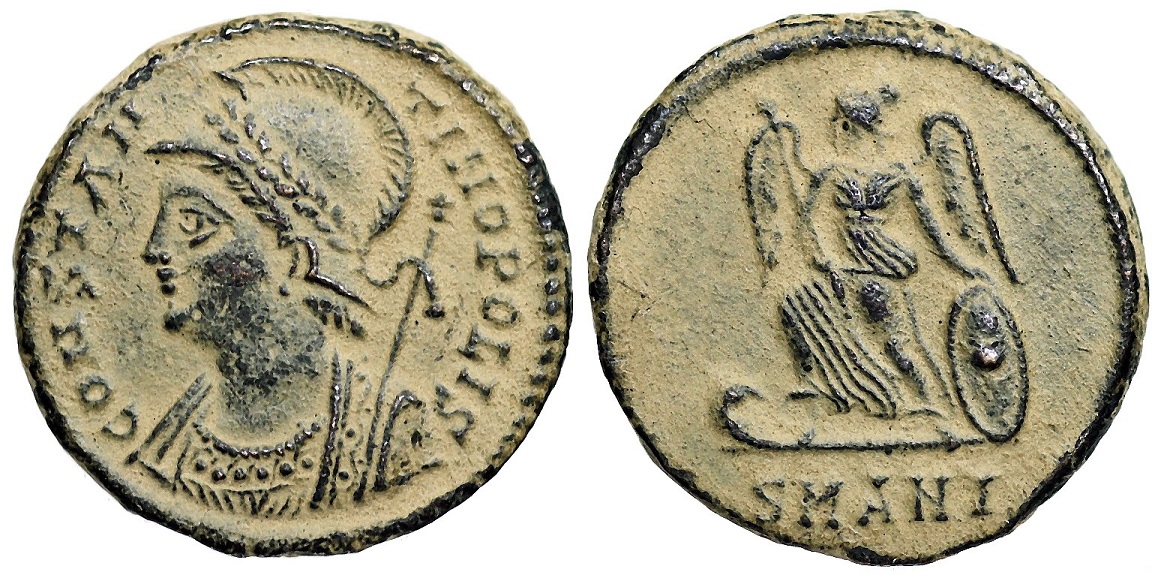
17x18mm 3.0gm Obv. CONSTAN-TINOPOLIS laureate, helmeted, wearing imperial mantle, holding scepter. Rev. Victory stg. l., on prow with spear, shield. in ex. SMANI RIC VII Antioch 92 |
 |
| A.D. 335-7 15x17mm 2.3gm Obv. CONSTAN-TINOPOLIS laureate, helmeted, wearing imperial mantle, holding scepter. Rev. Victory stg. l., on prow with spear, shield. in ex. SMANI RIC VII Antioch 114 |
 |
|
|
|
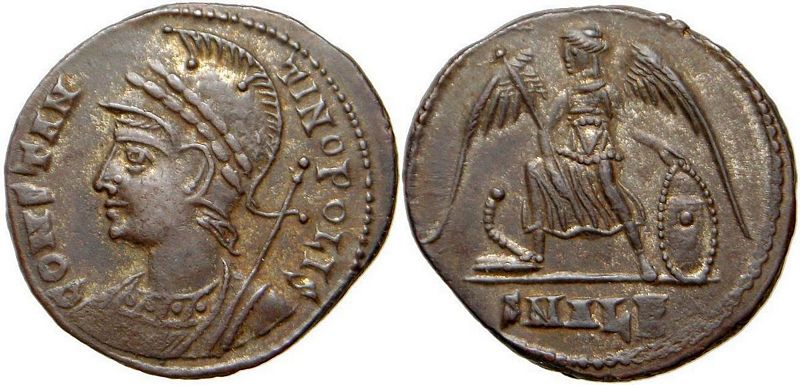
19x17mm 2.7g Obv. CONSTAN-TINOPOLIS laureate, helmeted, wearing imperial mantle, holding scepter. Rev. Victory stg. on prow, holding long scepter in r. hand, and resting l. hand on shield. SMALB in exergue RIC VII Alexandria 64 r1 picture from Beastcoins |
 |
|
A.D. 333-335 17x18mm
2.3g Obv. CONSTAN-TINOPOLIS laureate,
helmeted, wearing imperial mantle, holding scepter. Rev. Victory stg. on prow, holding long
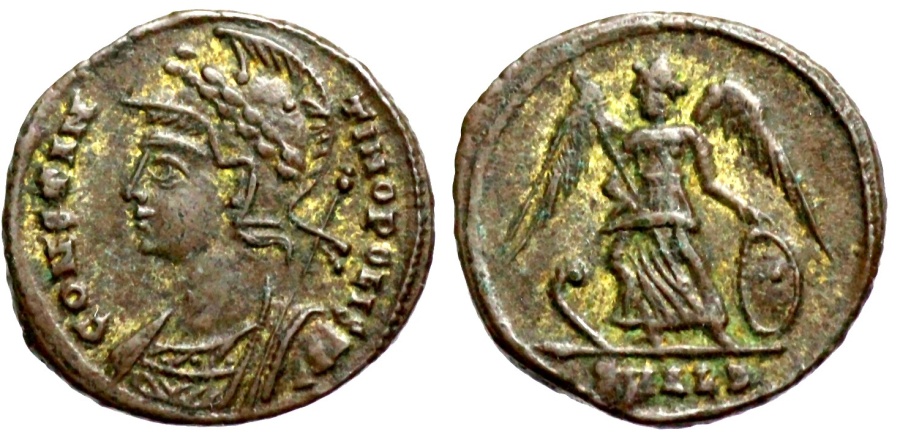
scepter in r. hand, and resting l. hand on shield. In ex. SMALB RIC VII Alexandria 64 |
 |
VRBS ROMA
Lyons
|
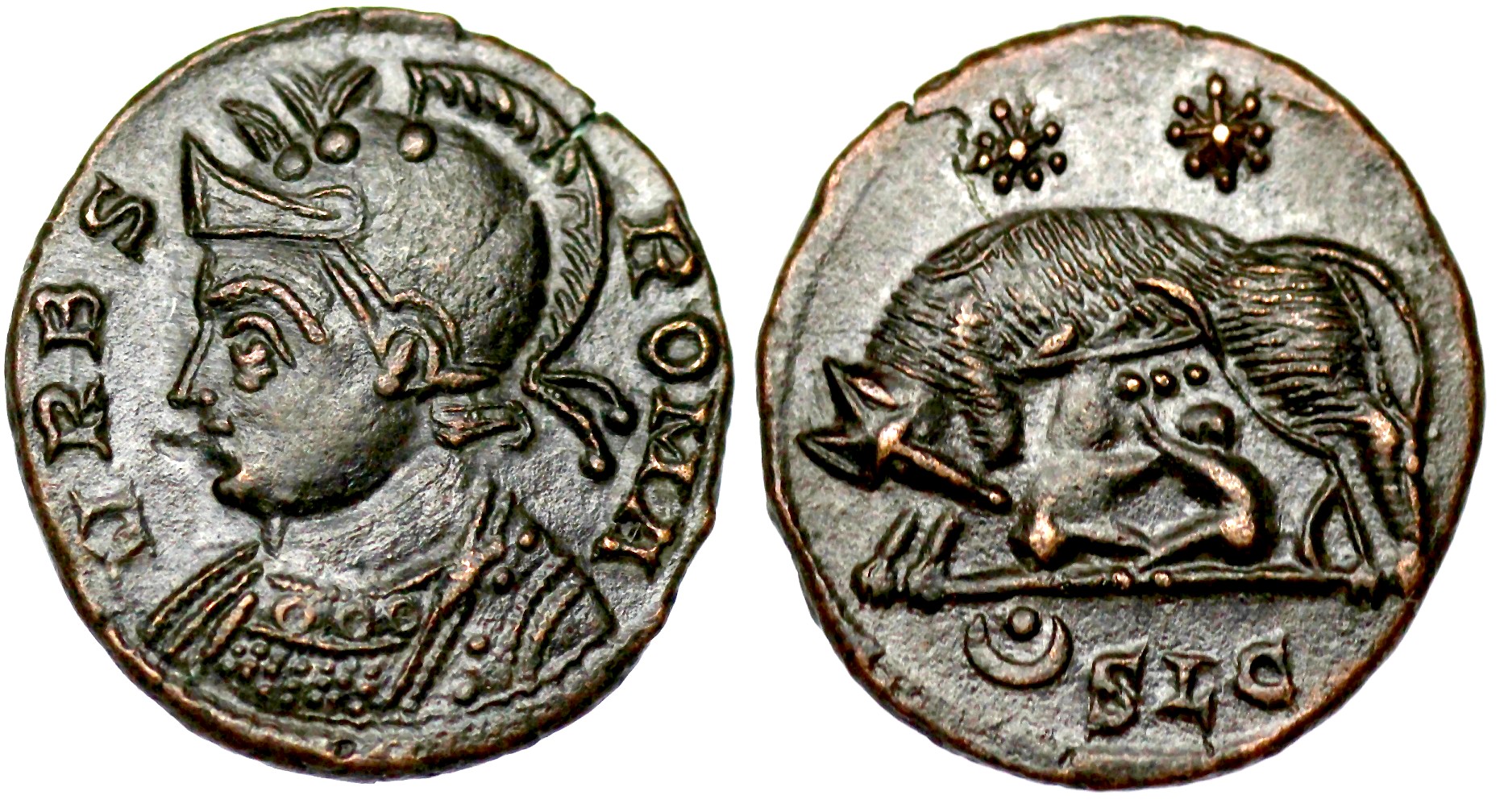
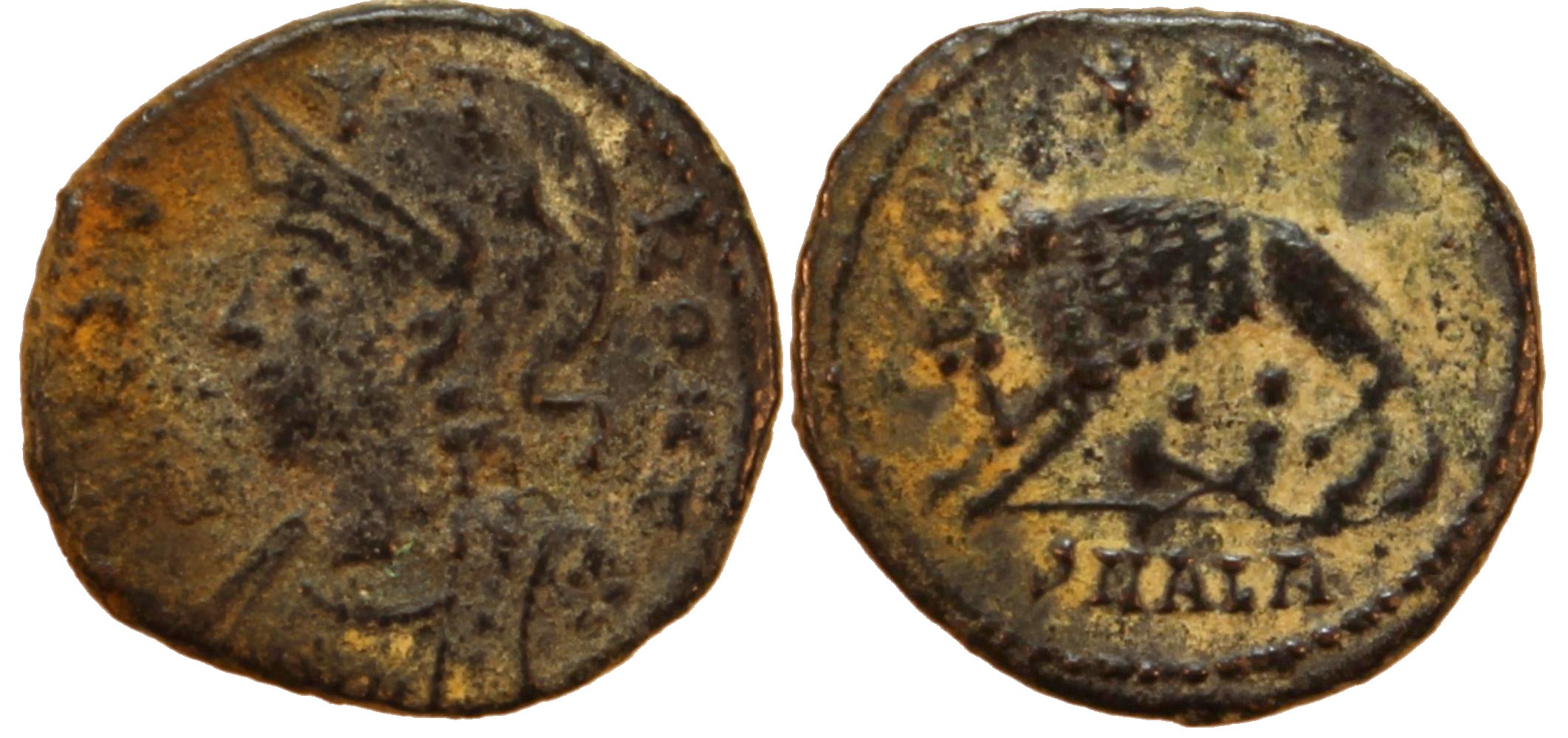
VRBS ROMA A.D. 330- 331 Ӕ nummus 16x17mm 2.0g VRBS ROMA; Roma, helmeted, wearing imperial cloak. REV.; She-wolf left suckling twins (Romulus and Remus); above, two stars. In ex. SLG RIC VII Lyon 242 Note the circular design on the shoulder |
 |
|
|
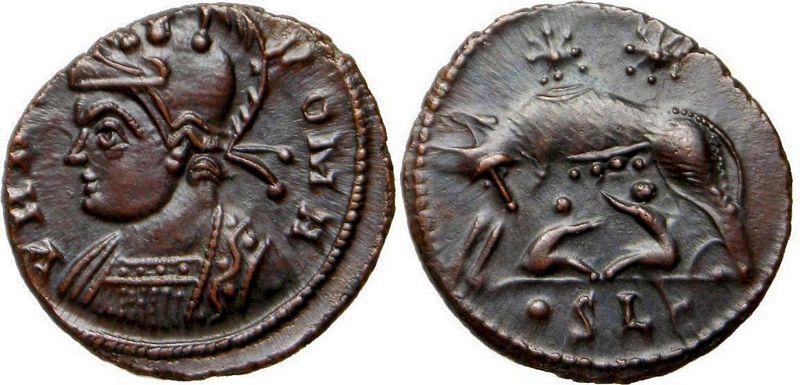
16mm 1.9gm Obv. VRBS-ROMA [City of Rome] Roma, helmeted, wearing imperial cloak. Rev. She-wolf left suckling twins (Romulus and Remus); above, two stars. dot SLG RIC VII Lugdunum (Lyons) 247 r3 from the Nether Compton hoard |
 |
|
A.D. 332 16x17mm
2.3gm VRBS-ROMA; Roma, helmeted, wearing
imperial cloak. Rev. She-wolf left suckling twins
(Romulus and Remus); above, two stars. In ex. dot in crescent SLG RIC VII Lyons 257 |
 |
|
Trier
|
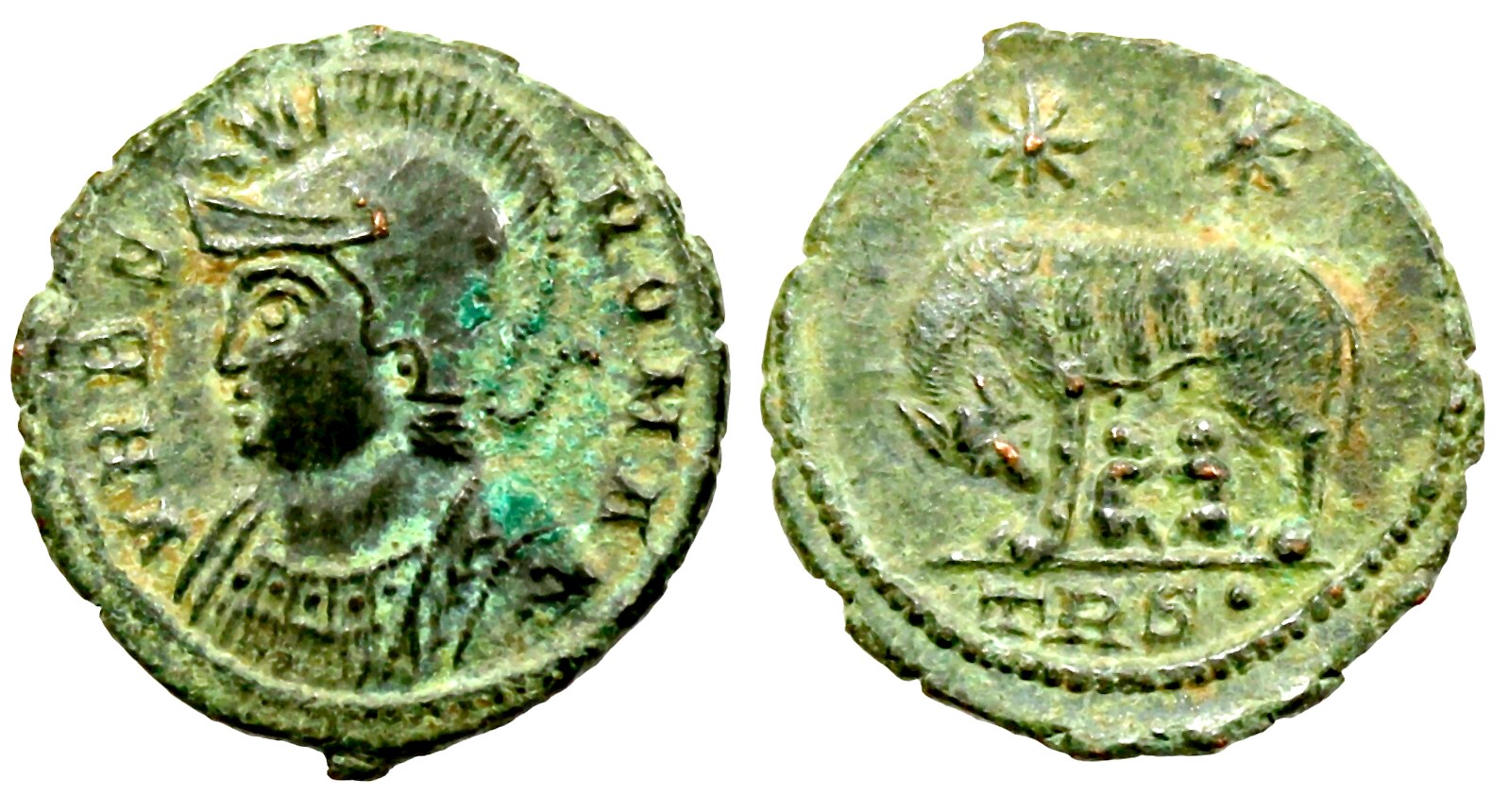
A.D. 330-1 17x18mm
2.5gm VRBS-ROMA; [City of Rome] Roma,
helmeted, wearing imperial cloak. Rev. She-wolf with florette on shoulder
left with twins (Romulus and Remus); above, two stars. In ex. TRS dot RIC VII Trier 529 |
 |
|
|
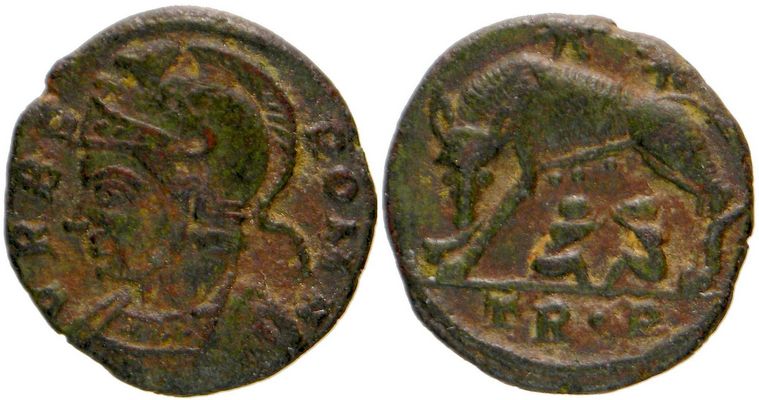
15mm 1.4gm Obv. VRBS-ROMA [City of Rome] Roma, helmeted, wearing imperial cloak. Rev. She-wolf left with twins (Romulus and Remus); above, two stars. in ex. TR dot P RIC VII Trier 542 c3 from an old Dutch collection—ticket says a gift from Mr. Elberling December 1864. |
 |
|
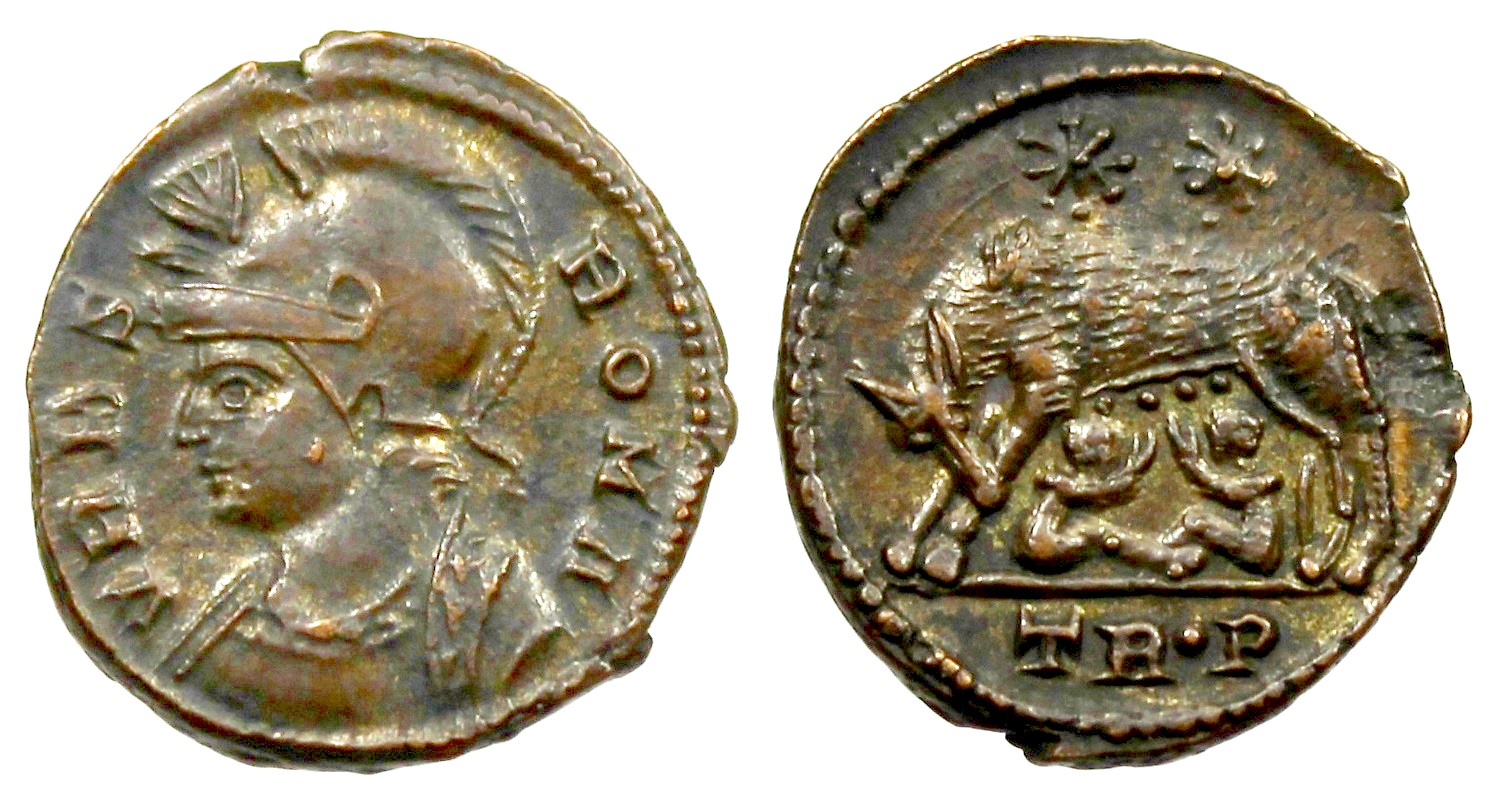
A.D. 332- 333 16x17mm
2.0gm Obv. VRBS-ROMA [City of Rome] Roma,
helmeted, wearing imperial cloak. Rev. She-wolf left with twins (Romulus
and Remus); above, two stars. In ex. TR dot P RIC VII Trier 542 |
 |
|
|
A.D. 332- 333 16mm
2.3gm Obv. VRBS-ROMA [City of Rome] Roma,
helmeted, wearing imperial cloak. Rev. She-wolf left with twins (Romulus
and Remus); above, two stars. In ex. TR dot P RIC VII Trier 542 |
 |
|
|
A.D. 332- 333 16mm
2.4gm Obv. VRBS-ROMA [City of Rome] Roma,
helmeted, wearing imperial cloak. Rev. She-wolf, double crescent
shoulder, left with twins (Romulus and Remus); above,
two stars. In ex. TRS star RIC VII Trier 547 |
 |
|
|
A.D. 332- 333 17x18mm
2.4gm Obv. VRBS-ROMA [City of Rome] Roma,
helmeted, wearing imperial cloak. Rev. She-wolf left with twins (Romulus
and Remus); above, two stars. In ex. TRP star RIC VII Trier 547 |
 |
|
|
A.D. 333- 334 17mm
2.3gm Obv. VRBS-ROMA [City of Rome] Roma,
helmeted, wearing imperial cloak. Rev. She-wolf left with twins (Romulus
and Remus); above, two stars. In ex. TRS, wreath between stars. RIC VII Trier 553 |
 |
|
|
18.5mm 2.3 gm Obv. VRBS-ROMA [City of Rome] Roma, helmeted, wearing imperial cloak and looking up to the heavens. Rev. She-wolf left with twins (Romulus and Remus); above, two stars with a wreath between them. In exergue TRP Similar to RIC VII Trier 553 Unlisted with eyes to heaven bust |
 |
|
|
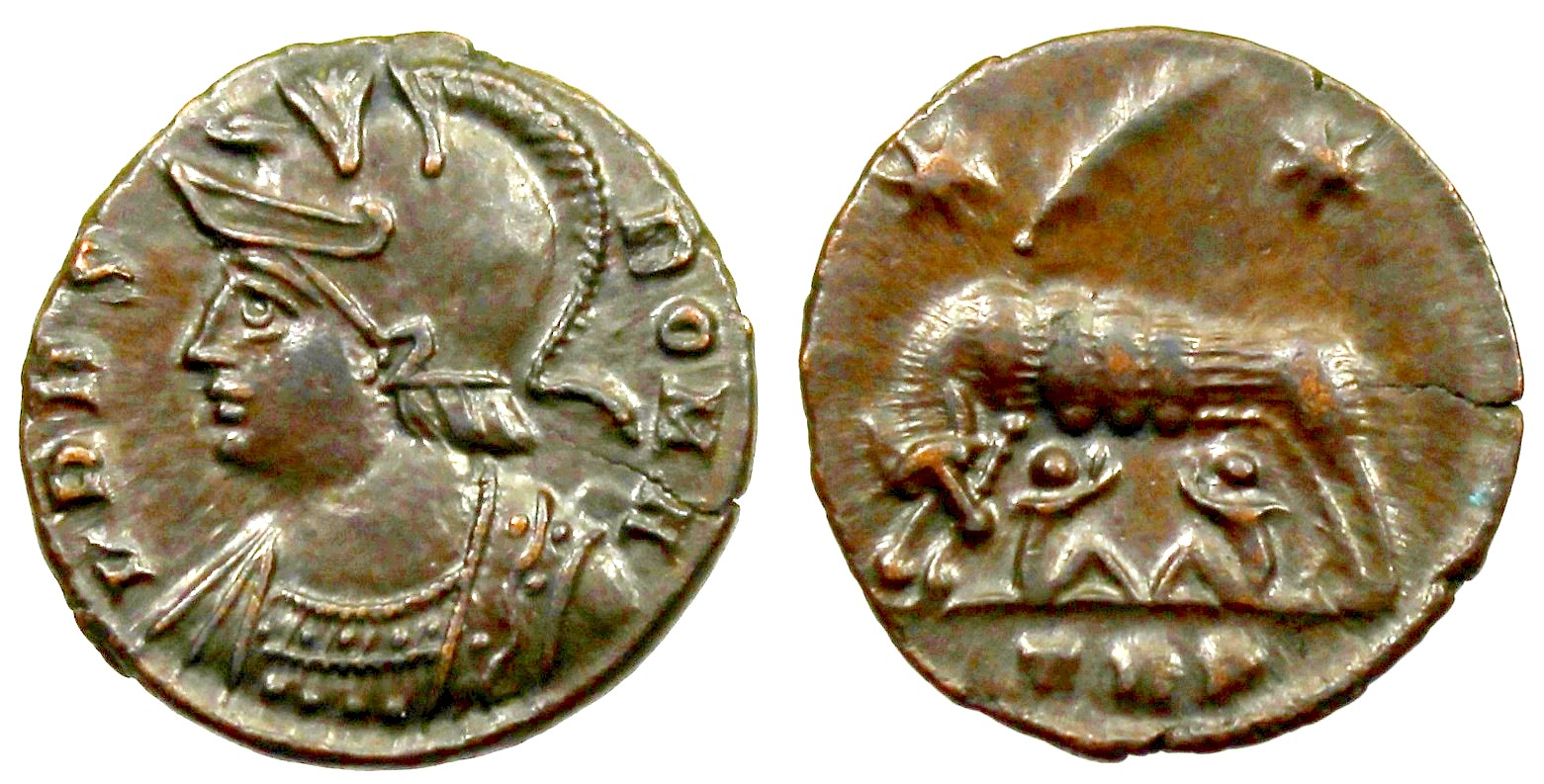
A.D. 333- 334 17mm
1.9gm Obv. VRBS-ROMA [City of Rome] Roma,
helmeted, wearing imperial cloak. Rev. She-wolf left with twins (Romulus
and Remus); above, two stars. In ex. TRP, palm branch between stars. RIC VII Trier 561 |
 |
|
|
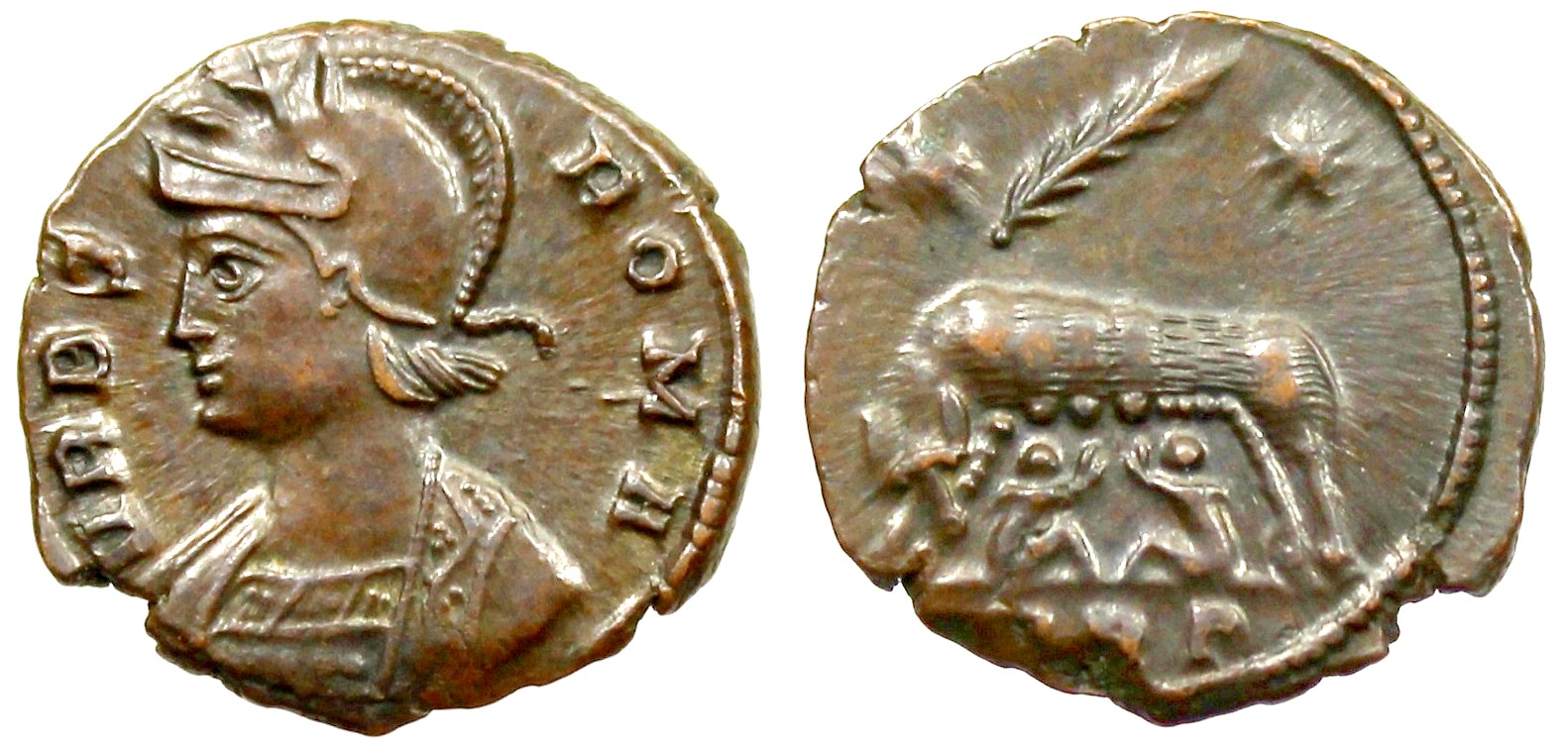
A.D. 333- 334 17mm
2.3gm Obv. VRBS-ROMA [City of Rome] Roma,
helmeted, wearing imperial cloak. Rev. She-wolf left with twins (Romulus
and Remus); above, two stars. In ex. TRP, palm branch between stars. RIC VII Trier 561 |
 |
|
|
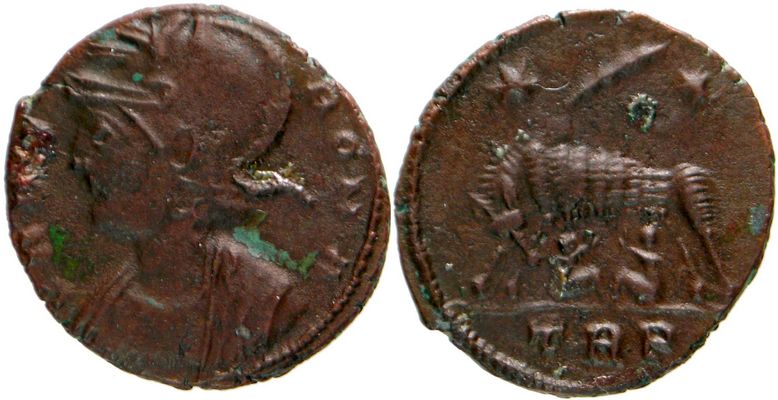
Obv. VRBS-ROMA [City of Rome] Roma, helmeted, wearing imperial cloak. Rev. She-wolf left with twins (Romulus and Remus); above, two stars. laurel branch in center; in ex. TRP RIC VII Trier 561 c3 This coin is from the 'monneron' hoard |
 |
|
Arles
|
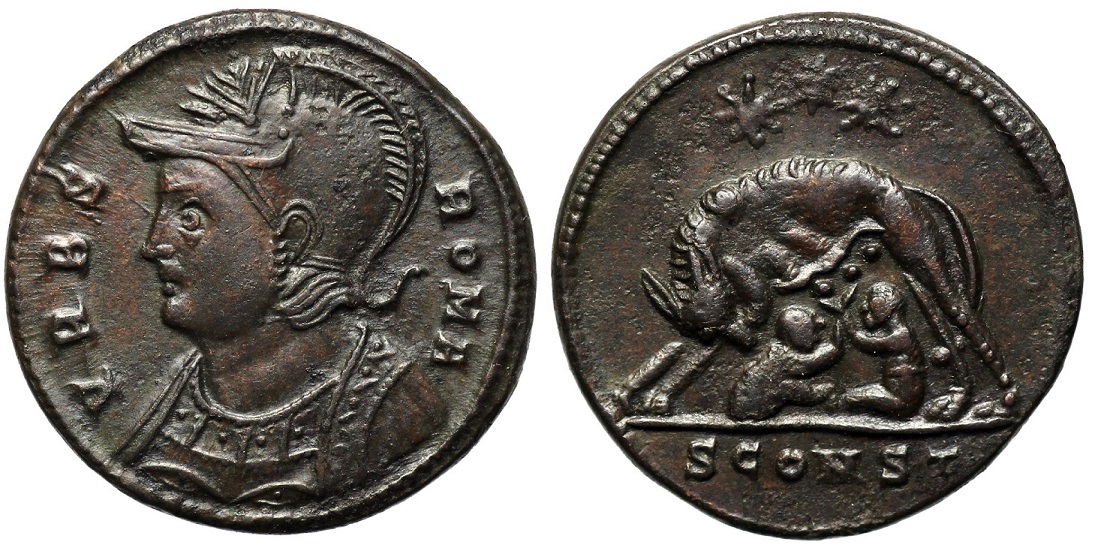
A.D.
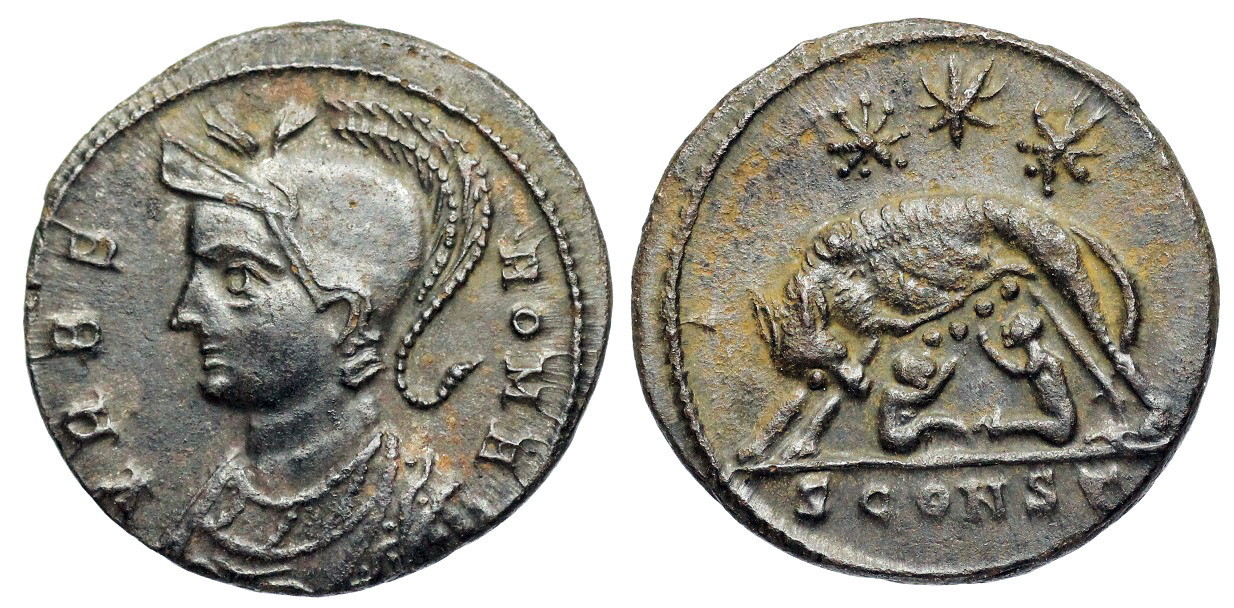
330- 331 17x18mm 2.6gm Obv.
VRBS-ROMA [City of Rome] Roma, helmeted, wearing
imperial cloak. Rev.
She-wolf left with twins (Romulus and Remus); above,
two stars with ✶between them. In
ex. SCONST RIC
VII Arles -- ; Ferrando 957 |
 |
|
A.D.
330- 331 17x18mm 2.2gm Obv.
VRBS-ROMA [City of Rome] Roma, helmeted, wearing
imperial cloak. Rev.
She-wolf left with twins (Romulus and Remus); above,
two stars with ✶between
them. In
ex. SCONST RIC
VII Arles -- ; Ferrando 957 |
 |
|
|
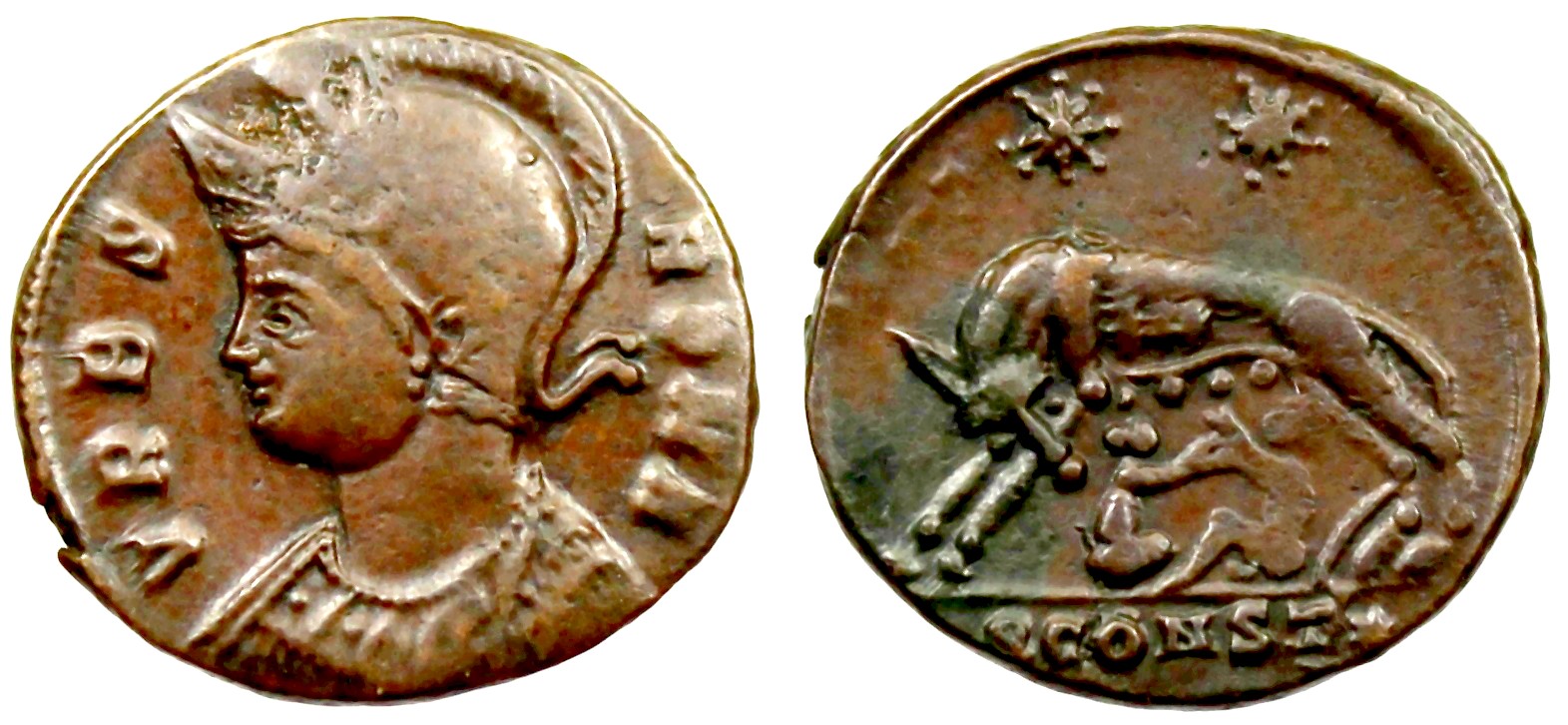
A.D. 330- 331 16mm
1.7gm Obv. VRBS-ROMA [City of Rome] Roma,
helmeted, wearing imperial cloak. Rev. She-wolf left with twins (Romulus
and Remus); above, two stars with Chi-Rho between
them. In exergue SCONST star RIC VII Arles 351 |
 |
|
|
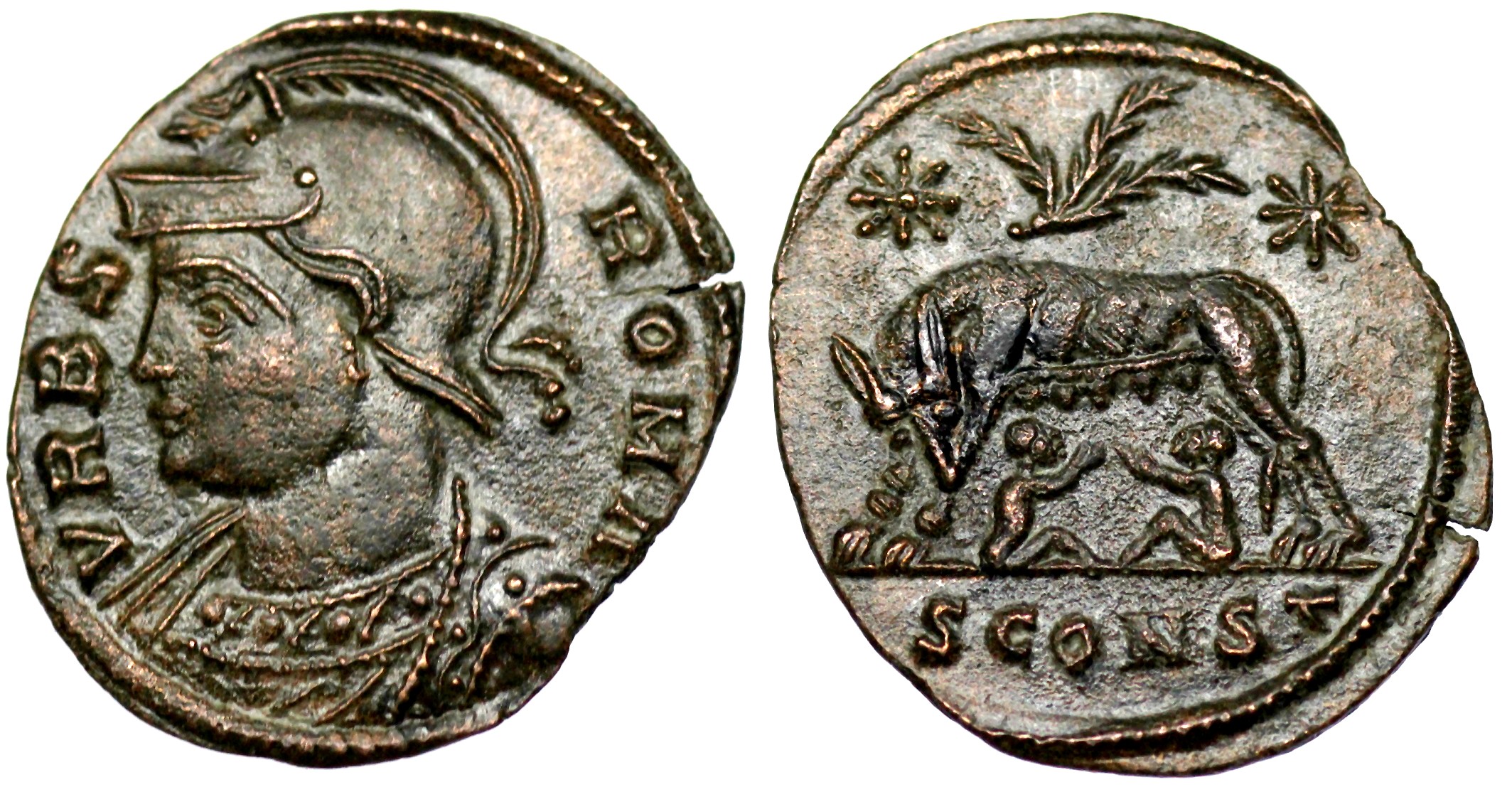
A.D. 332- 333 17x20mm
1.9gm VRBS-ROMA; Roma, helmeted, wearing
imperial cloak. REV: She-wolf left with twins (Romulus
and Remus); above, two stars with palm branch between. In ex. SCONST RIC VII Arles 368 |
 |
|
|
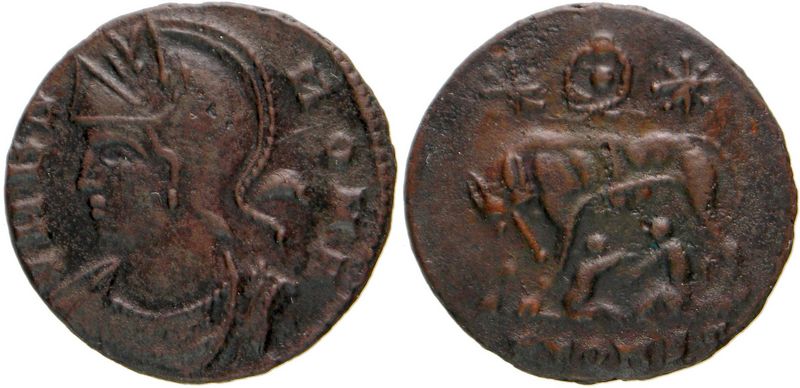
A.D. 333- 334 18x19mm
2.6gm Obv. VRBS-ROMA [City of Rome] Roma,
helmeted, wearing imperial cloak. Rev. She-wolf left with twins (Romulus
and Remus); above, two stars. In ex. (?)CONST, wreath with dot
between stars. RIC VII Arles 379 |
 |
|
|
|
Obv. VRBS-ROMA [City of Rome] Roma, helmeted, wearing imperial cloak. Rev. She-wolf left with twins (Romulus and Remus); above, two stars. wreath (with dot) in centre PCONST RIC VII Arles 379 r3 from the 'monneron' hoard |
 |
|
16mm 1.7gm Obv. VRBS-ROMA [City of Rome] Roma, helmeted, wearing imperial cloak. Rev. She-wolf left with twins (Romulus and Remus); above, two stars with Chi-Rho between them. PCONST RIC VII Arles 400 |
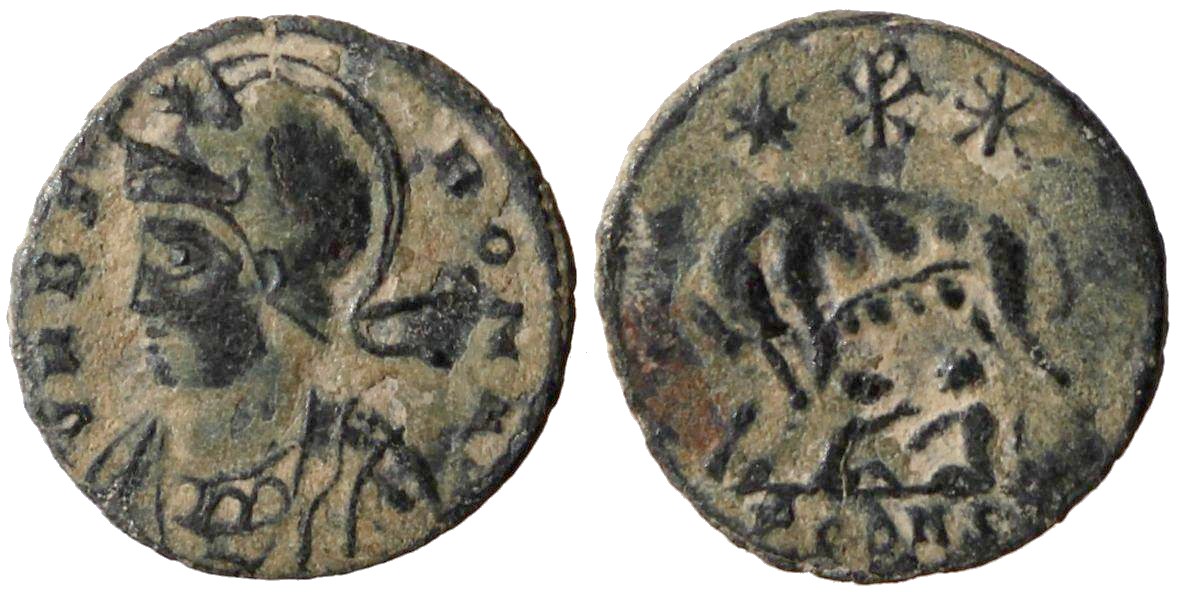 |
|
| VRBS ROMA A.D. 336 15x17mm 1.6g Obv. VRBS-ROMA [City of Rome] Roma, helmeted, wearing imperial cloak. Rev. She-wolf left with twins (Romulus and Remus); above, two stars [one on left more a Chi-Rho] with Chi-Rho between them. in ex. PCONST RIC VII Arles 400 |
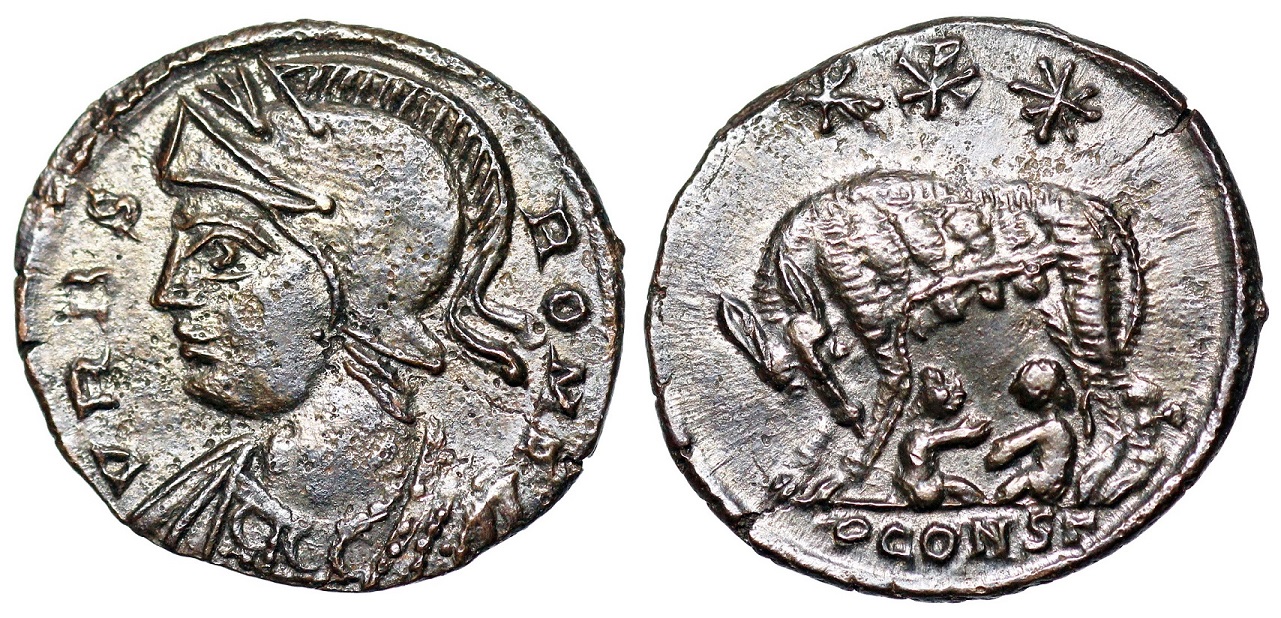 |
|
|
|
Obv. VRBS-ROMA [City of Rome] Roma, helmeted, wearing imperial cloak. Rev. She-wolf left with twins (Romulus and Remus); above, two stars. gamma SIS RIC VII Siscia 222 c3 |
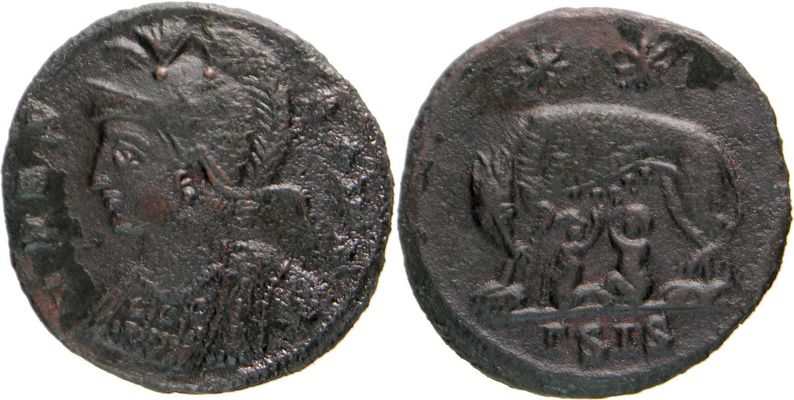 |
|
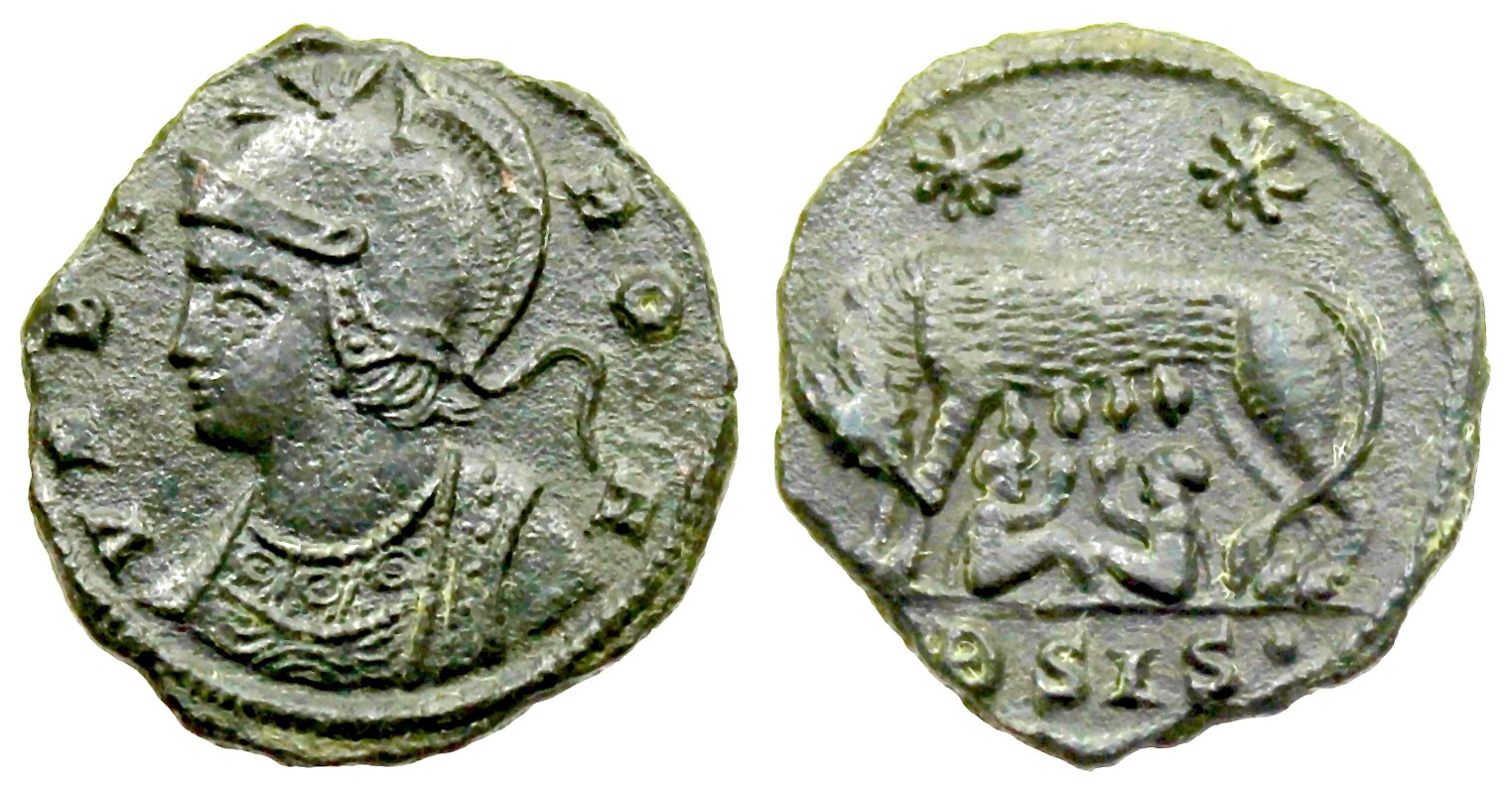
A.D. 330-3 18mm
2.6gm VRBS-ROMA [City of Rome] Roma,
helmeted, wearing imperial cloak. REV. She-wolf left with twins (Romulus
and Remus); above, two stars. In ex. dot ASIS dot RIC VII Siscia 240 |
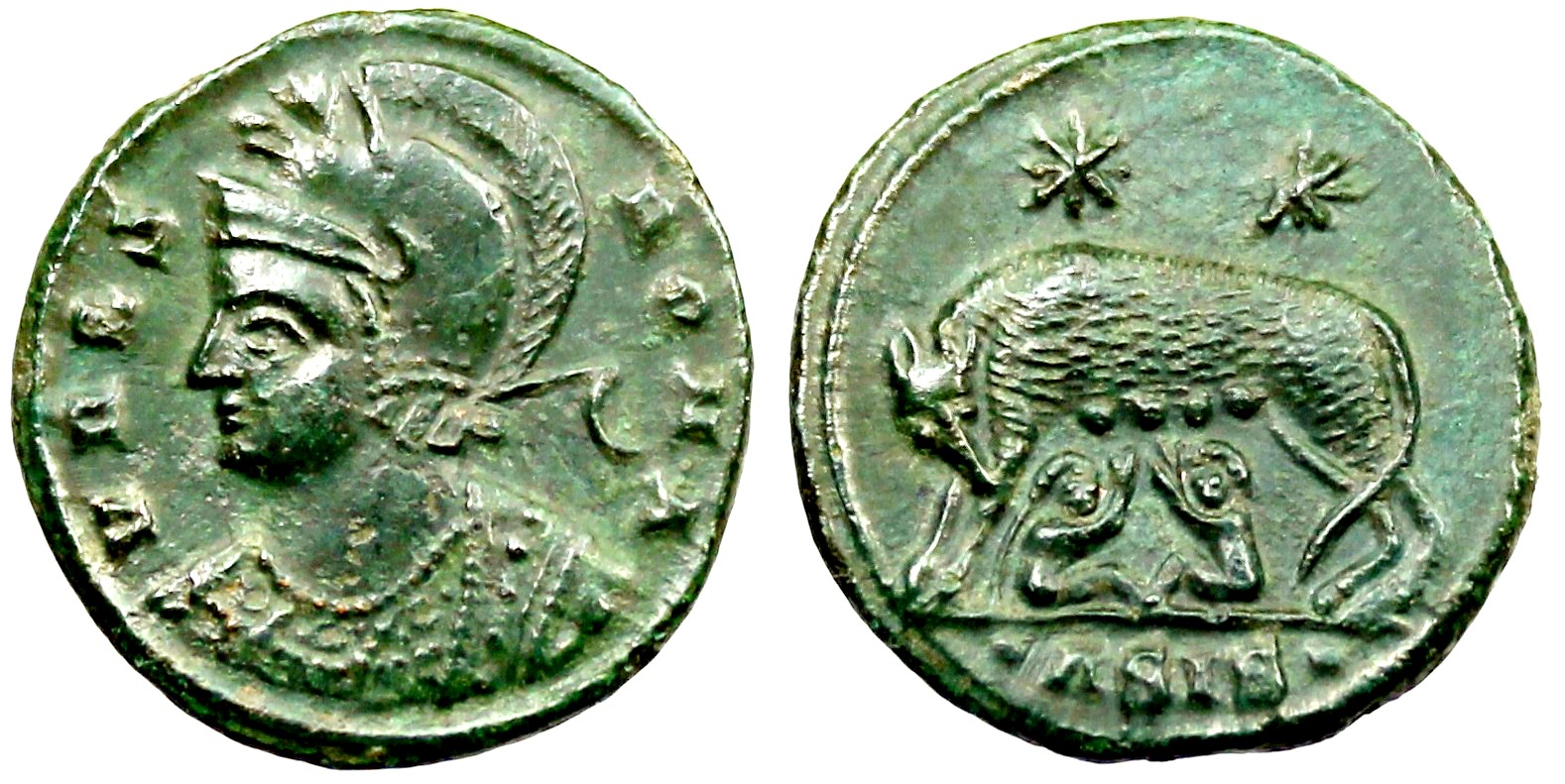 |
|
|
18mm
2.8gm Rev. She-wolf left with twins (Romulus and Remus); above, two stars. dot BSIS dot RIC VII Siscia 240 r4 |
 |
|
Thessalonica |
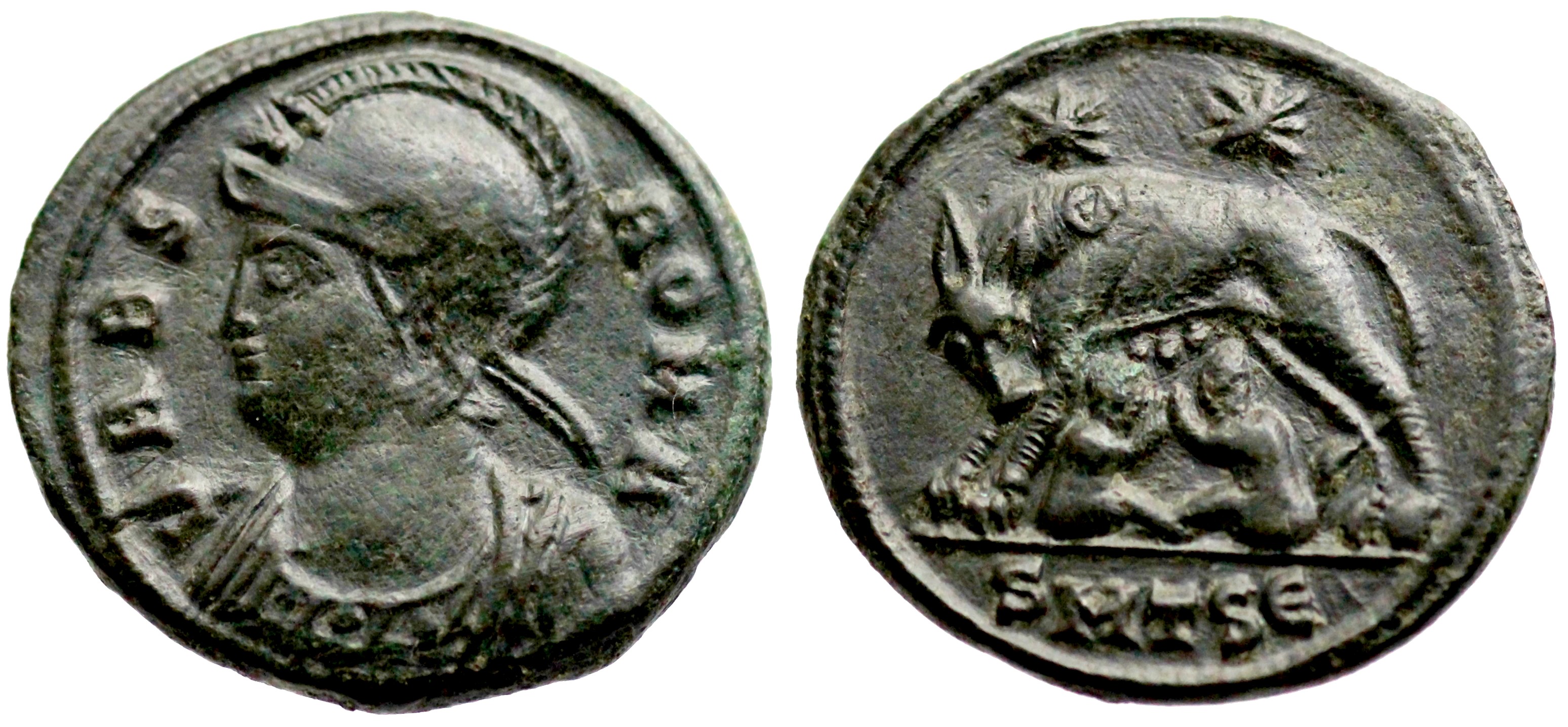
A.D. 330-3 18x19mm
3.0gm VRBS-ROMA [City of Rome] Roma,
helmeted, wearing imperial cloak. REV. She-wolf with circle on shoulder
standing left with twins (Romulus and Remus); above,
two stars. In ex. SMTSE RIC VII Thessalonica 187 |
 |
Heraclea
|
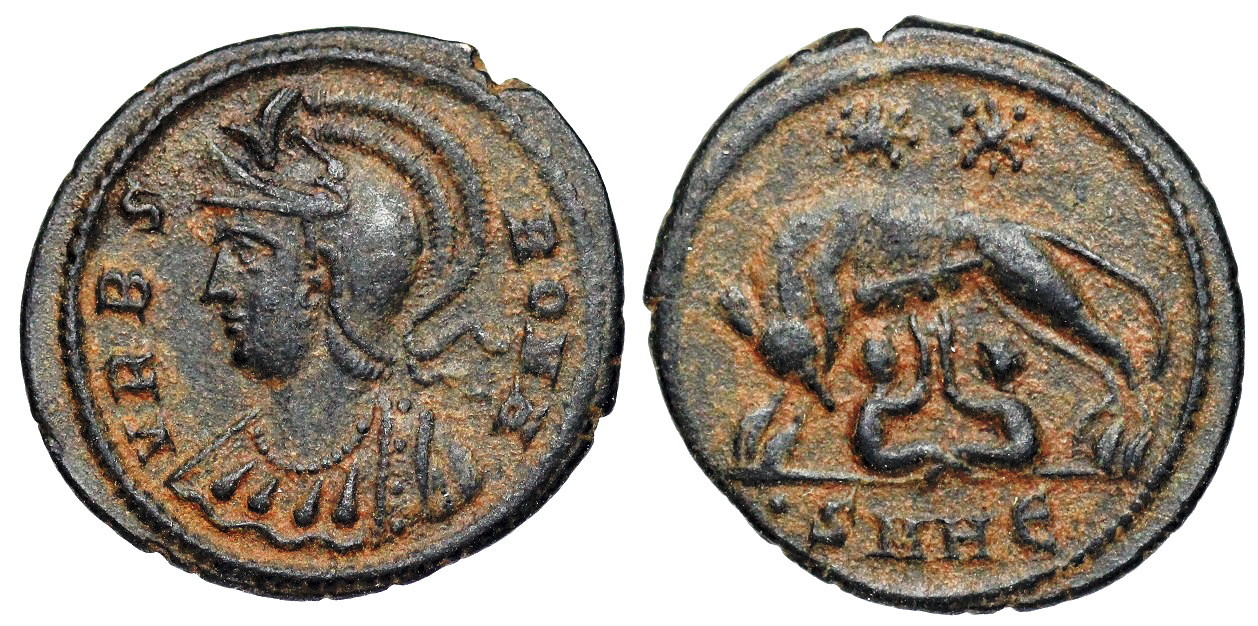
VRBS ROMA A.D. 330-3 18x19mm 2.5gm VRBS ROMA; Roma, helmeted, wearing imperial cloak. REV. She-wolf standing left with twins (Romulus and Remus); above, two stars. In ex. •SMHE RIC VII Heraclea 119 |
 |
Constantinople
|
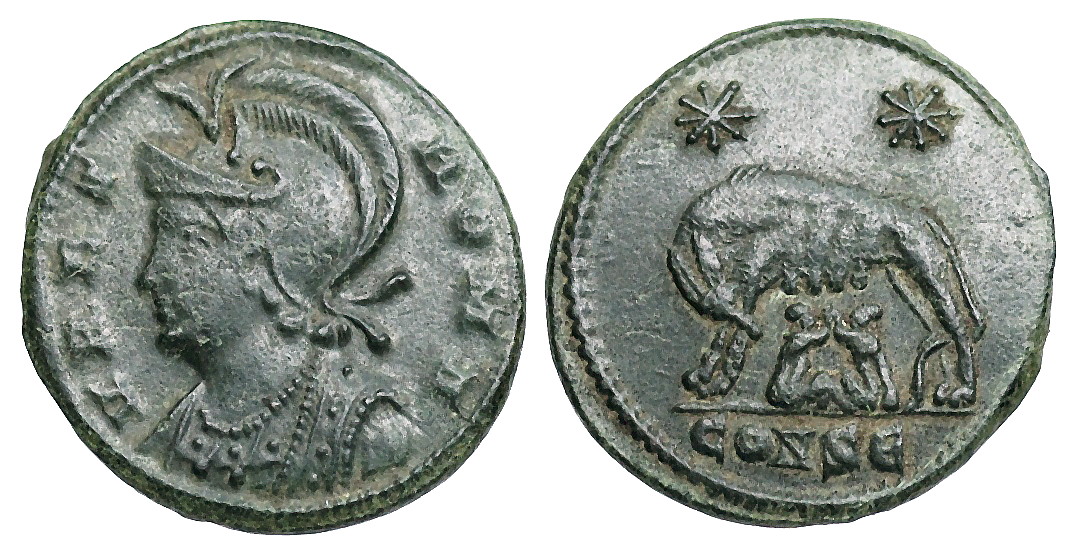
VRBS ROMA A.D. 330- 333 18x19mm 2.6gm Obv. VRBS-ROMA [City of Rome] Roma, helmeted, wearing imperial cloak. Rev. She-wolf left with twins (Romulus and Remus); above, two stars. In ex. CONSE RIC VII Constantinople 62 |
 |
Nicomedia
|
A.D. 330-5 18mm
2.4gm VRBS-ROMA [City of Rome] Roma,
helmeted, wearing imperial cloak. Rev. She-wolf left with twins (Romulus
and Remus); above, two stars with three vertical dots
between. In ex. SMN gamma RIC VII Nicomedia 195 |
 |
Cyzicus
|
A.D. 330- 333 17x18mm 2.7gm Obv. VRBS-ROMA [City of Rome] Roma, helmeted, wearing imperial cloak. Rev. She-wolf left with twins (Romulus and Remus); above, two stars. In ex. SMKΓ RIC VII Cyzicus 91 |
 |
Antioch
|
A.D. 335- 337 17mm 2.8gm Obv. VRBS-ROMA [City of Rome] Roma, helmeted, wearing imperial cloak. Rev. She-wolf left with twins (Romulus and Remus); above, two stars. In ex. SMANΘ RIC VII Antioch 91 |
 |
| A.D. 335 18mm 3.0gm Obv. VRBS-ROMA [City of Rome] Roma, helmeted, wearing imperial cloak. Rev. She-wolf left with twins (Romulus and Remus); above, two stars. In ex. SMANΘ RIC VII Antioch 91 Eyes to heavens bust |
 |
|
|
|
16mm 2gm Obv. VRBS-ROMA [City of Rome] Roma, helmeted, wearing imperial cloak. Rev. She-wolf left with twins (Romulus and Remus); above, two stars. SMALB in exergue RIC VIII Alexandria 26 |
 |
GLORIA EXERCITVS
&
POP ROMANVS
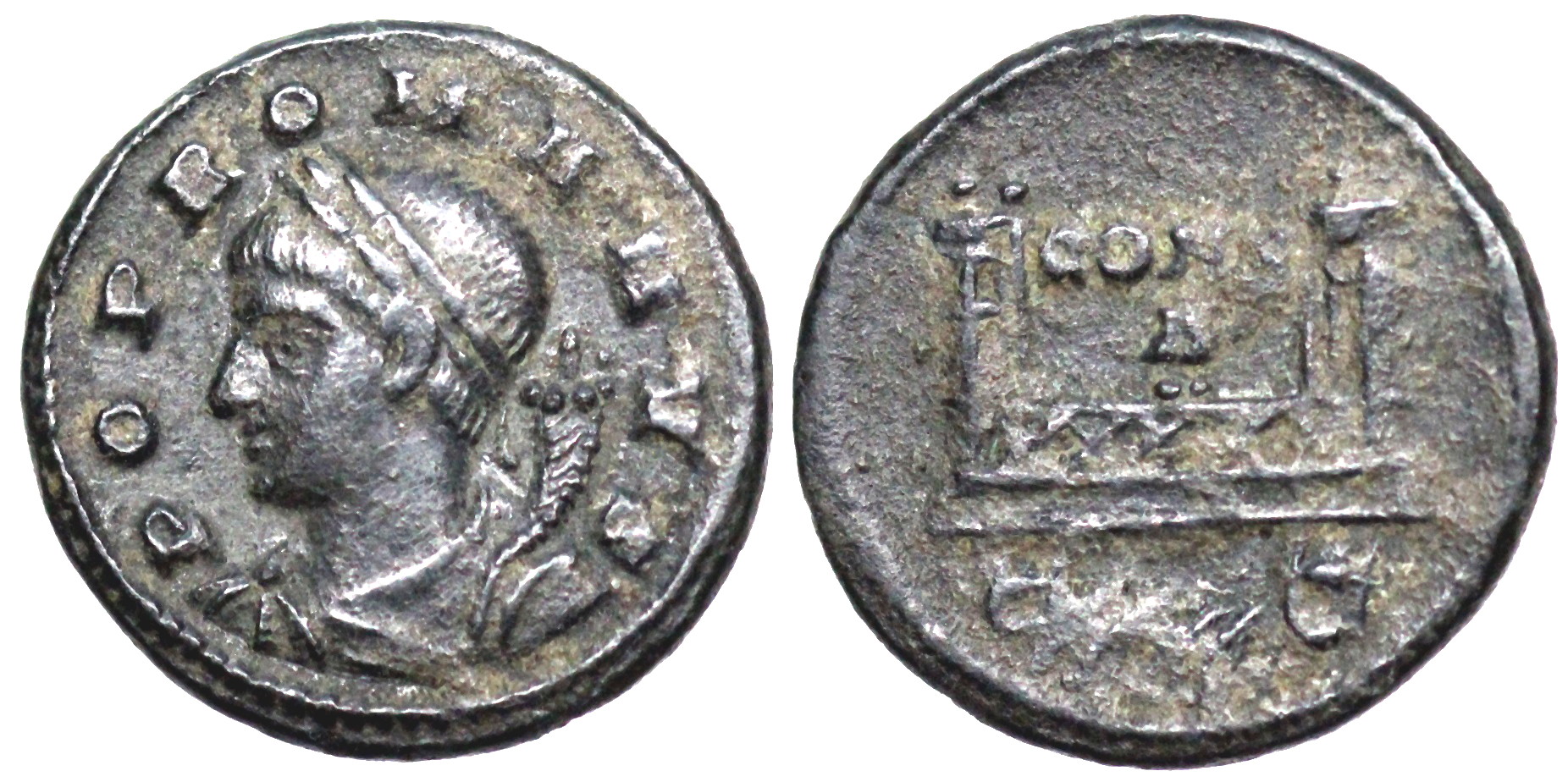
The POP ROMANVS type was issued circa A.D. 330
and this half- “centenionales” was likely a donative issued to
commemorate the founding of Constantinople. There are two
types, the star reverse and bridge reverse. Some think
that the two reverses might represent the cities of Rome and
Constantinople, the star for Constantinople and the bridge for
Rome. There has been speculation that the bridge is an
allusion to Constantine's victory at the Milvian Bridge but it
seems unlikely given how many years had passed, it is probably
just a bridge over a river, and possibly a bridge over the
Danube. It seems likely that this bridge issue has nothing to
do with Rome, as Constantine built a bridge over the Danube
circa A.D. 328 -- "Constantine the pious crossed the Danube
very many times, and made a bridge for it in stone." Chronicon
Paschale
These small bridge coins may just be souvenirs
of the massive undertaking involved in the bridge. The Rome
mint even issued a medallion to commemorate this event-
RIC VII Rome 298. The reverse is SALVS REIP
bridge with three arches, whereon emperor advancing right in
military dress, holding transverse spear, shield, preceded by
Victory, holding trophy, turning head towards him,
in front, suppliant; beneath, to left, Danube resting; in
exergue DANVBIS. This medallion was struck between 327-333.
For an article on this medallion see Andreas Alföldi, “Die
Donaubrücke Constantins des Grossen und verwandte historische
Darstellungen auf spätrömischen Münzen” Zeitschrift für
Numismatik 36 (1926) : 161- 167.

These coins were included in RIC VIII because when RIC VII was published, numismatists believed that these coins were struck circa A.D. 340, however the Llanbethery Hoard of Constantinian coins, which had one example, proved that these coins were struck earlier.
|
|
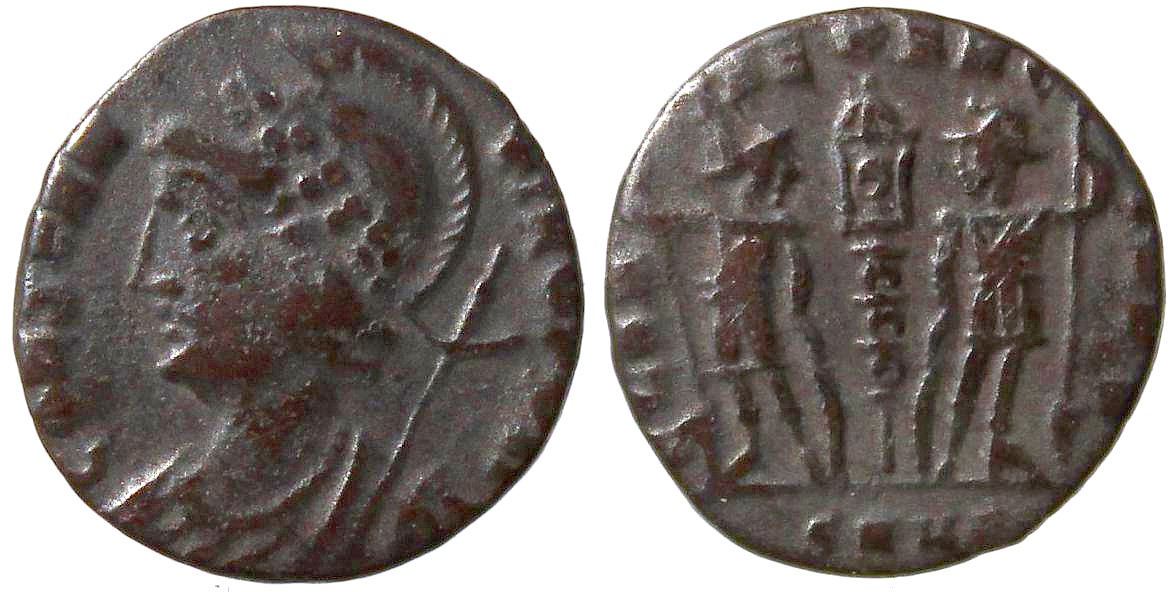
15mm 1.6gm CONSTAN-TINOPOLI laureate, helmeted, wearing imperial mantle, holding reversed spear. GLOR-IA EXERC-ITVS dot, Two soldiers helmeted, stg. facing one another, reversed spear in outer hands, inner hands on shields resting on ground; between them one standard. In ex. SMHB RIC VII Heraclea 157 |
 |
|
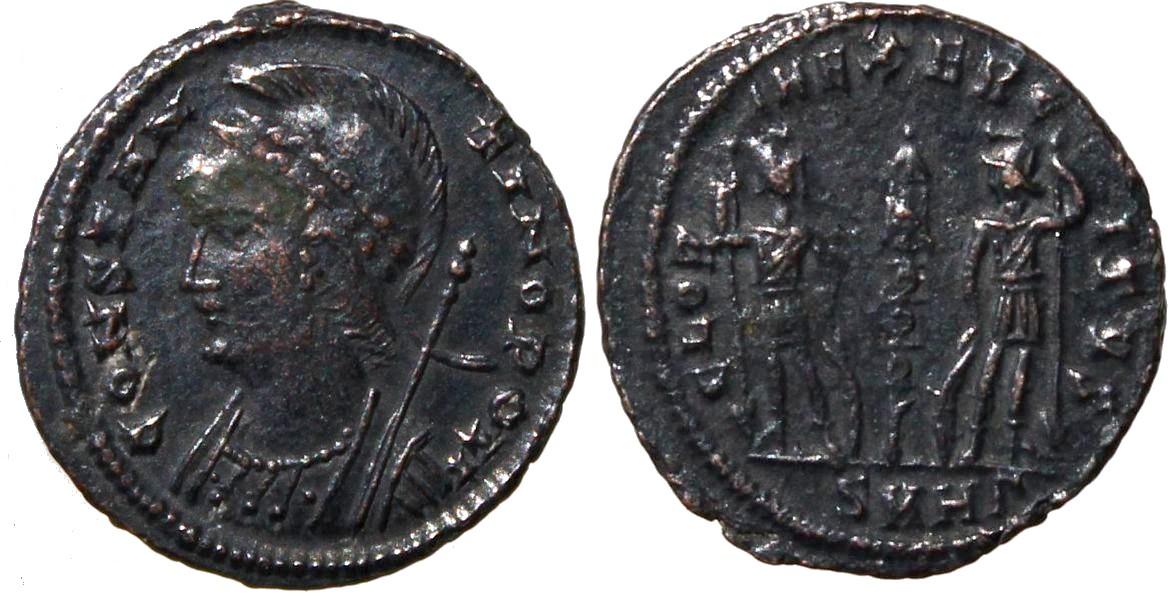
16.5mm 2.0gm CONSTAN-TINOPOLI laureate, helmeted, wearing imperial mantle, holding reversed spear. GLOR-IA EXERC-ITVS dot, Two soldiers helmeted, stg. facing one another, reversed spear in outer hands, inner hands on shields resting on ground; between them one standard. In ex. SMH gamma RIC VII Heraclea 157 |
 |
|
| Constantinople |
15x16mm 1.8gm VRBS-ROMA [City of Rome] Roma, helmeted, wearing imperial cloak. GLOR-IA EXERC-ITVS, Two soldiers helmeted, stg. facing one another, reversed spear in outer hands, inner hands on shields resting on ground; between them one standard. In ex. CONSZ RIC VIII Constantinople 46 |
 |
| POP ROMANVS |
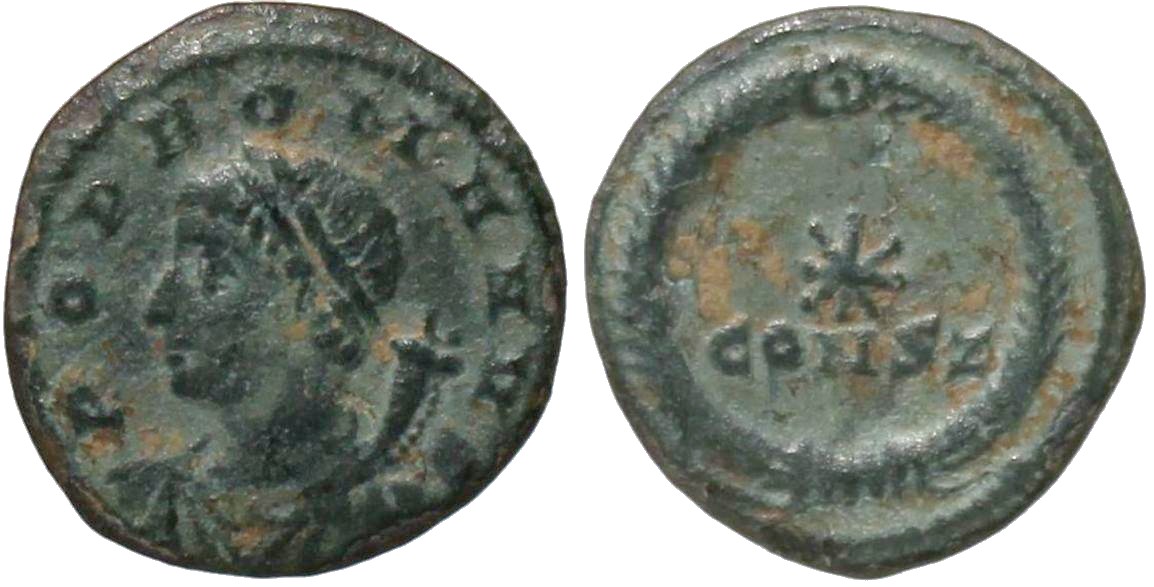
13mm .94gm POP ROMANVS, laureate & draped bust of the Roman people left, cornucopia over shoulder REV: wreath surrounding star and mintmark of CONSB RIC VIII Constantinople 22 |
 |
|
13mm 0.67gm POP ROMANVS- laureate & draped bust of the Roman people left, cornucopia over shoulder REV- wreath surrounding star and mintmark of CONSZ RIC VIII Constantinople 22 |
 |
|
| A.D. 330 |
 |
|
|
POP
ROMANVS
|
 |
Anepigraphic |
|
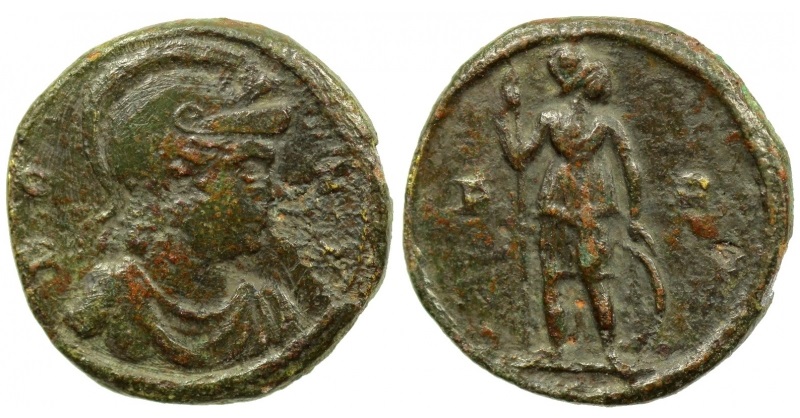 |
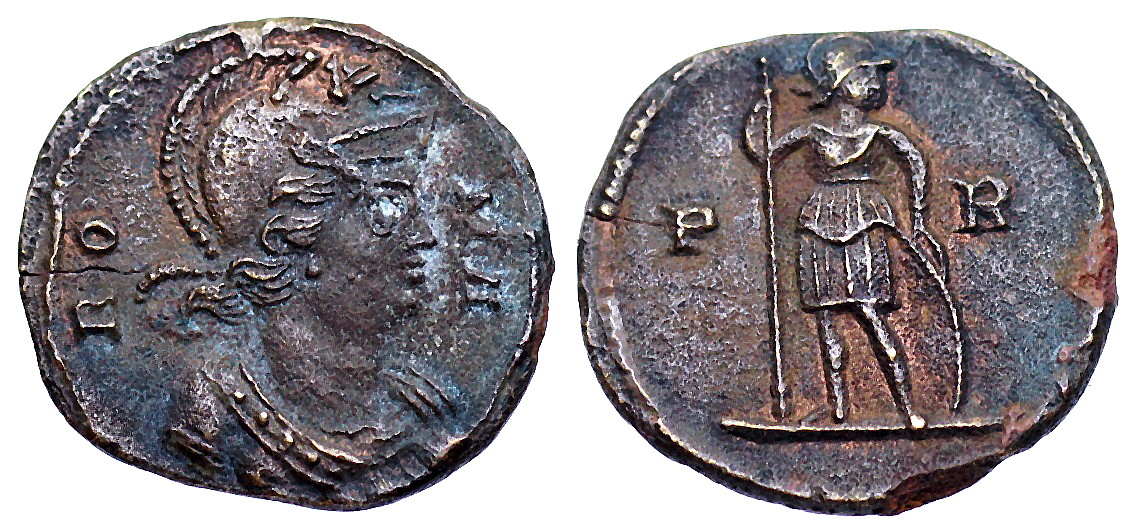
| Constantinopolis Commemorative A.D. 330 15x16mm 1.8gm OBV: ROMA- helmeted and draped bust of ROMA right. REV: Anepigraphic- Virtus, helmeted and in military dress, standing left, head right, holding spear in right hand and resting left hand on shield. P-R across fields. RIC VIII Rome 104 |
 |
|
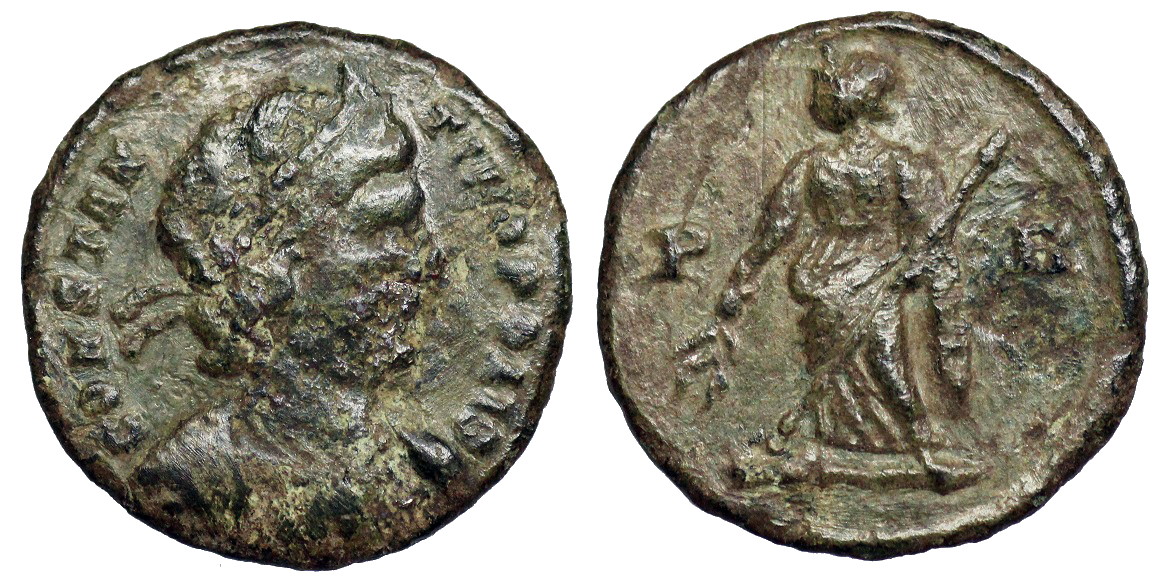
| Constantinopolis Commemorative A.D. 330 15mm 1.4gm OBV: CONSTANTINOPOLIS- laureate and draped bust of Constantinopolis right. REV: Pax stg. l., holding branch and transverse sceptre; P-R across fields. RIC VIII Rome 105 |
 |
|
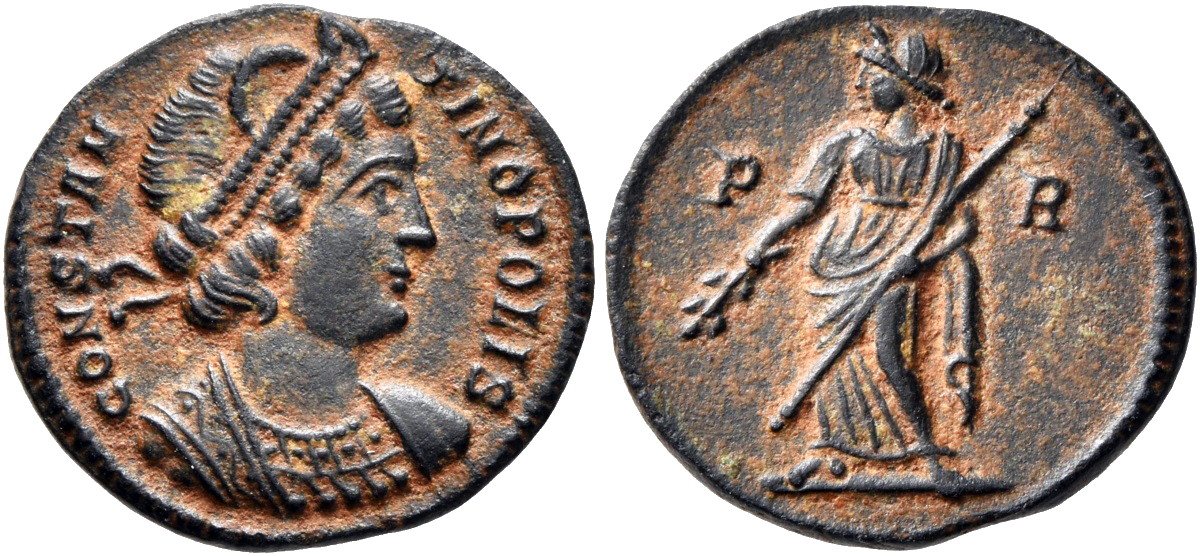
| Constantinopolis Commemorative A.D. 330 16mm 1.9gm OBV: CONSTANTINOPOLIS- pearl diademed and draped bust of Constantinopolis right. REV: Pax stg. l., holding branch and transverse sceptre; P-R across fields. RIC VIII Rome 106 |
 |
Constantinopolis
Commemorative
|
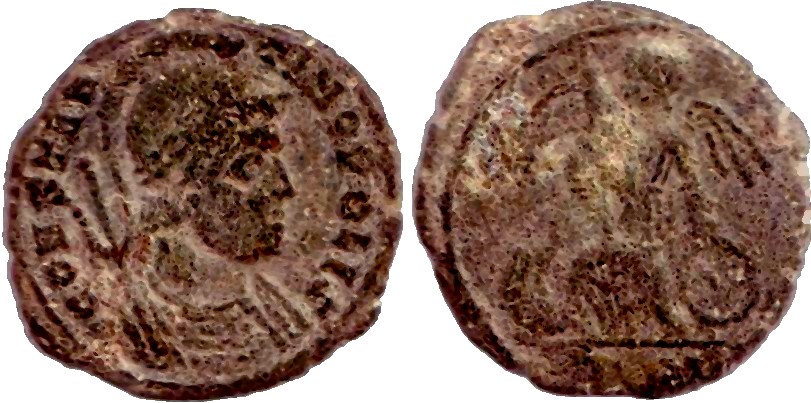
17mm 2.1gm Obv. CONSTAN-TINOPOLIS facing right laureate, helmeted, wearing imperial mantle, holding scepter. Rev. Victory stg. on prow, holding long scepter in r. hand, and resting l. hand on shield. in exergue it looks like TR (P) this coin has a right facing bust. it is very good in style, but must be unofficial There was a right facing Constantinopolis copy with a similar mintmark in the Maidenhatch hoard. This hoard of fourth-century copies was found in 1970 at Maidenhatch Farm in England. Cohen also listed a right facing issue like this as number 23. |
 |
|
Trier Imitation
|
 |
|
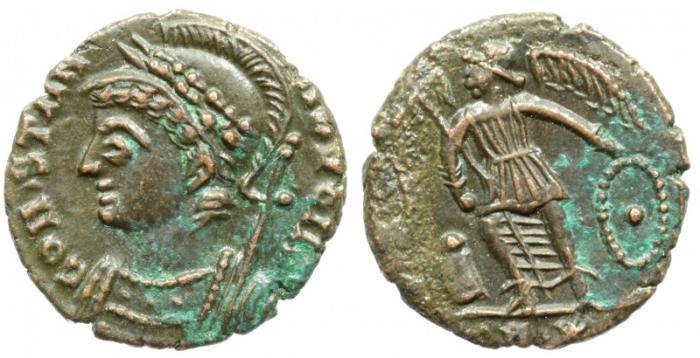
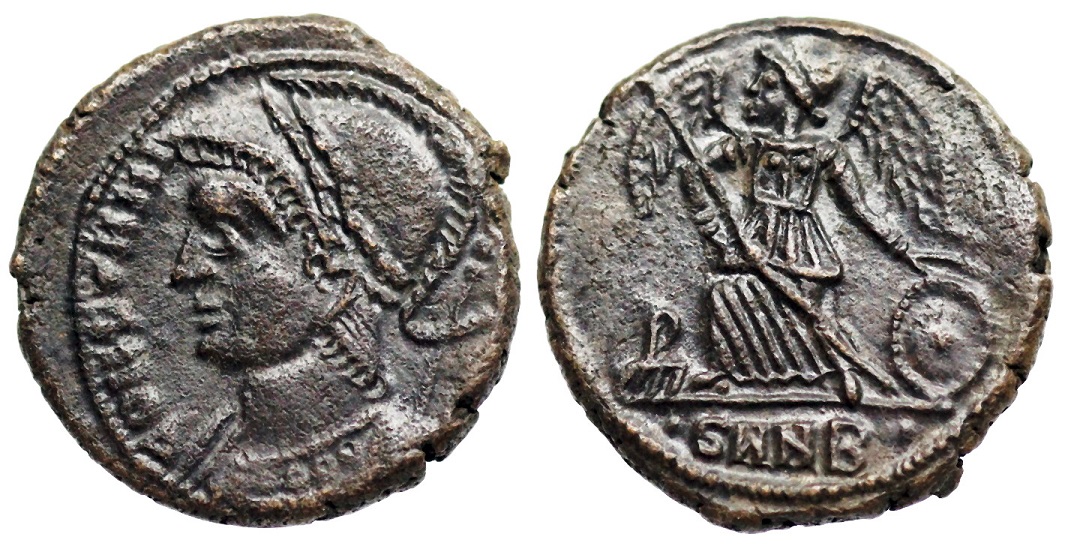
| Constantinopolis Commemorative Circa A.D. 330- 335 16mm 2.7gm CONSTANT-INOPOLIS; laureate, helmeted, wearing imperial mantle, holding scepter. Rev. Victory stg. on prow, holding long scepter in r. hand, and resting l. hand on shield. in ex. • SMNB • unofficial issue |
 |
|
|
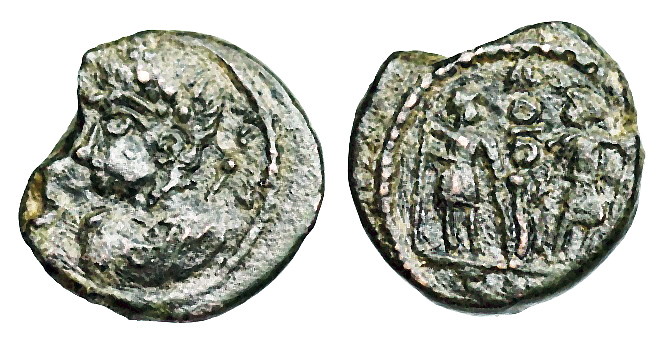
CONSTANTINOPOLIS GLORIA EXERCITVS 10.5mm 0.63gm |
 |
1 C. H. Roberts, “A Footnote to the Civil War of A.D. 324.” Journal of Egyptian Archaeology 31 (1945) : 113.
2 John of Ephesus lived circa A.D. 507- 588 and spent many years in Constantinople. Translated from the original Syriac by R. Payne Smith in Ecclesiastical History of John, Bishop of Ephesus, Oxford University Press, 1860 : p. 192.
3 J. P.
C. Kent, “Urbs Roma and Constantinopolis: Medallions
at the Mint of Rome.” Scripta Nummaria Roman. Essays
Presented to Humphrey Sutherland. London: Spink & Son
(1978) : 106.
last modified on 17 July 2026