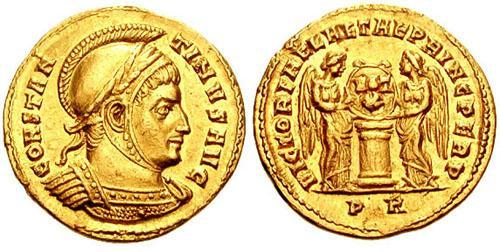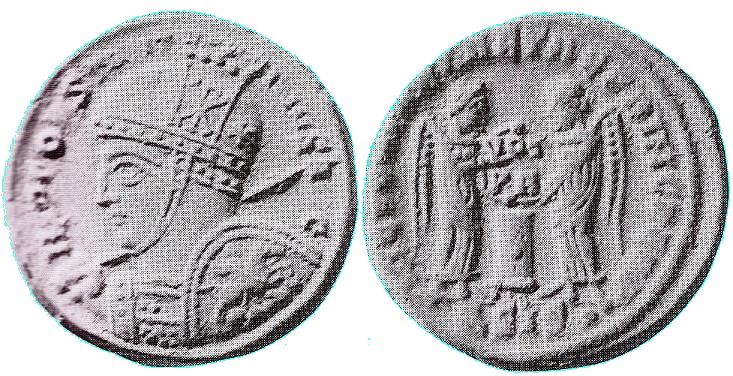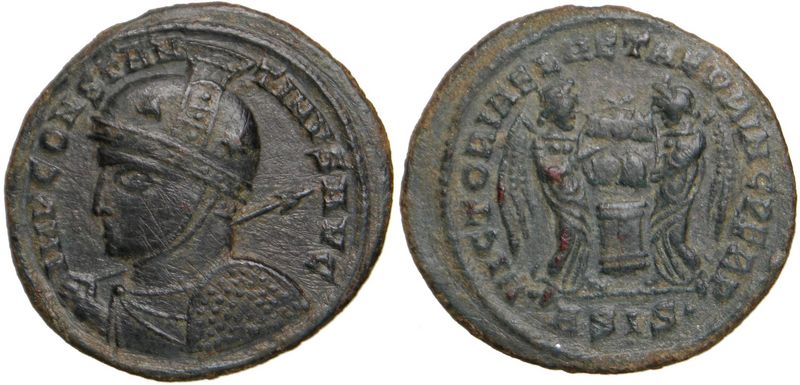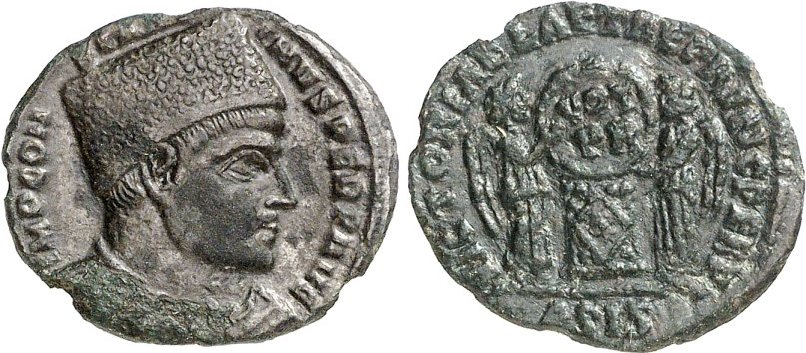
VICTORIAE LAETAE PRINC PERP
VICTORIAE LAETAE PRINC PERP
Constantine issued these coins intermittently
from 313-320. Arles - 319-320, London - 318-320, Lugdunum (Lyon) -
319-320, Rome – circa 315 (gold issue),
Siscia - 318-320, Ticinum- 318-319, Trier - 313, 318-319. The
billon (roughly 25% percent silver) coin was the first appearance
of VLPP type. Circa 313 A.D., Trier struck this coin along with
two other billon types of the same denomination-- for more
information, go to the page about the billon
coins from Trier. The VLPP's of 318- 320 had circa 4%
silver. Here is a page
with
line drawings of the VLPP's in the Vienna collection from
the book by Guido Bruck, Die Spätrömische Kupferprägung - Ein
Bestimmungsbuch Für Schlecht Erhaltene Münzen.
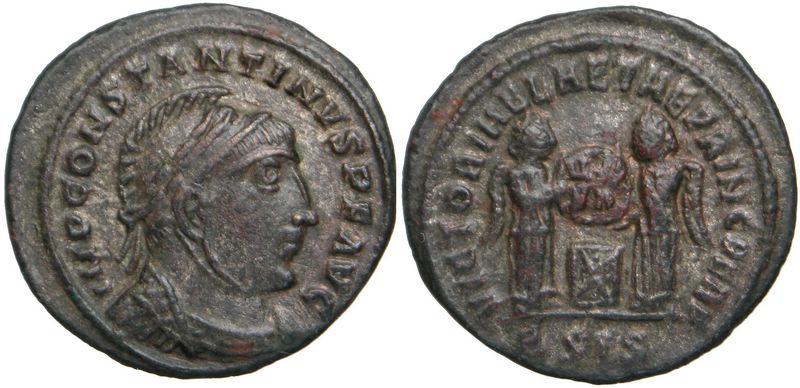
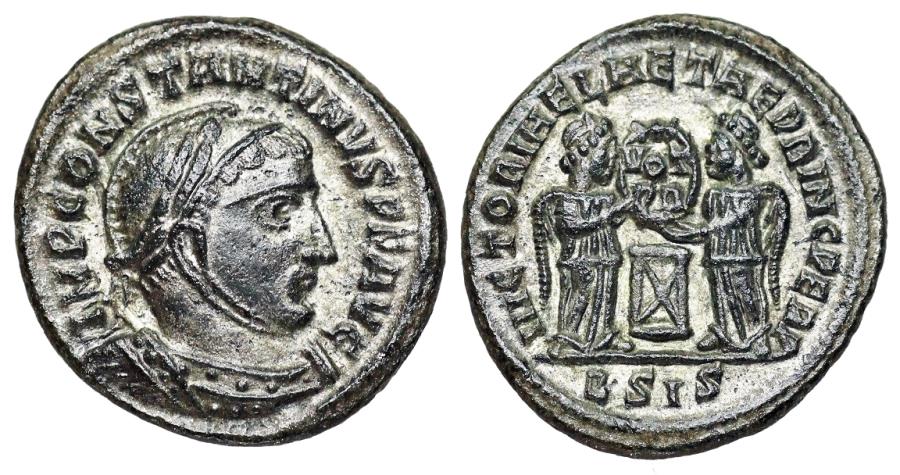
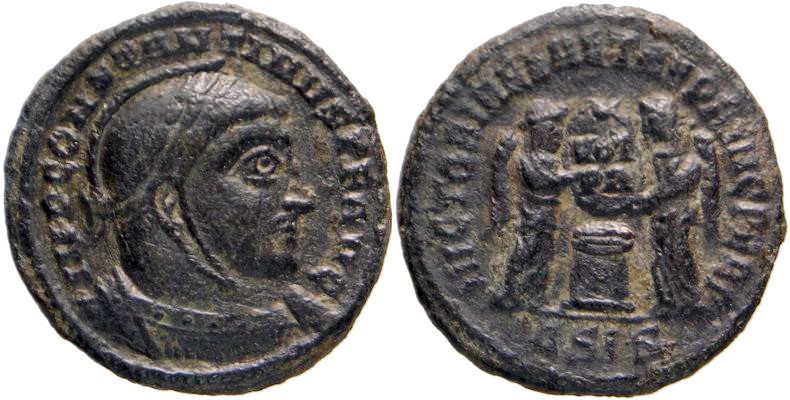
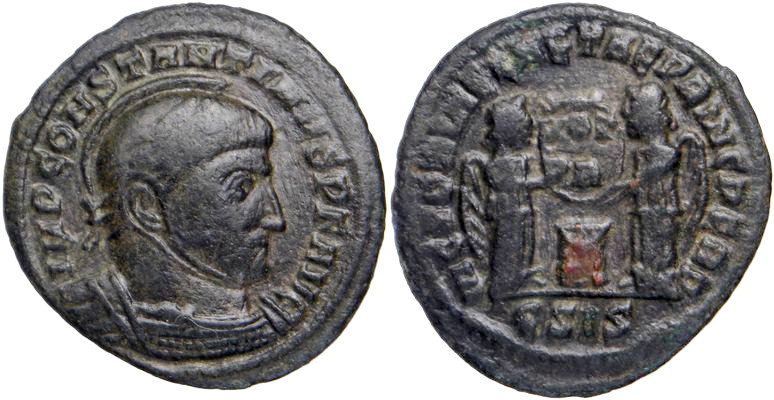
VICTORIAE LAETAE PRINC PERP translates
as "Joyous (well-earned) victory to the eternal Prince" and
VOT PR engraved on the shield is VOTA POPVLI
ROMANI "vows of the Roman people"
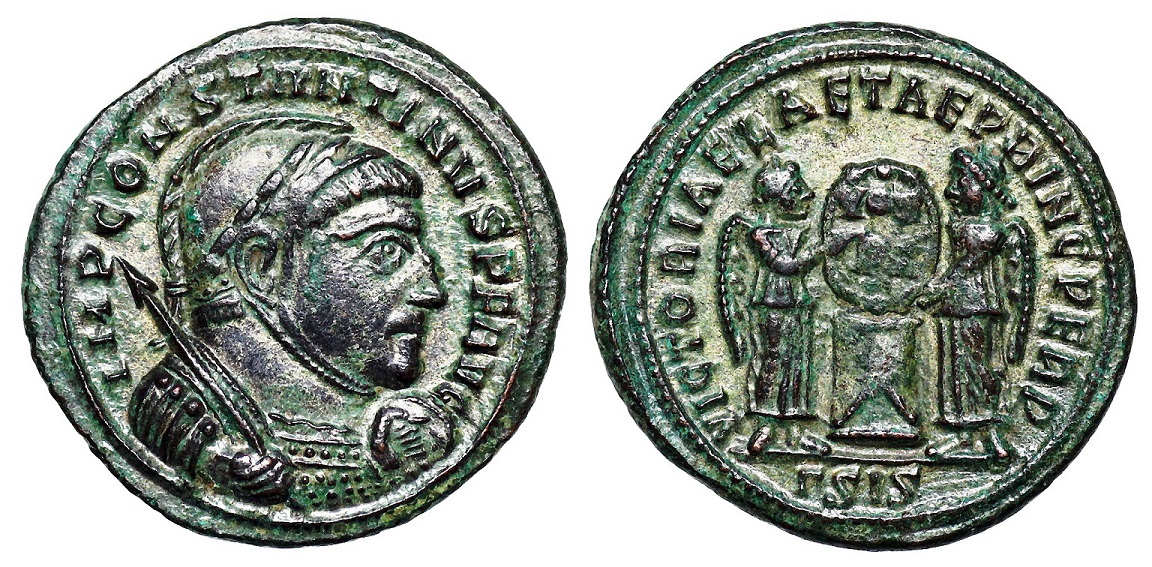
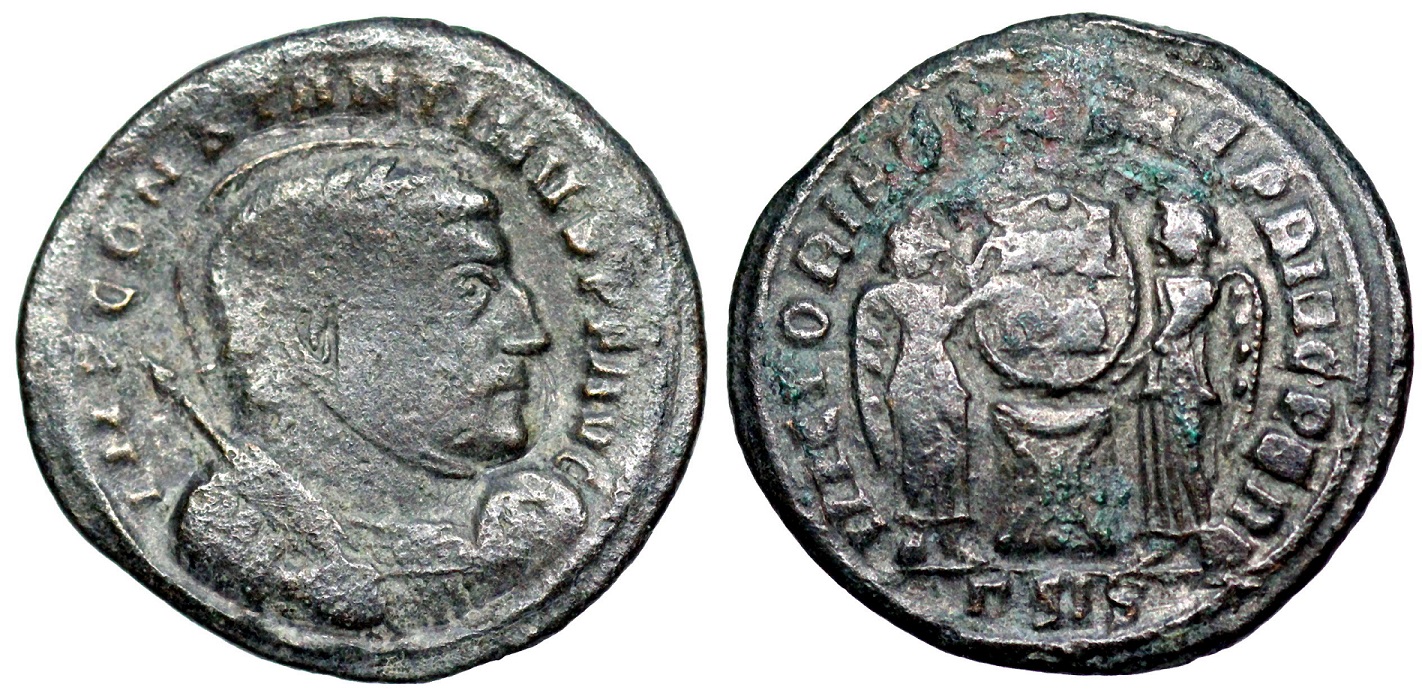
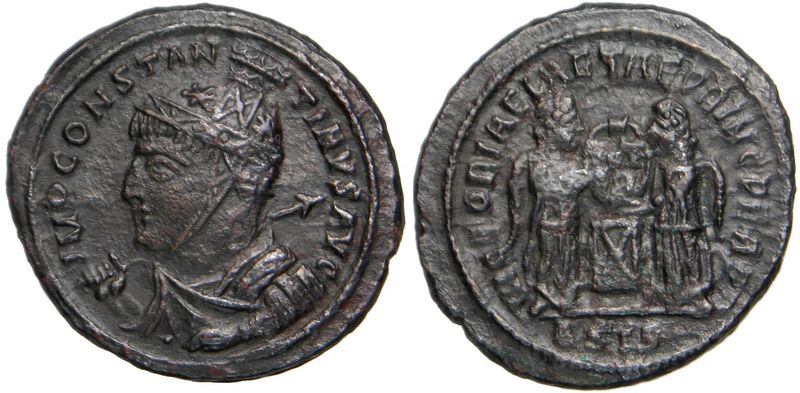
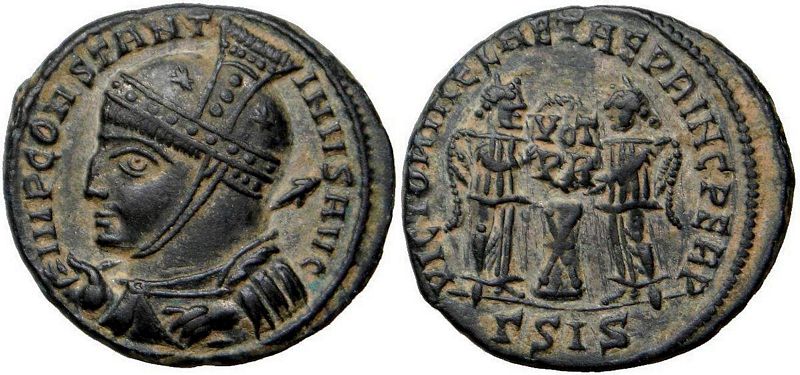
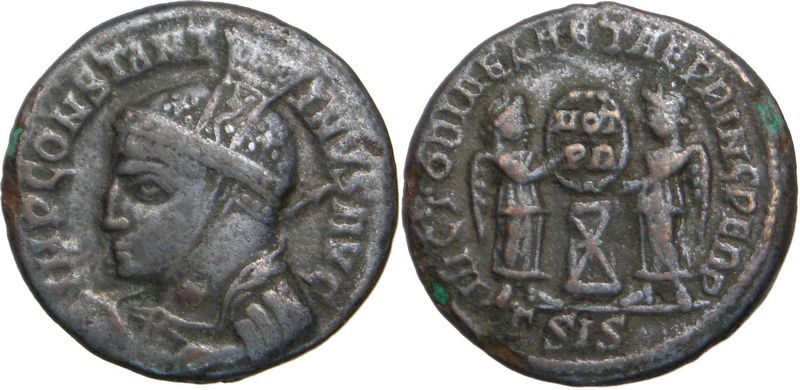
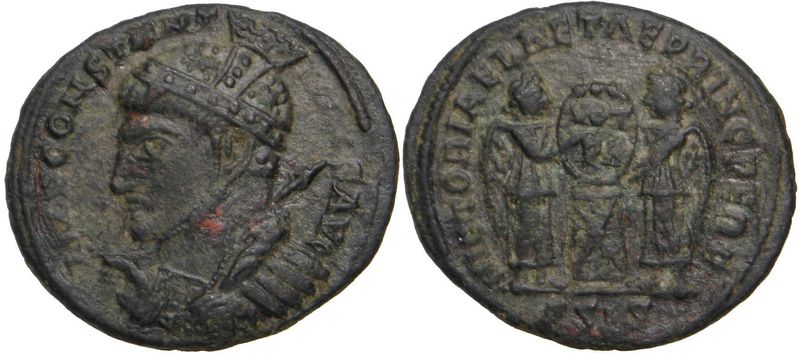
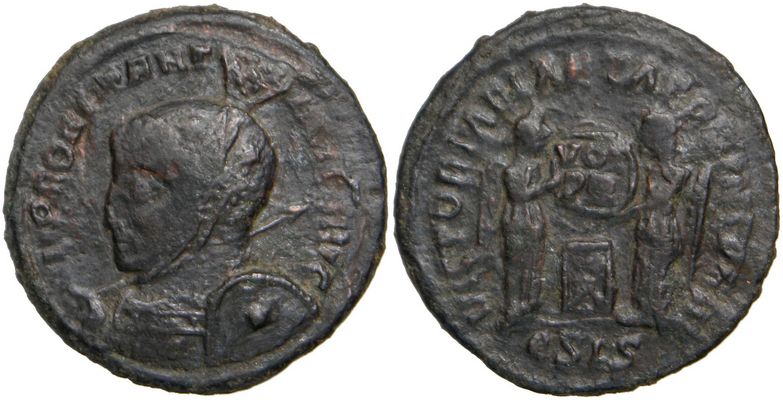
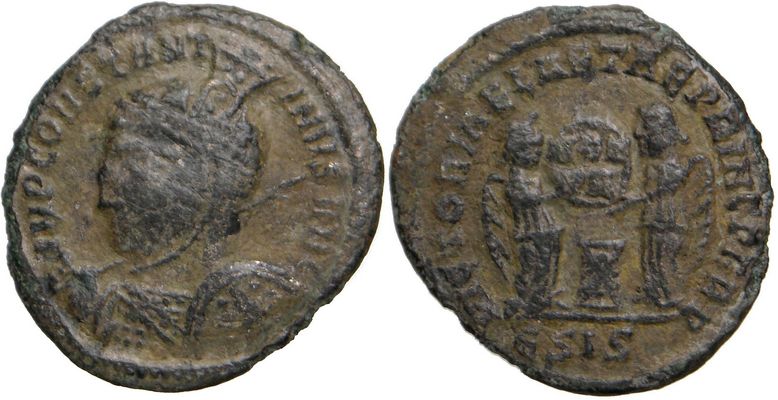
This page is about coins from Siscia and they are arranged by RIC number, but there are also references to the Bikic-Do hoard.¹ This hoard contained 406 VLPP's from Siscia. At Siscia these coins were eventually issued for all five rulers at the time (Constantine I, Licinius I, Crispus, Licinius II and Constantine II); but the first series,ASIS✶ [with the long reverse legend], was issued only for Constantine (RIC 47-51). The next series (RIC 52-58) was only issued for the Constantine family members. It is interesting to note that the heroic bust with spear and shield (the H12 bust and also the H11 with just spear) was only issued for Constantine and was never issued for Licinius -- he is always depicted as just laureate. After Constantine's victory at the Milvian Bridge, the helmet may have even been association with Christianity, and some rare examples even have a chi-rho in the crossbar.
Constantine had just won the territory of Siscia from Licinius in 317. Siscia was also the farthest east of the mints that issued the VLPP's, so it was closest to the remaining territory of Licinius. Constantine was also having troubles with "barbarians" from the North. This military bust may been propaganda on the part of Constantine aimed at Licinius and perhaps the fractious Northern tribes-- a little reminder that God was on his side!
RIC VII describes the reverse of these coins
as two victories holding a shield. It is actually a wreath though.
This reverse is just like the type issued a few years later by Magnentius,
which RIC VIII correctly describes as two
victories holding a wreath. My descriptions call it a
shield, following RIC VII, but it is a wreath, which is evidenced
by the wreath ties easily visible on the top of most examples. If
you look closely on a clear example, you will see that only one
victory is holding the wreath. The other victory is actually
inscribing the wreath. You can see the stylus in the hand of
victory on some examples. The reverse description should be
something like this: two Victories standing, facing one another,
one inscribing wreath with VOT PR, while the other Victory holds
the wreath above an altar. RIC also describes the bust as
cuirassed only, but on some of the H11 and H12 busts, they are
draped and cuirassed, and even rarer, some show only drapery,
and no trace of cuirass. There are a variety of designs on the
shields and helmets, especially in the crossbars. Sometimes the
shields are inscribed with a horseman leaping over a fallen enemy,
but this design is predominantly from officina B. I
have put a horse icon next to coins that have a horseman on the
shield.
The chart below is a quick reference for I.D.
The obverse legend can have various breaks. The officinae that
minted these coins are A,B,gamma,delta and epsilon. Even though
some may not be listed in RIC, they are all to be expected.
Starting with RIC 73, there is an I on altar for off. A and
B; and an S on altar for off. gamma,delta, and epsilon. It is not
known what, if anything, these letters stand for. It is tempting
to think an S and I stood for Siscia, but other mints also use
letters which could not stand for their respective cities. The
reverse legends starting with RIC 81 are the shorter VICT.legends.
There are many variations in the altar design, but I do not pay
much attention to the differences for any classification
purposes,since there does not seem to be any pattern. The earlier
issues (RIC 47-56) are on a small (and thicker) flan with a small
portrait and have a higher relief. As the issues continue (this is
most evident by the short reverse legend), the flans and portrait
become larger (the flan is also thinner) and the relief is
smaller.
D2-helmeted, cuirassed (it seems an error in RIC, busts are
probably all D6)
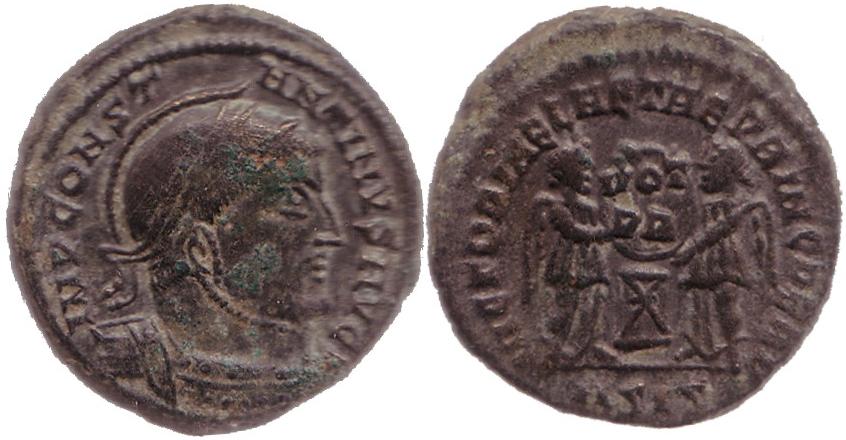
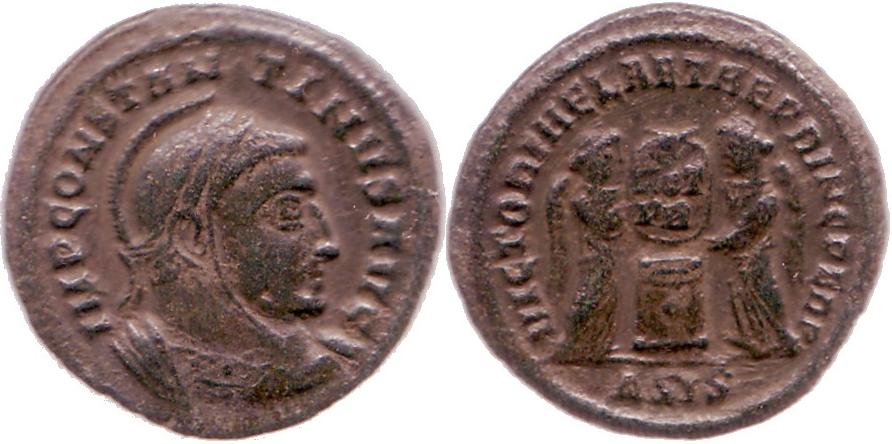
D6-Laureate, helmeted, cuirassed
H11 - High-crested helmet, cuirassed, spear across right
shoulder
H12 - High-crested helmet, cuirassed, spear across right
shoulder, shield on left arm
coins with an H6 bust ( laureate helmet,
cuirassed, spear across right shoulder, shield on left) are also
known, but not listed in RIC.
There are also very rare examples of Constantine wearing a Pannonia cap.
|
|
|
|
|
|
|
|
|
|
|
|
|
|
|
|
|
|
|
|
|
|
|
|
|
|
|
|
|
|
|
|
|
|
|
|
|
|
|
|
|
|
|
|
|
|
|
|
|
|
|
|
|
|
|
|
|
|
|
|
|
|
|
|
|
|
|
|
|
|
|
|
| ---- | CONSTANTINVS AVG | H11 left | VICTORIAE | ASIS |
|
|
|
|
|
|
| ---- | IMP CONSTANTINVS P F AVG | H6 right | VICTORIAE | ASIS • |
| ---- | IMP CONSTANTINVS P F AVG | H11 left | VICTORIAE | ASIS • |
|
|
|
|
|
|
|
|
|
|
|
|
|
|
|
|
|
|
| ---- | CONSTANTINVS AVG | H11 left | VICTORIAE |
|
| Starting with RIC 73, there is an I on altar for off. A and B; and an S on altar for off. gamma,delta, and epsilon. | ||||
|
|
|
|
|
|
| ---- | IMP CONSTANTINVS AVG | H11 left | VICTORIAE |
|
|
|
|
|
|
|
| ---- | IMP CONSTANTINVS P F AVG | D6 | VICT. | •ASIS • |
|
|
|
|
|
|
|
|
|
|
|
|
|
|
|
|
|
|
|
|
|
|
|
|
|
|
|
|
|
|
|
|
|
|
|
|
|
|
|
|
|
|
|
|
|
|
|
|
| ---- | IMP CONSTANTINVS AVG | D6 | VICT. |
|
| ---- | IMP CONSTANTINVS AVG | H11 left | VICT. |
|
|
|
|
|
|
|
| ---- | CONSTANTINVS AVG | D6 | VICT. |
|
| ---- | CONSTANTINVS AVG | H11 left | VICT. |
|
|
|
|
|
|
|
|
|
|
|
|
|
| ---- | CONSTANTINVS AVG | H12 left | VICT. |
|
ASIS✶ - ASIS
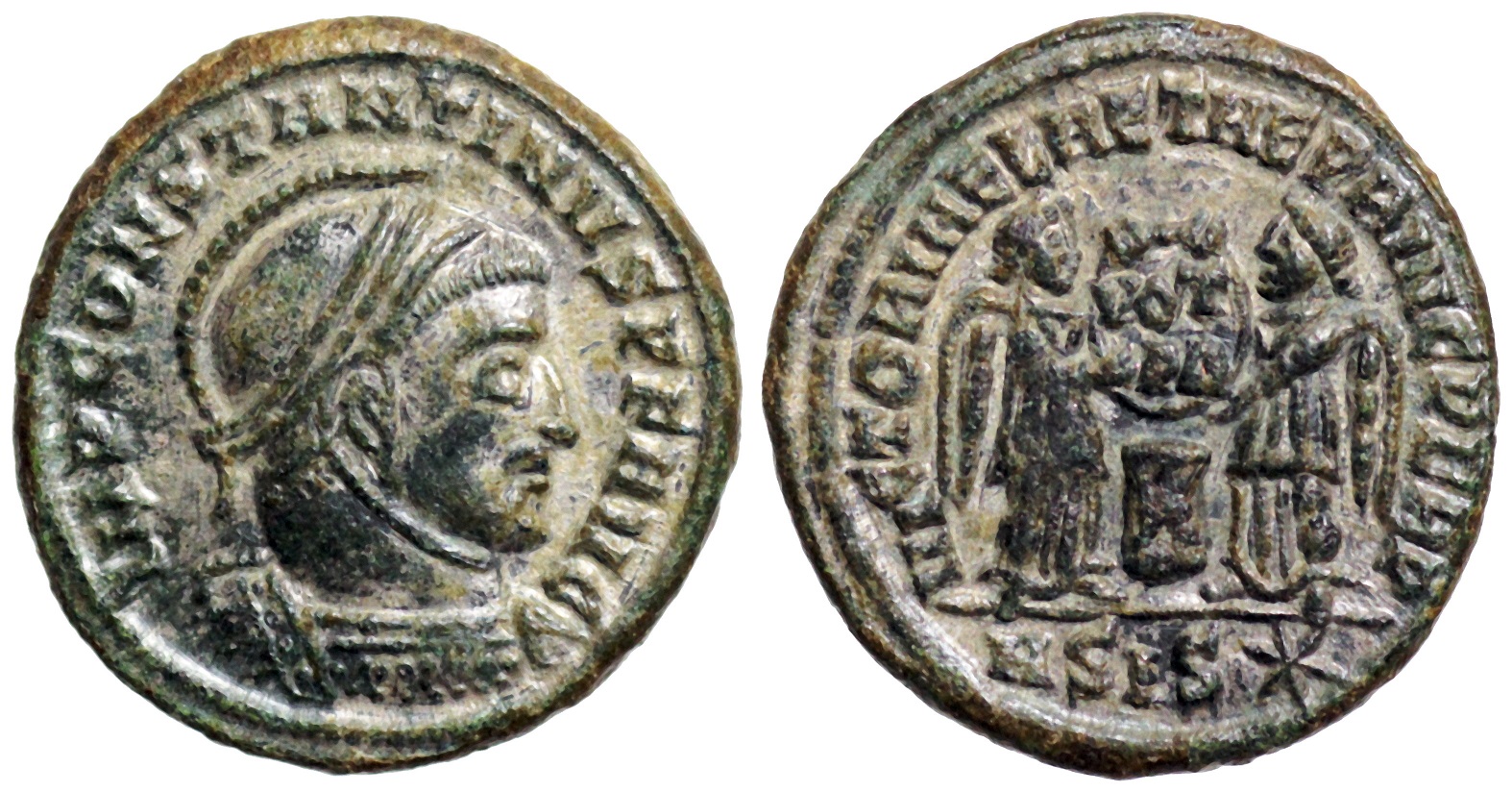
RIC 47
|
A.D. 318 18mm
3.3gm IMP CONSTANTINVS P F AVG -- laureate
helmet and cuirassed bust right. VICTORIAE LAETAE PRINC PERP -- two
Victories stg., facing one another, together holding
shield inscribed VOT PR on altar. in ex. ASIS ✶ RIC VII Siscia 47 |
 |
|
|
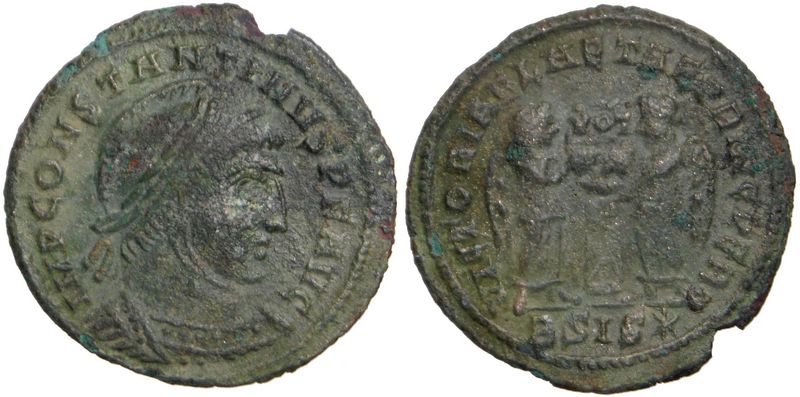
19mm 2.6gm IMP CONSTANTINVS P F AVG -- laureate helmet and cuirassed bust right. VICTORIAE LAETAE PRINC PERP -- two Victories stg., facing one another, together holding shield inscribed VOT PR on altar. in ex. BSIS ✶ RIC VII Siscia 47 |
 |
|
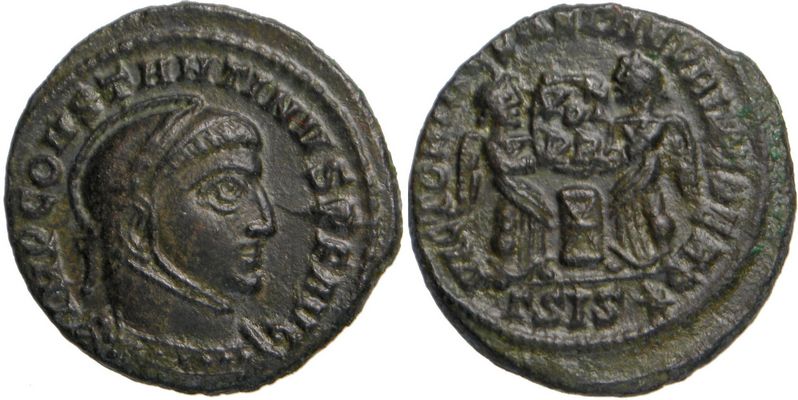
19x18mm 3.2 IMP CONSTANTINVS P F AVG -- laureate helmet and cuirassed bust right. VICTORIAE LAETAE PRINC PERP -- two Victories stg., facing one another, together holding shield inscribed VOT PR on altar. in ex. Γ SIS ✶ RIC VII Siscia 47 |
 |
|
|
|
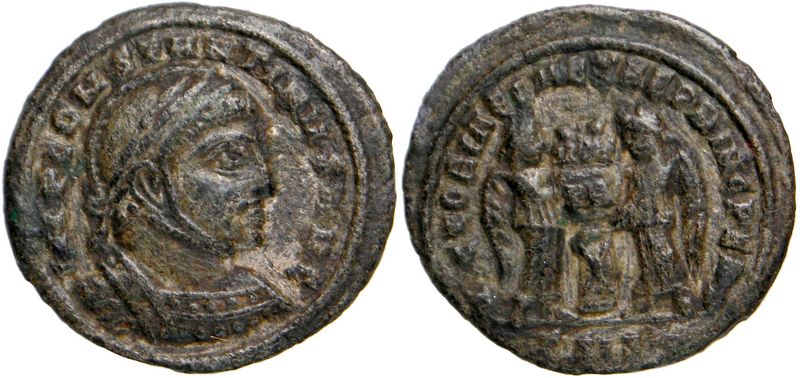
20x19mm 3.0gm IMP CONSTANTINVS AVG -- laureate helmet and cuirassed bust right. VICTORIAE LAETAE PRINC PERP -- two Victories stg., facing one another, together holding shield inscribed VOT PR on altar in ex. ΓSIS ✶ RIC VII Siscia 48 |
 |
|
|
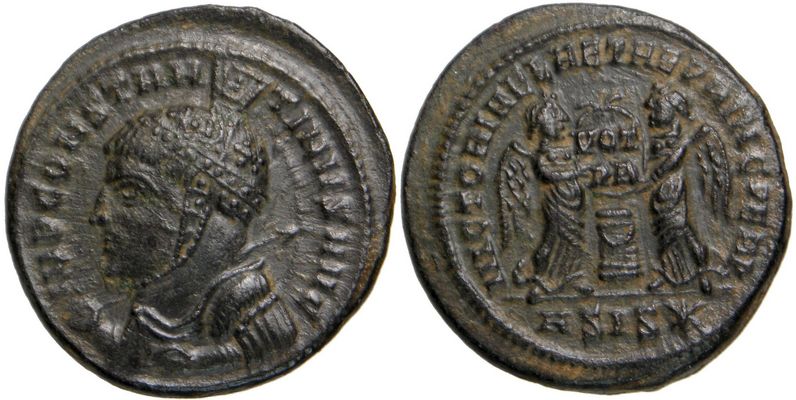
19mm 3.5gm IMP CONSTAN-TINVS AVG -- high crested helmet, cuir., spear across right shoulder. VICTORIAE LAETAE PRINC PERP -- two Victories stg., facing one another, together holding shield inscribed VOT PR on altar. in ex. ASIS ✶ RIC VII Siscia 49 |
 |
|
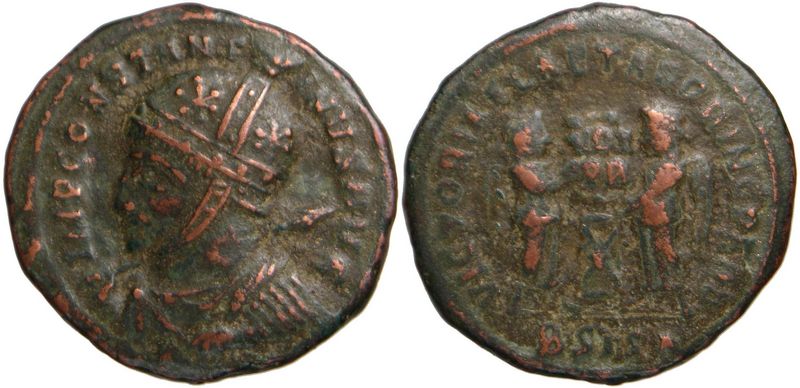
18mm 2.8gm IMP CONSTANT-INVS AVG -- high crested helmet, cuir., spear across right shoulder. VICTORIAE LAETAE PRINC PERP -- two Victories stg., facing one another, together holding shield inscribed VOT PR on altar. in ex. BSIS ✶ RIC VII Siscia 49 unlisted officina |
 |
|
|
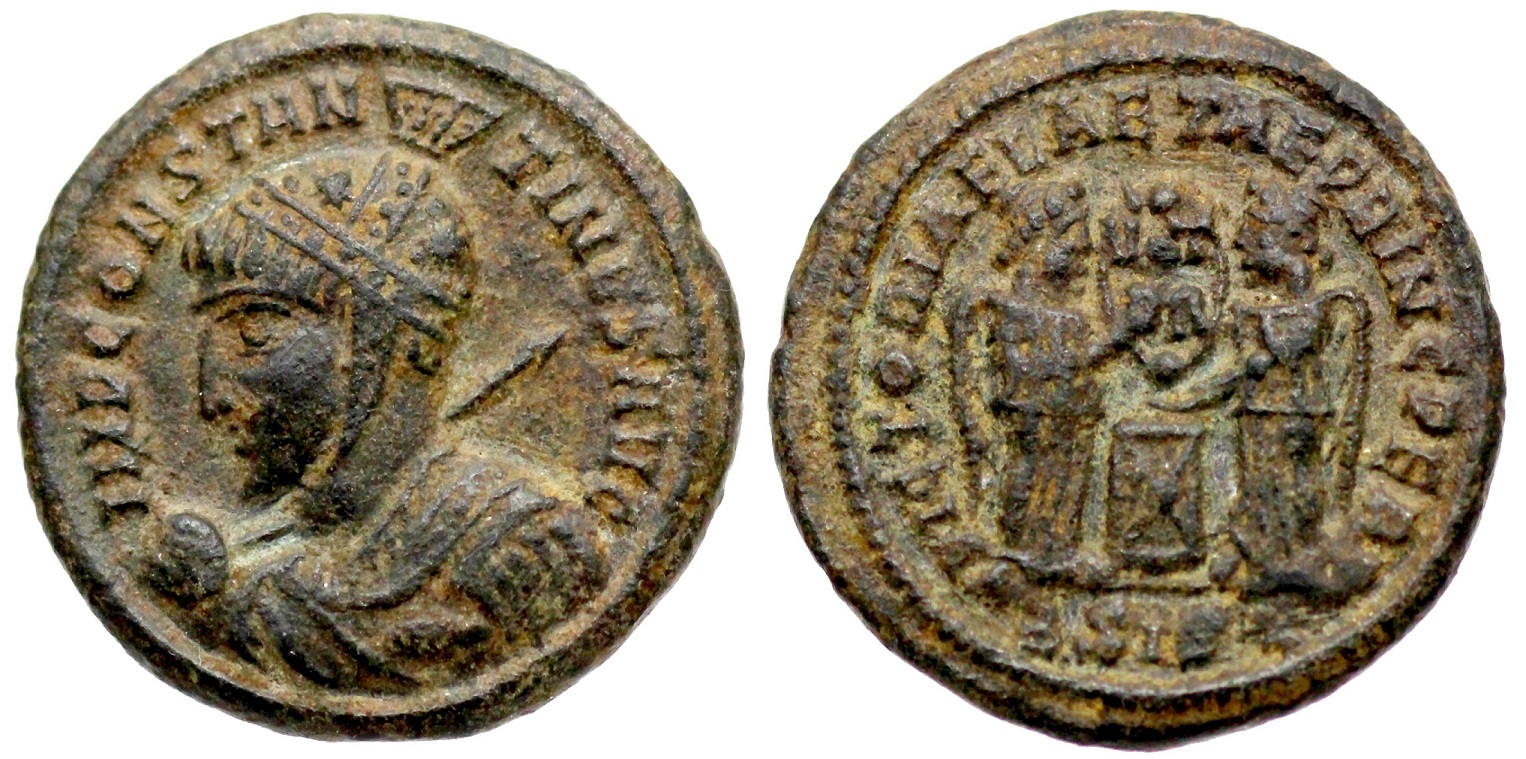
A.D. 318 18mm
3.3gm IMP CONSTAN-TINVS AVG -- high crested
helmet, cuiraissed with spear across right shoulder. VICTORIAE LAETAE PRINC PERP --
two Victories stg., facing one another, together
holding shield inscribed VOT PR on altar. In ex. BSIS✶ RIC VII Siscia 49 |
 |
|
|
19x20mm 3.2gm IMP CONSTANT-INVS AVG -- high crested helmet, cuir., spear across right shoulder. VICTORIAE LAETAE PRINC PERP -- two Victories stg., facing one another, together holding shield inscribed VOT PR on altar. in ex. ΓSIS ✶ RIC VII Siscia 49 unlisted officina |
 |
|
|
19x18mm 2.8gm IMP CONSTAN-TINVS AVG -- high crested helmet, cuir., spear across right shoulder. VICTORIAE LAETAE PRINC PERP -- two Victories stg., facing one another, together holding shield inscribed VOT PRon altar. in ex. ∆SIS ✶ RIC VII Siscia 49 unlisted officina |
 |
|
|
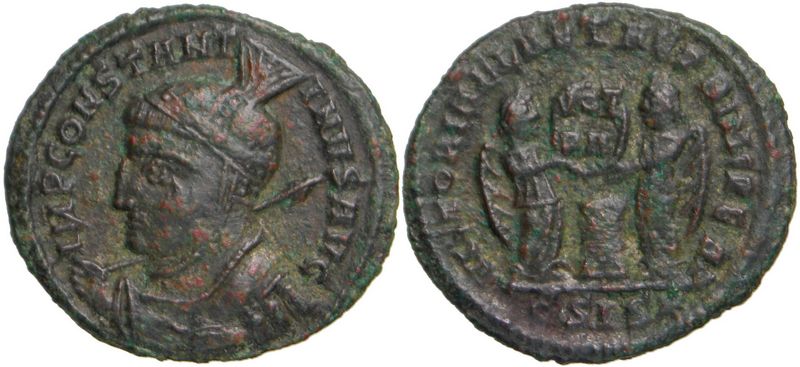
19x17mm 2.8gm IMP CONSTANT-INVS AVG -- high crested helmet, cuir., spear across right shoulder. VICTORIAE LAETAE PRINC PERP -- two Victories stg., facing one another, together holding shield inscribed VOT PR on altar. in ex. ESIS ✶ RIC VII Siscia 49 unlisted officina |
 |
|
RIC 50
|
A.D. 318 |
 |
 |
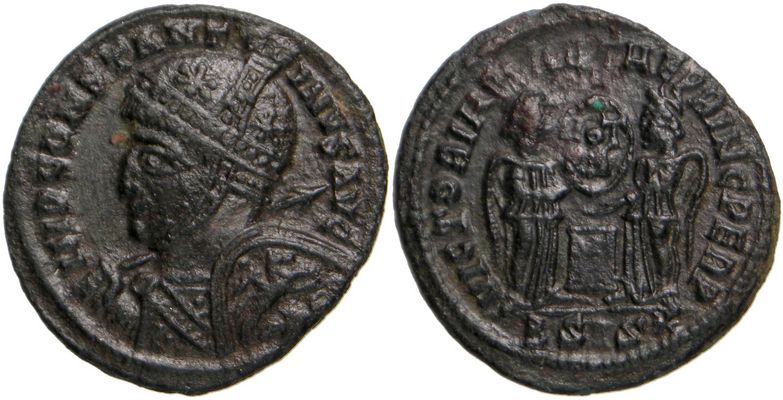
19x17mm 2.8gm IMP CONSTANT-INVS AVG -- high crested helmet, cuir., spear across r. shoulder, shield inscribed with horseman on left arm VICTORIAE LAETAE PRINC PERP -- two Victories stg., facing one another, together holding shield inscribed VOT PR on altar. in ex. BSIS✶ RIC VII Siscia 50 |
 |
|
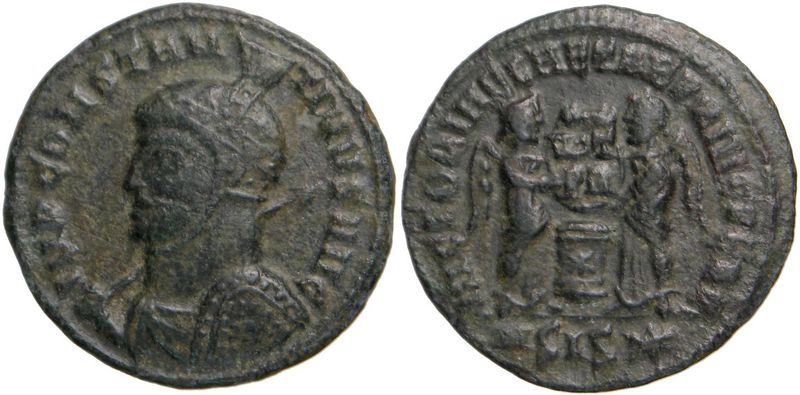
19x18mm 2.8gm IMP CONSTAN-TINVS AVG -- high crested helmet, cuir., spear across r. shoulder, shield inscribed with horseman on left arm VICTORIAE LAETAE PRINC PERP -- two Victories stg., facing one another, together holding shield inscribed VOT PR on altar (star on altar). in ex. ∆SIS✶ RIC VII Siscia 50 |
 |
|
|
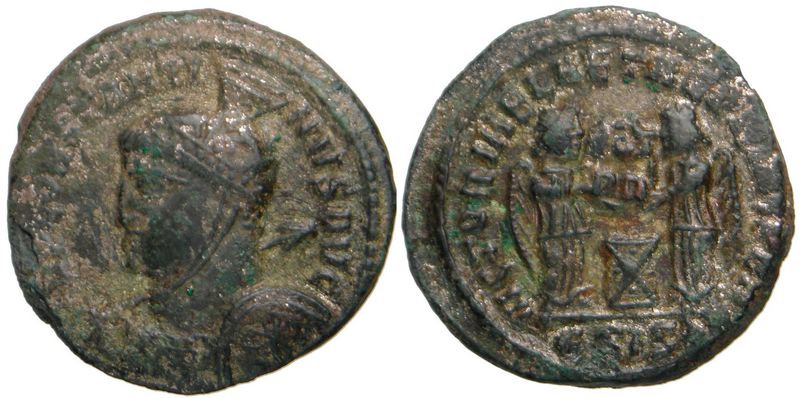
19mm 2.6gm IMP CONSTANTI-NVS AVG -- high crested helmet, cuir., spear across r. shoulder, shield inscribed with cross-like design VICTORIAE LAETAE PRINC PERP -- two Victories stg., facing one another, together holding shield inscribed VOT PR on altar. in ex. ESIS✶ RIC VII Siscia 50 unlisted obverse legend break |
 |
|
RIC 52
|
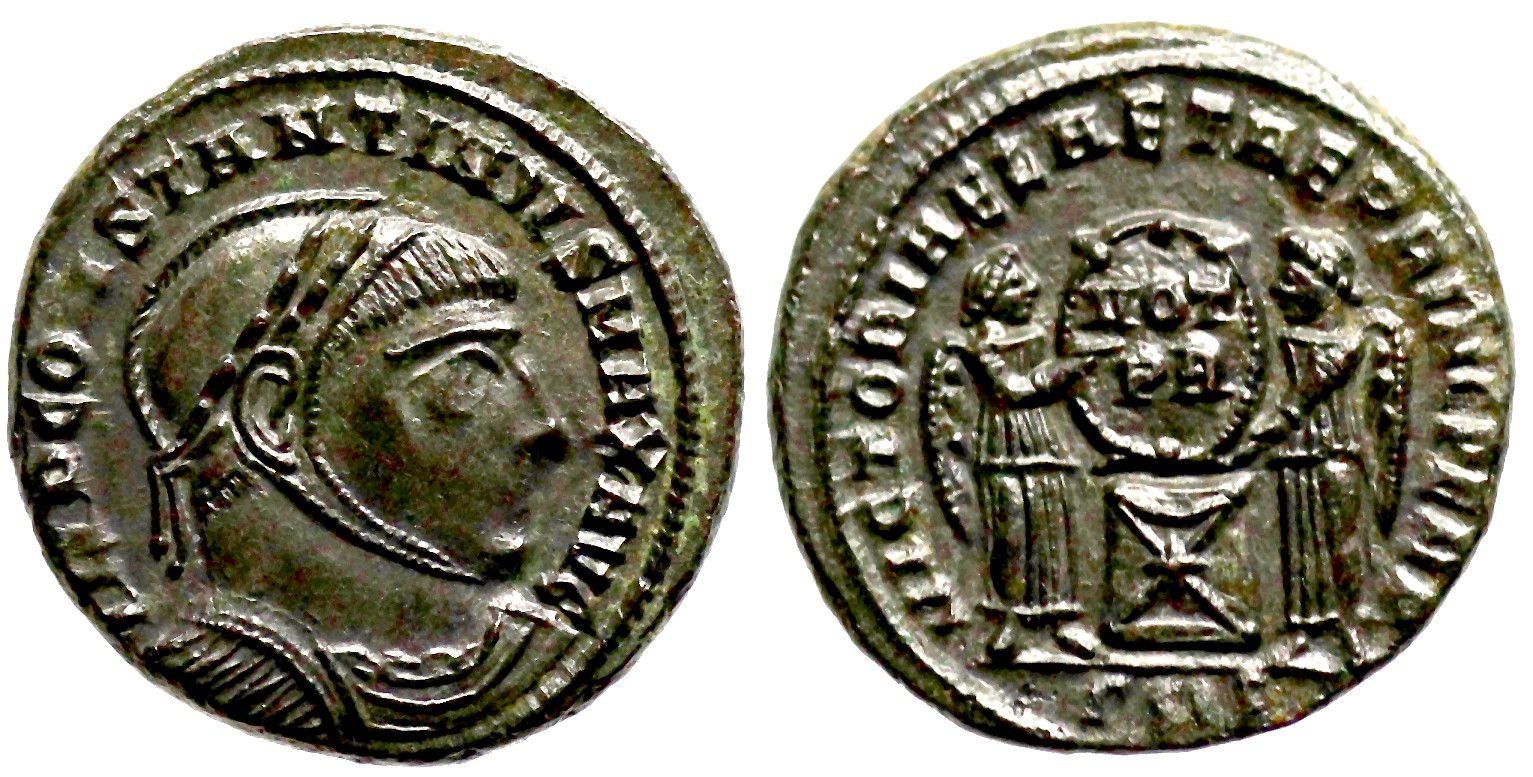
A.D. 318-19 18mm
3.3gm IMP CONSTANTINVS MAX AVG -- helmeted,
laureate and cuirassed bust right. VICTORIAE LAETAE PRINC PERP -- two
Victories stg., facing one another, together holding
shield inscribed VOT PR on altar . In ex. ΓSIS RIC VII Siscia 52
|
 |
|
|
20x19mm 3.0gm IMP CONSTANTINVS P F AVG -- helmeted, laureate, cuirassed VICTORIAE LAETAE PRINC PERP -- two Victories stg., facing one another, together holding shield inscribed VOT PR in ex. BSIS RIC VII Siscia 53 |
 |
| A.D. 318-19 17x18mm 3.1gm IMP CONSTANTINVS P F AVG; helmeted, laureate, cuirassed VICTORIAE LAETAE PRINC PERP; two Victories stg., facing one another, together holding wreath inscribed VOT PR. in ex. BSIS RIC VII Siscia 53 |
 |
|
|
19mm 2.7gm IMP CONSTANTINVS P F AVG -- helmeted, laureate, cuirassed VICTORIAE LAETAE PRINC PERP -- two Victories stg., facing one another, together holding shield inscribed VOT PR in ex. ∆SIS RIC VII Siscia 53 |
 |
|
|
18mm 2.6gm IMP CONSTANTINVS P F AVG -- helmeted, laureate, cuirassed VICTORIAE LAETAE PRINC PERP -- two Victories stg., facing one another, together holding shield inscribed VOT PR in ex. ESIS RIC VII Siscia 53 |
 |
|
| A.D. 318-19 18mm 3.3gm IMP CONSTANTINVS P F AVG; laureate helmet and cuirassed bust right. VICTORIAE LAETAE PRINC PERP; two Victories stg., facing one another, together holding shield inscribed VOT PR. in ex. ESIS RIC VII Siscia 53 Unusual decorated helmet |
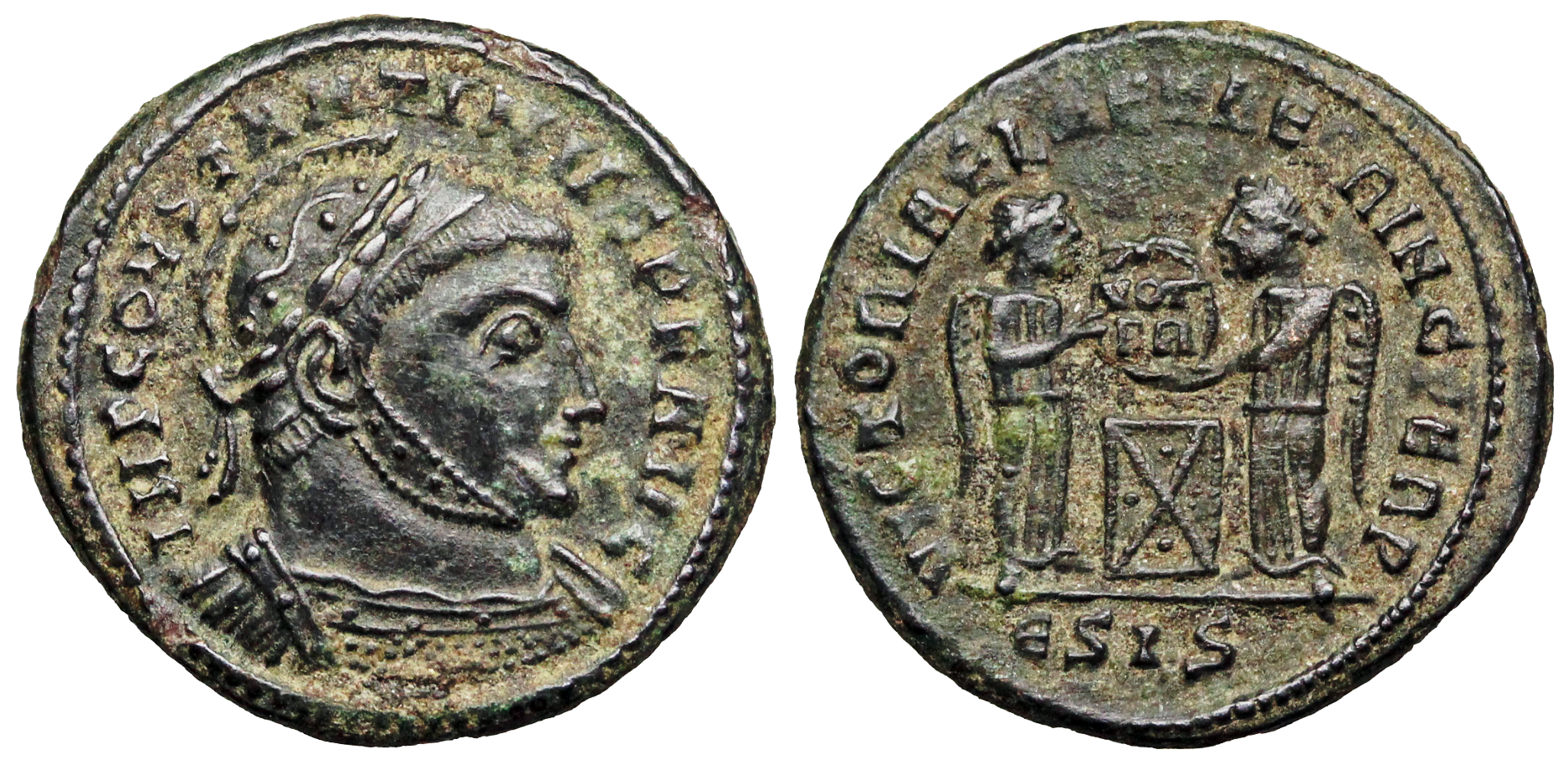 |
|
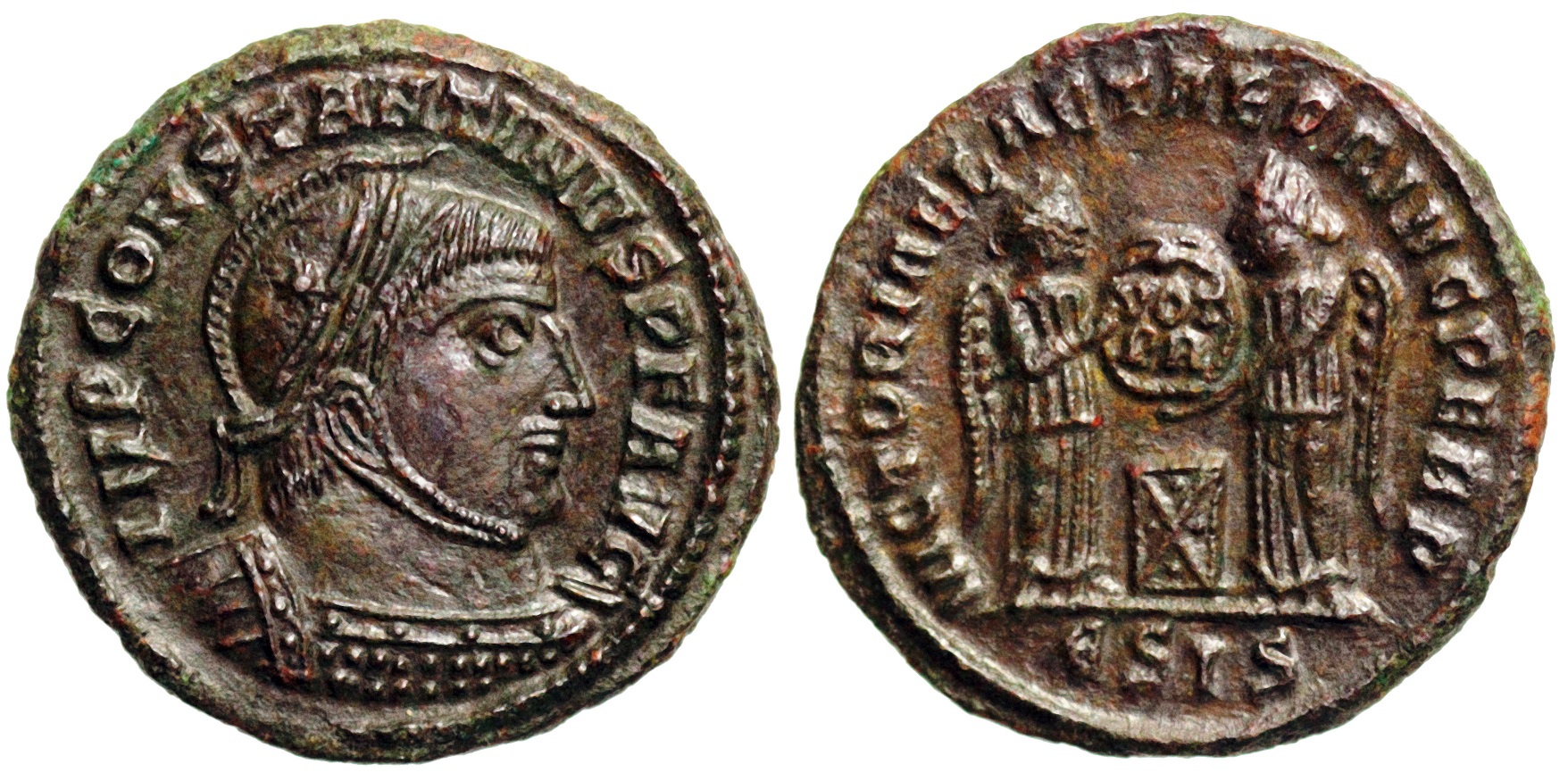
✶ on helmet |
18mm
2.7gm IMP CONSTANTINVS P F AVG -- cuirassed
bust right wearing laureate helmet decorated with
star. VICTORIAE LAETAE PRINC PERP -- two
Victories stg., facing one another, together holding
shield inscribed VOT PR. In ex. ESIS RIC VII Siscia 53
|
 |
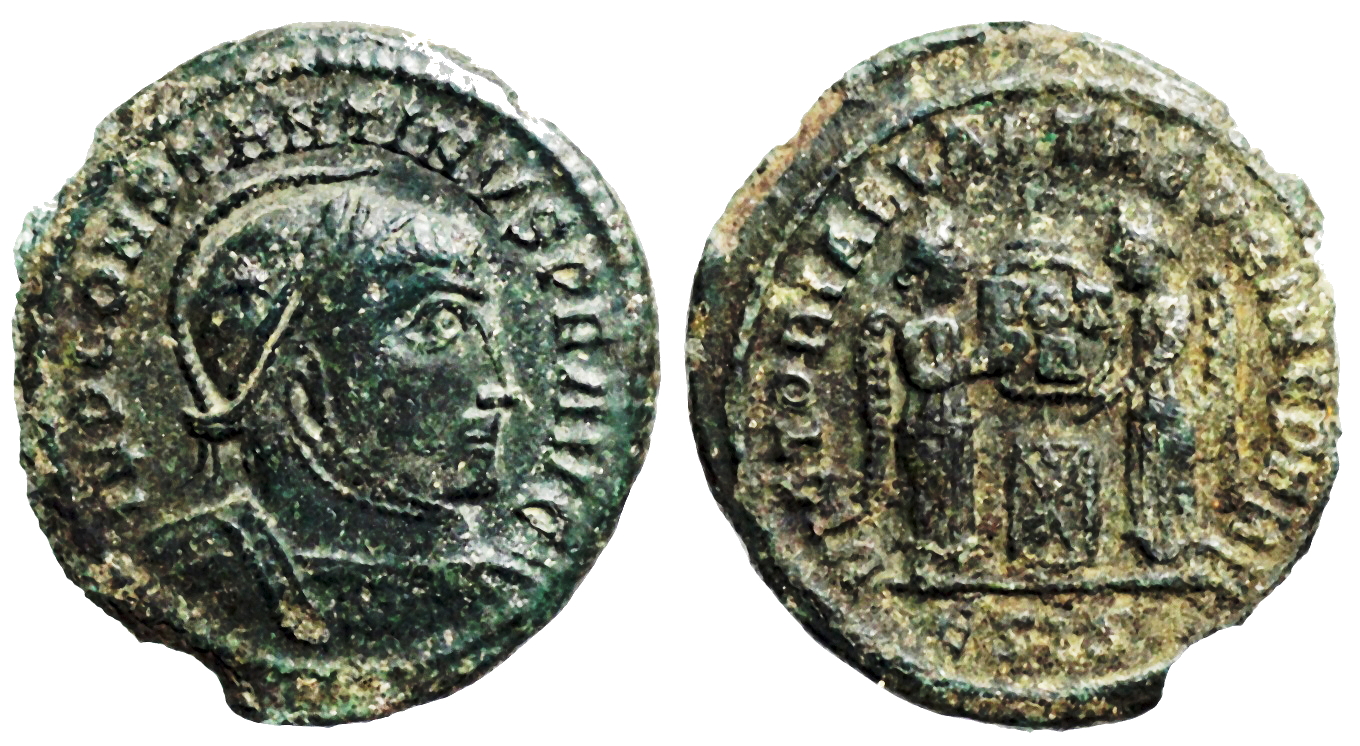
✶
on helmet |
18mm 2.7gm IMP
CONSTANTINVS P F AVG -- cuirassed bust right wearing
laureate helmet decorated with star. VICTORIAE
LAETAE PRINC PERP -- two Victories stg., facing one
another, together holding shield inscribed VOT PR. In ex. ESIS RIC VII
Siscia 53 star on helmet |
 |
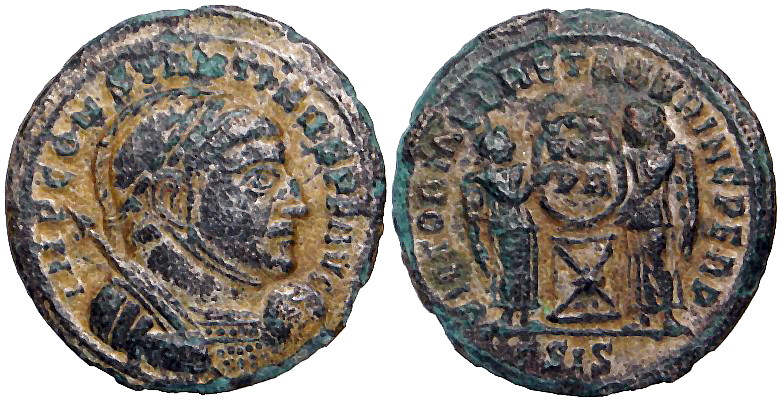
H6 bust |
A.D. 318-19 19mm 2.6gm IMP CONSTANTINVS P F AVG -- laureate helmet, cuir., spear across right shoulder and shield on left (very small shield!) VICTORIAE LAETAE PRINC PERP -- two Victories stg., facing one another, together holding shield inscribed VOT PR on altar. in ex. ΓSIS RIC does not list bust type H6 should be after Siscia 53 |
 |
| A.D. 318-19 19mm 3.0g IMP CONSTANTINVS P F AVG; laureate helmet and cuirassed bust right with spear across right shoulder and shield/ buckler on left. VICTORIAE LAETAE PRINC PERP; two Victories stg., facing one another, together holding shield inscribed VOT PR on altar. in ex. ΓSIS RIC VII Siscia – |
 |
|
| A.D. 318-19 18x19mm 2.7g IMP CONSTANTINVS P F AVG; laureate helmet and cuirassed bust right with spear across right shoulder and shield/ buckler on left. VICTORIAE LAETAE PRINC PERP; two Victories stg., facing one another, together holding shield inscribed VOT PR on altar. in ex. ΓSIS RIC VII Siscia – |
 |
|
|
|
19x18mm 3.6gm IMP CONST-ANTINVS AVG -- helmeted, laureate, cuirassed VICTORIAE LAETAE PRINC PERP -- two Victories stg., facing one another, together holding shield inscribed VOT PR on altar. in ex. ASIS RIC VII Siscia 54 |
 |
|
19mm 2.6gm IMP CONSTAN-TINVS AVG -- helmeted, laureate, cuirassed VICTORIAE LAETAE PRINC PERP -- two Victories stg., facing one another, together holding shield inscribed VOT PR on altar. in ex. ASIS RIC VII Siscia 54 |
 |
|
|
|
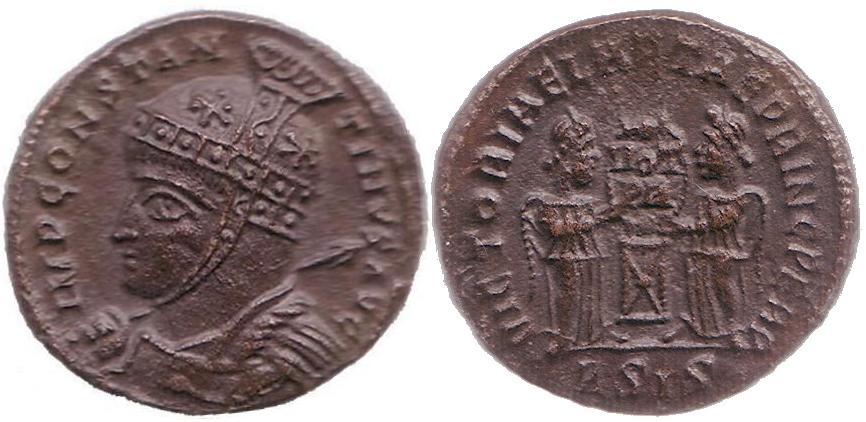
19x17mm 2.6gm IMP CONSTAN-TINVS AVG -- high crested helmet, cuir., spear across right shoulder. VICTORIAE LAETAE PRINC PERP -- two Victories stg., facing one another, together holding shield inscribed VOT PR on altar. in ex. BSIS RIC VII Siscia 55 |
 |
|
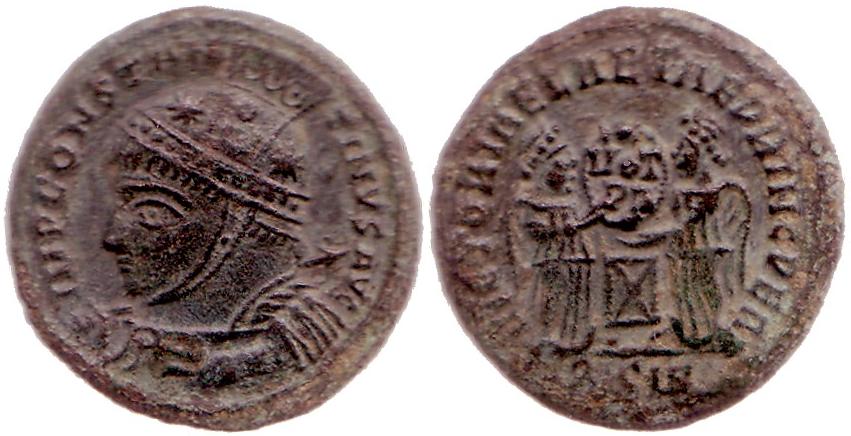
18mm 3.0gm IMP CONSTAN-TINVS AVG -- high crested helmet with circle over crescent (sun over moon) in crossbar, cuir., spear across right shoulder. VICTORIAE LAETAE PRINC PER[P] -- two Victories stg., facing one another, together holding shield inscribed VOT PR on altar. in ex. BSIS RIC VII Siscia 55 Note that there was not room for the P in PERP on reverse |
 |
|
|
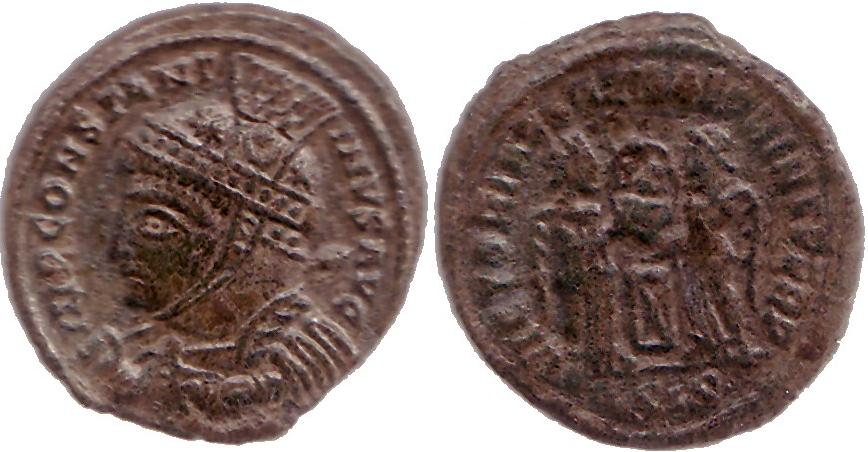
19mm 3.0gm IMP CONSTANT-INVS AVG -- high crested helmet with circle over crescent (sun over moon) in crossbar, cuir., spear across right shoulder. VICTORIAE LAETAE PRINC PERP -- two Victories stg., facing one another, together holding shield inscribed VOT PR on altar. in ex. BSIS RIC VII Siscia 55 |
 |
|
|
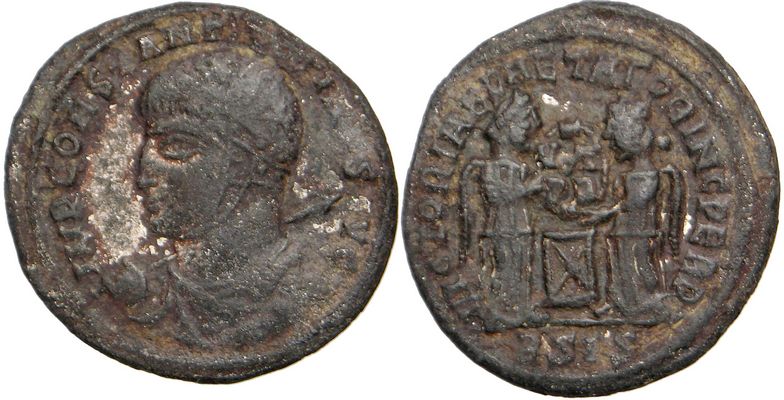
19mm 2.6gm IMP CONSTANT-INVS AVG -- high crested helmet, cuir., spear across right shoulder. VICTORIAE LAETAE PRINC PERP -- two Victories stg., facing one another, together holding shield inscribed VOT PR on altar. in ex. BSIS RIC VII Siscia 55 |
 |
|
|
20x19mm 3.4gm IMP CONSTAN-TINVS AVG -- high crested helmet with an X in the crossbar of the helmet , cuir., spear across right shoulder. VICTORIAE LAETAE PRINC PERP -- two Victories stg., facing one another, together holding shield inscribed VOT PR on altar. in ex. BSIS RIC VII Siscia 55 |
 |
|
|
19x18mm 3.2gm IMP CONSTANT-INVS AVG -- high crested helmet, cuir., spear across right shoulder. VICTORIAE LAETAE PRINC PERP -- two Victories stg., facing one another, together holding shield inscribed VOT PR on altar. in ex. ΓSIS RIC VII Siscia 55 |
 |
|
|
18mm 3.5gm IMP CONSTANT-INVS AVG -- high crested helmet with wavy line and dots on either side in crossbar, cuir., spear across right shoulder. VICTORIAE LAETAE PRINC PERP -- two Victories stg., facing one another, together holding shield inscribed VOT PR on altar. in ex. ΓSIS RIC VII Siscia 55 |
 |
|
|
19x17mm 3.1gm IMP CONSTANT-[INVS] AVG -- high crested helmet, cuir., spear across right shoulder. VICTORIAE LAETAE PRINC PERP -- two Victories stg., facing one another, together holding shield inscribed VOT PR on altar. in ex. ΓSIS RIC VII Siscia 55 |
 |
|
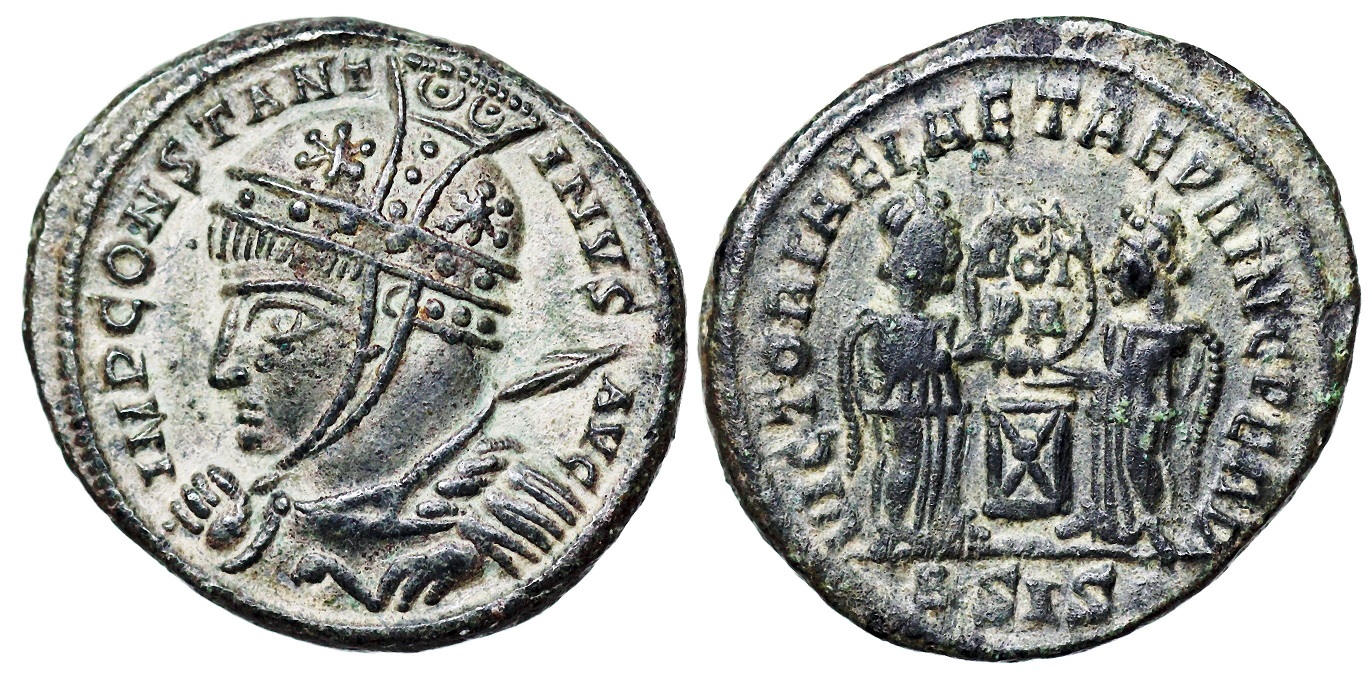
| Constantine I A.D. 318-19 17x18mm 3.0g IMP CONSTANT-INVS AVG; high crested helmet, cuir., spear across right shoulder [sceptre? in left]. VICTORIAE LAETAE PRINC PERP; two Victories stg., facing one another, together holding shield inscribed VOT PR on altar. in ex. BSIS RIC VII Siscia 55 what looks like it may be a sceptre in left hand |
 |
|
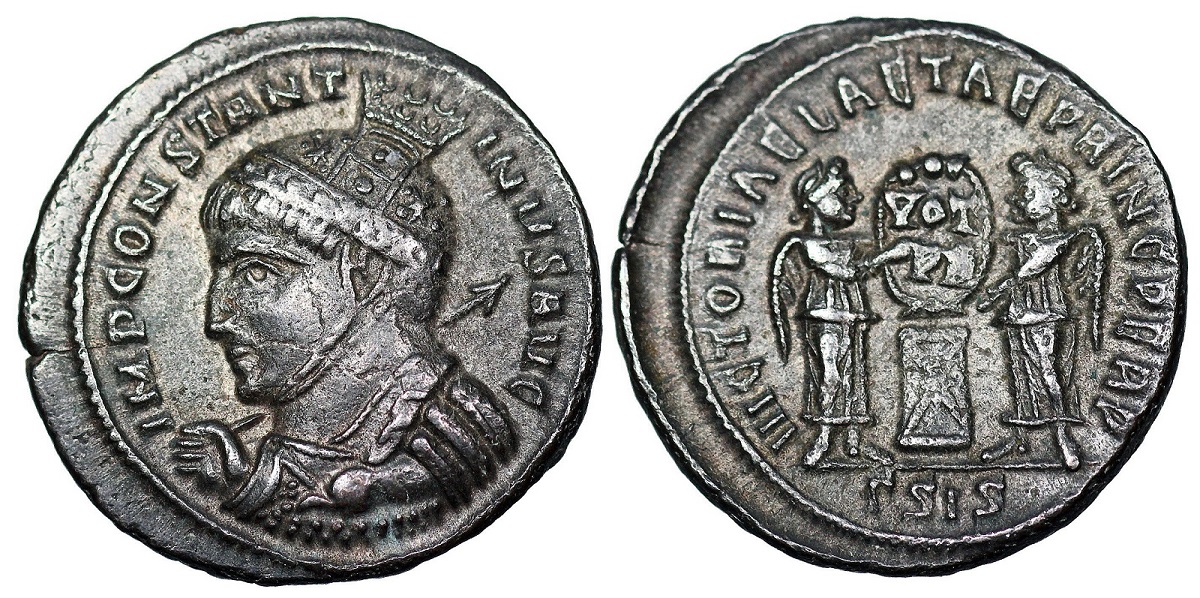
A.D. 318-19 19mm 3.1gm IMP CONSTANTINVS AVG; high crested helmet, cuir., spear across right shoulder; right hand holding parazonium[?]. VICTORIAE LAETAE PRINC PERP; two Victories stg., facing one another, together holding shield inscribed VOT PR on altar. in ex. ΓSIS RIC VII Siscia 55 |
 |
|
|
H11 bust |
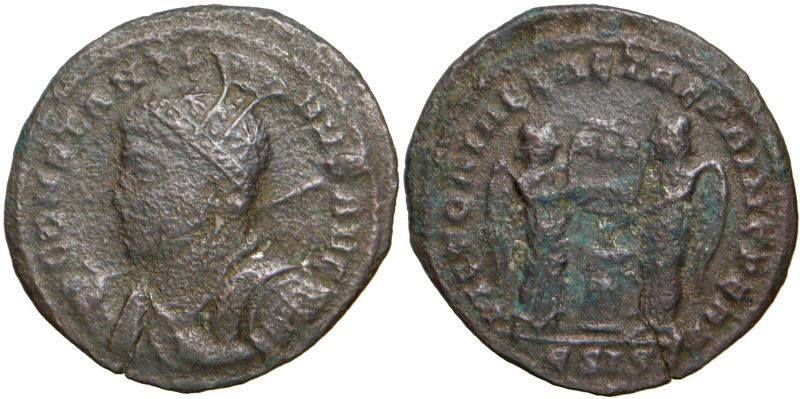
21x20mm 2.6gm CONSTANTI-NVS AVG -- high crested helmet, cuir., spear across right shoulder. VICTORIAE LAETAE PRINC PERP -- two Victories stg., facing one another, together holding shield inscribed VOT PR on altar. In ex. ESIS Unlisted in RIC should be before RIC 56 |
 |
|
|
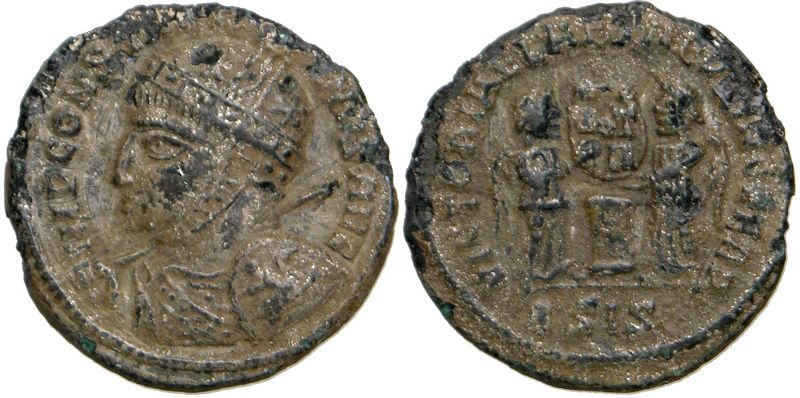
18mm 2.3gm IMP CONSTAN-TINVS AVG -- high crested helmet, cuir., spear across r. shoulder, shield on left arm inscribed with horseman. VICTORIAE LAETAE PRINC PERP -- two Victories stg., facing one another, together holding shield inscribed VOT PR on altar. in ex. BSIS RIC VII Siscia 56 |
 |
|
A.D. 318-19 18mm
3.0gm IMP CONSTAN-TINVS AVG -- high crested
helmet, cuir., spear across r. shoulder, shield on
left arm inscribed with horseman. VICTORIAE LAETAE PRINC PERP -- two
Victories stg., facing one another, together holding
shield inscribed VOT PR on altar. In ex. BSIS RIC VII Siscia 56 from the Bishop's Wood Hoard of 1895 |
 |
|
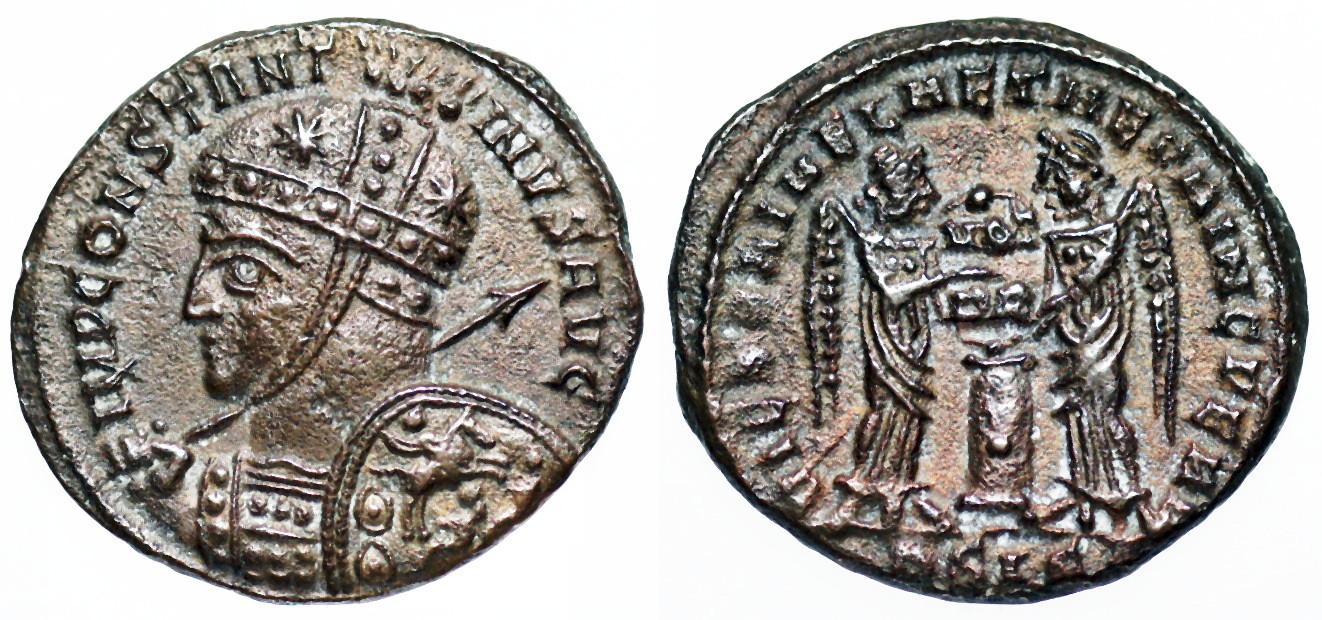
A.D. 318-19 18x19mm 2.7gm IMP
CONSTANT-INVS AVG; high crested helmet, cuir., spear
across r. shoulder, shield on left arm inscribed with
horseman. VICTORIAE
LAETAE PRINC PERP; two Victories stg., facing one
another, together holding shield inscribed VOT PR on
altar. In ex. BSIS RIC VII Siscia
56 Horseman
leaping over two fallen enemies |
 |
hippocamp
|
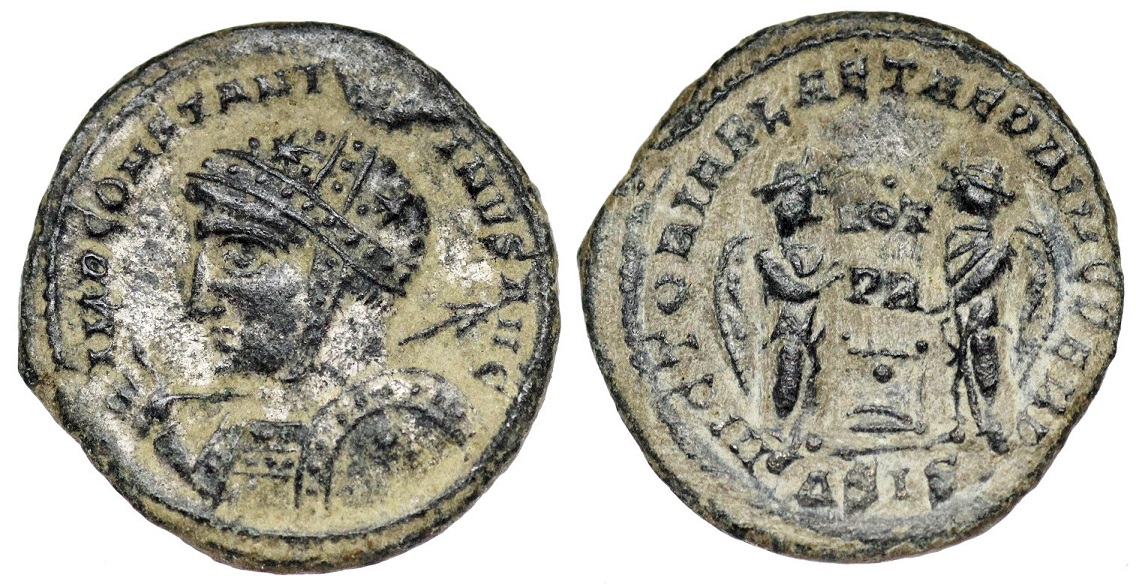
A.D. 318-19 18mm 2.4gm IMP CONSTANT-INVS AVG; high crested helmet, cuir., spear across r. shoulder, shield on left arm inscribed with hippocamp. VICTORIAE LAETAE PRINC PERP; two Victories stg., facing one another, together holding wreath inscribed VOT PR on altar. in ex. BSIS RIC VII Siscia 56 Hippocamp on shield |
 |
| A.D. 318-19 19mm 3.4gm IMP CONSTANT-INVS AVG; high crested helmet, cuir., spear across r. shoulder, shield on left arm VICTORIAE LAETAE PRINC PERP; two Victories stg., facing one another, together holding wreath inscribed VOT PR on altar. in ex. ΔSIS RIC VII Siscia 56 unlisted workshop |
 |
|
|
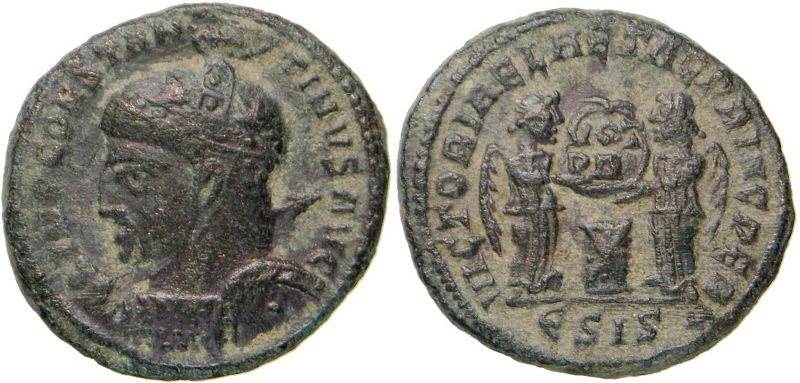
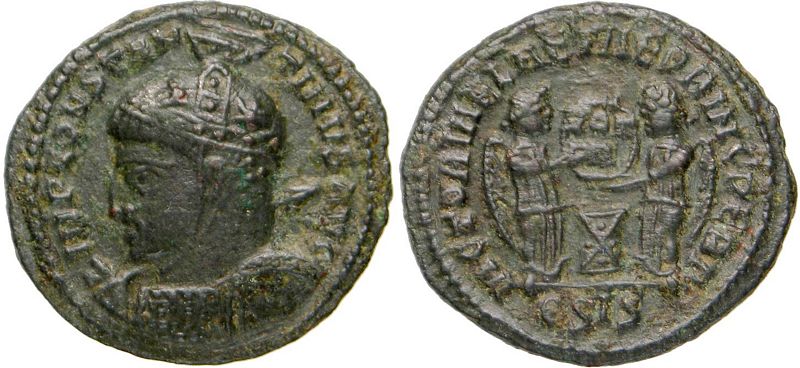
19x18mm 3.0gm IMP CONSTAN-TINVS AVG -- high crested helmet, cuir., spear across r. shoulder, shield on left arm VICTORIAE LAETAE PRINC PERP -- two Victories stg., facing one another, together holding shield inscribed VOT PR on altar. in ex. ESIS RIC VII Siscia 56 obverse die match with next coin |
 |
|
|
18x19mm 3.4gm IMP CONSTAN-TINVS AVG -- high crested helmet, cuir., spear across r. shoulder, shield on left arm VICTORIAE LAETAE PRINC PERP -- two Victories stg., facing one another, together holding shield inscribed VOT PR on altar. in ex. ESIS RIC VII Siscia 56 obverse die match with previous coin |
 |
|
|
19mm 3.3gm IMP CONSTANT-INVS AVG -- high crested helmet, cuir., spear across r. shoulder, shield on left arm VICTORIAE LAETAE PRINC PERP -- two Victories stg., facing one another, together holding shield inscribed VOT PR on altar. in ex. ESIS RIC VII Siscia 56 |
 |
|
|
19x17mm 2.0gm IMP CONSTANT-INVS AVG -- high crested helmet, cuir., spear across r. shoulder, shield on left arm. VICTORIAE LAETAE PRINC PERP -- two Victories stg., facing one another, together holding shield inscribed VOT PR on altar. in ex. ESIS RIC VII Siscia 56 |
 |

last modified on 15 June 2026
¹ Jean-Pierre Callu's analysis of the Bikic-Do hoard appeared in Sirmium VIII. Études de Numismatique Danubienne: Trésors, Lingots, Imitations. Monnaies de Fouilles IV au XII Siècle (Rome: Ecole francaise de Rome, 1978), which was edited by Noël Duval and Vladislav Popovic.